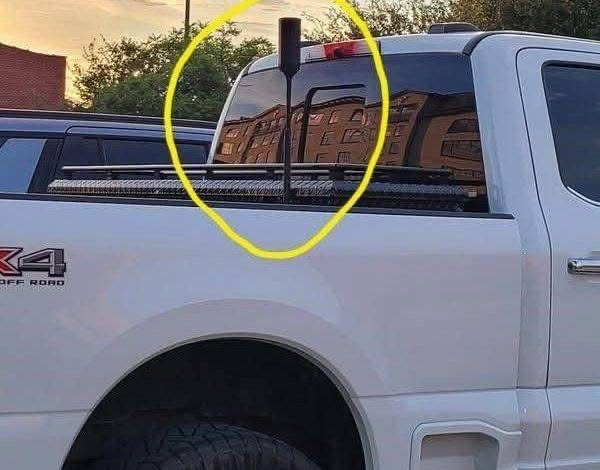
Many people see a tall rod mounted on a pickup or semi-truck and assume it’s an old CB radio antenna. While that used to be true, today it’s often something more advanced: a mobile cell-signal booster. These devices have become essential for anyone who spends time driving through remote areas where phone reception is unreliable.
Smartphones have small internal antennas that work fine in urban areas, but they struggle in regions with distant or spaced-out towers. A signal booster solves that problem by using a high-mounted external antenna to grab even the faintest signal. The antenna sends that signal to an amplifier inside the vehicle, which strengthens it and passes it to a small interior antenna. From there, the improved signal is rebroadcast throughout the cab.
The result is a dramatic improvement in call clarity, navigation accuracy, text delivery, and overall connectivity—especially in places where a phone alone can’t maintain a stable connection. This simple three-part system—external antenna, amplifier, internal antenna—helps a wide range of travelers. Farmers driving across large fields, contractors on rural job sites, long-haul truckers, RV owners, campers, delivery drivers, and outdoor adventurers all depend on these boosters to stay safely connected.
For anyone who frequently drives beyond city limits, the difference is noticeable. Modern boosters support LTE and 5G networks and can help multiple devices at once. Popular systems like the weBoost Drive Reach and HiBoost Travel 3.0 typically cost a few hundred dollars, but for many drivers, the reliability they provide is priceless. What looks like a simple rod is actually a crucial tool—one that keeps travelers connected, informed, and safer on the open road.