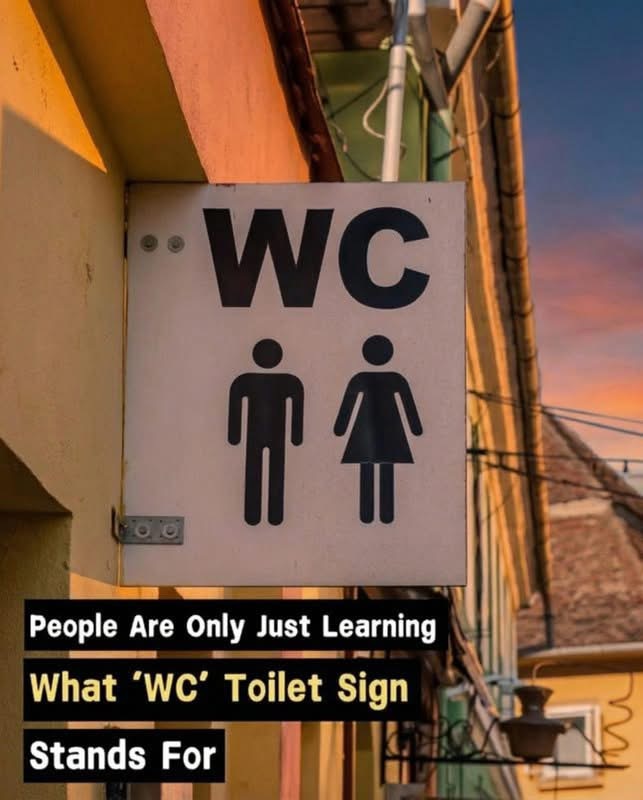
Have you ever noticed the letters “WC” outside a public restroom and paused to wonder what they stand for? You’re not alone. Around the world, people encounter different labels for the same everyday space, and each term reflects a bit of history, culture, and habit. While “bathroom,” “restroom,” and “washroom” are common in North America, “WC” appears more often in international settings. At first glance, none of these names seem perfectly logical, which is part of what makes the topic so interesting. Language evolves not just to describe function, but also to sound polite, familiar, or practical depending on time and place.
A lighthearted example of this confusion once circulated online when a couple joked about the names used for public restrooms. They pointed out that people don’t actually rest in a restroom or take a bath in a bathroom, sparking a playful debate. Viewers quickly joined in, sharing stories about asking for a “washroom” in unfamiliar places or being surprised by signs marked “WC.” These conversations highlight how strongly regional language sticks with us. What feels normal in one country can sound unusual or amusing somewhere else, even when everyone is talking about the same thing.
So what does “WC” actually mean? The letters stand for “water closet,” a term that dates back to a time when indoor plumbing was still new. Historically, a water closet referred to a small, enclosed room that contained a toilet, separate from areas used for bathing. Over time, dictionaries came to define it simply as a room or compartment with a toilet and related fixtures. While the phrase may sound old-fashioned in some places today, it remains widely used on signs in airports, hotels, and public buildings, especially where travelers from many countries are expected.
The history behind the term explains why it still exists alongside other names. Before indoor plumbing became widespread in the late 19th and early 20th centuries, bathing and toilet facilities were often separate. As homes modernized, these functions were combined for convenience, giving rise to the modern bathroom. However, the older terminology never fully disappeared. Instead, it adapted. In some regions, “WC” now refers to a small private toilet area, sometimes within a larger bathroom. Ultimately, whether you say bathroom, restroom, washroom, loo, or WC, the variety of names reflects how language, culture, and everyday life shape the words we use—often in ways that are practical, familiar, and a little bit amusing.