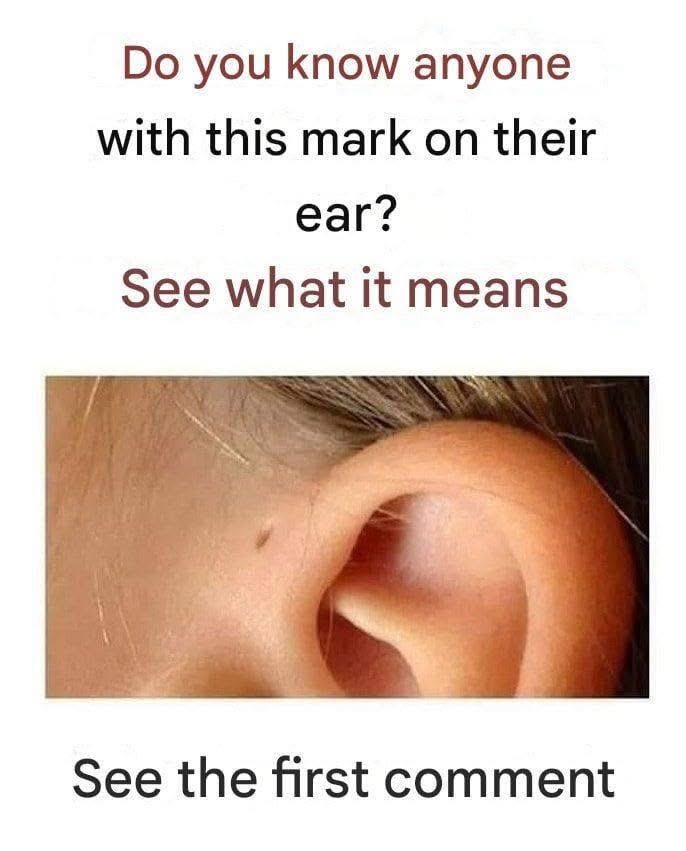
When people notice a small hole or dimple just in front of the ear for the first time, it often sparks confusion and curiosity. Many assume it is a piercing mark, a scar from childhood, or a minor skin imperfection that appeared later in life. In reality, this tiny opening is usually something a person is born with, present from the earliest stages of development. Known medically as a preauricular sinus or preauricular pit, it is a congenital trait that forms long before birth, often without the individual or their parents fully understanding what it is. Because it rarely causes problems, many people live their entire lives unaware that the small indentation has a specific name or explanation. It does not affect hearing, appearance, or daily functioning, which is why it often goes unnoticed until someone points it out or asks a casual question. Despite its subtle presence, this small feature is a fascinating example of how complex and precise human development is, and how even the smallest variations can tell a deeper biological story.
The formation of a preauricular sinus occurs very early in pregnancy, typically around the sixth week of gestation, when the structures that will eventually become the outer ear are developing. During this stage, multiple tissue folds must fuse together in a precise sequence. If this fusion is slightly incomplete, a small tract or opening can remain near the ear. This process is entirely unintentional and does not reflect a problem with growth or health. In many cases, the trait is hereditary, meaning it can be passed down through generations, sometimes appearing in several members of the same family. It may occur on one ear or, more rarely, on both. Because it is present at birth, it is classified as a congenital condition, yet it is generally considered benign. Medical professionals usually note it only during routine examinations, and unless symptoms develop, no treatment or intervention is required.
For most individuals, a preauricular sinus is completely harmless, causing no discomfort or complications throughout life. However, in a small number of cases, the tiny opening can become infected. This happens when bacteria enter the sinus tract, leading to redness, swelling, tenderness, or discharge. Such infections can be uncomfortable and, if left untreated, may recur. When an infection occurs, doctors typically prescribe antibiotics to clear it and recommend keeping the area clean and dry. In situations where infections happen repeatedly, a minor surgical procedure may be suggested to remove the sinus tract entirely. This surgery is usually straightforward and highly effective, preventing future issues. Importantly, even when complications arise, they are localized and manageable, and the condition does not pose a broader health risk. It does not impact hearing, brain function, or overall development, which reassures many people once they learn more about it.
Beyond its medical explanation, the small hole near the ear has also attracted cultural interpretations and myths in different parts of the world. In some cultures, it has been associated with good luck, heightened intuition, or special abilities, while in others it is simply viewed as an unusual but meaningless physical trait. These interpretations often arise from the human tendency to assign significance to rare or distinctive features, especially when they are visible but poorly understood. While such beliefs can be intriguing, modern medicine emphasizes that the preauricular sinus is simply a variation in anatomy. Still, these cultural stories highlight how physical differences often become woven into folklore and symbolism, reflecting how societies try to make sense of biological diversity long before scientific explanations are available.
From an evolutionary perspective, the preauricular sinus has inspired speculation among scientists and researchers interested in human origins. Some evolutionary biologists have suggested that the feature could be a remnant of structures related to gills in ancient aquatic ancestors, pointing to similarities in embryonic development across species. This idea is part of a broader discussion about how human embryos briefly display features that resemble those of other animals, reflecting shared evolutionary history. However, it is important to note that this theory remains speculative and unproven. Most experts agree that the preauricular sinus is best explained by localized variations in ear development rather than a direct evolutionary leftover. Still, the discussion itself underscores how even small anatomical features can prompt larger questions about where we come from and how complex life has evolved over millions of years.
Ultimately, the tiny hole near the ear is a quiet reminder of how unique every human body is. It shows that not all differences are dramatic or immediately noticeable, yet each one carries a story rooted in genetics, development, and biology. For those who have a preauricular sinus, it is usually nothing more than an interesting detail, one that requires little thought or concern. Learning about it often brings reassurance rather than alarm, replacing mystery with understanding. In a broader sense, this small feature illustrates how human diversity is built not only from visible traits like height or eye color, but also from subtle variations hidden in plain sight. These differences do not define a person, but they do highlight the intricate processes that shape every individual long before they are born, reminding us that even the smallest details have a place in the larger story of human life.