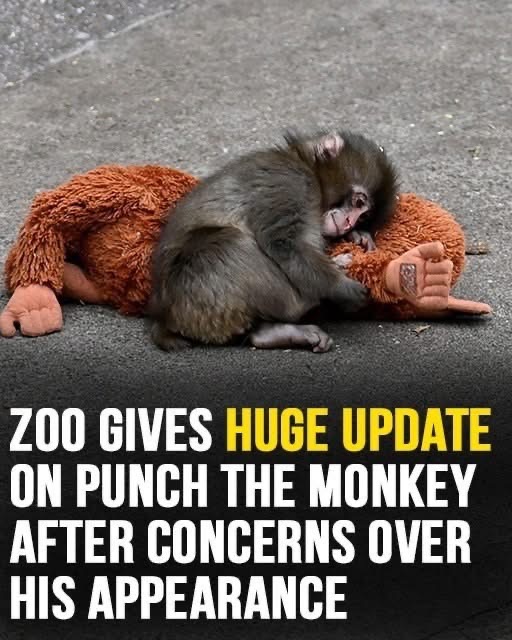
Punch’s story is not simply cute or heartwarming. It is fragile, difficult, and quietly hopeful. A newborn macaque rejected at birth was left without the comfort that young animals usually depend on. In those first uncertain moments, survival depended on human care and careful intervention.
Without a mother to cling to, Punch’s earliest days were defined by absence. Instead of a warm body and familiar sounds, he was surrounded by incubators, bottles, and attentive keepers working to keep him alive.
To provide comfort, caregivers placed a stuffed orangutan beside him. The toy became something like a lifeline, a soft presence he could hold onto during those vulnerable first weeks.
Photos of the tiny monkey holding the toy spread quickly online. People around the world reacted with strong emotions—sympathy, protectiveness, and sometimes criticism—often before fully understanding the challenges involved in raising an abandoned newborn animal.
As Punch grew stronger, the next challenge began: learning to interact with other macaques. For a social species, this step is essential, yet it can also be difficult for an animal raised without its mother.
Early introductions were not always smooth. Curious macaques sometimes tugged or approached too quickly, and Punch occasionally retreated in uncertainty. Observers worried about these moments, but they were also part of a natural learning process.
Gradually, progress appeared in small milestones. Punch began eating independently, moving confidently without constant human assistance, and spending more time exploring his surroundings.
Eventually, he no longer needed the stuffed toy that once provided comfort. His fur began to thicken again, and his confidence grew. Punch’s journey reveals a quieter truth: resilience is often built slowly, through imperfect care, patience, and many small steps forward.