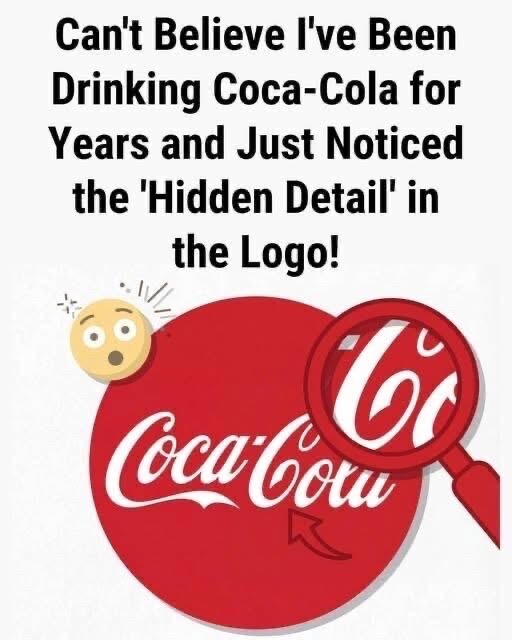
In the vast landscape of global commerce, few symbols are as instantly recognizable as the flowing white script of the Coca-Cola logo set against its signature vibrant red background. For over a century, this emblem has been a titan of branding, adorning everything from glass bottles in remote villages to massive digital billboards in Times Square. Yet, a new wave of fascination is sweeping across the internet as eagle-eyed consumers claim to have discovered a hidden detail within the iconic lettering—one that has been staring us in the face since the 19th century. Once pointed out, this subtle feature becomes a psychological anchor, making it nearly impossible to view a can of soda the same way again.
The discovery focuses on the graceful, looping curves of the Spencerian script, particularly within the second word of the brand name. Observers have begun to highlight how the letter “C” in Cola interacts with the surrounding flourishes, creating the unmistakable image of a human smile. The bottom curve of the letter arches upward in a buoyant, expressive manner, mimicking the gentle upturn of a grin. For many, the logo no longer looks like mere typography—it seems to be greeting the consumer with a warm, friendly smile before the first sip is even taken. This perceived hidden message has ignited a massive debate among design enthusiasts, historians, and casual fans alike, with everyone asking the same fundamental question: Was this a stroke of marketing genius from the 1880s, or is it simply a modern-day trick of the mind?
To understand the truth behind the smile, we must journey back to the brand’s origins. The logo was not crafted by a high-priced graphic design firm or a psychological focus group. Instead, it was created by Frank Mason Robinson, the bookkeeper for the drink’s inventor, John Stith Pemberton. Robinson was a master of Spencerian script, a style of penmanship that was the gold standard for business correspondence in the United States between 1850 and 1925. His goal was not to embed hidden emotional cues or subliminal messages into the name; rather, he focused on elegance, flow, and the distinctiveness of the two Cs. At the time, the priority was to make the brand name look prestigious and readable, with no thought given to hidden psychological triggers.
Historical records, early design sketches, and Robinson’s personal notes show no evidence that he ever intended to embed a secret grin into the logo. In the 1880s, concepts like hidden logos or negative space tricks—such as the famous arrow in the FedEx logo—were practically unheard of. The primary marketing strategy of the time was simple and descriptive. The idea that a bookkeeper would have the foresight to embed a psychological “smile” into the logo to subconsciously trigger happiness in consumers is a fascinating theory, but it lacks any factual foundation. From a historical standpoint, the smile is purely an accident of calligraphy.
However, just because the smile wasn’t intentional doesn’t mean it’s not real. The reason so many people now see this hidden detail has to do with the fascinating way our brains process visual information. Humans are biologically wired for a phenomenon called pareidolia—our tendency to see meaningful images, particularly faces and emotions, in random or ambiguous patterns. This is why we see the “Man in the Moon” or shapes in clouds. As social creatures, our brains are constantly scanning the environment for emotional signals. When we look at the fluid, upward strokes of the Coca-Cola script, our brains take the path of least resistance and interpret these shapes as a familiar human expression.
This phenomenon is further amplified by decades of brilliant atmospheric branding. For over a hundred years, Coca-Cola has marketed itself as a symbol of joy, nostalgia, and connection. From the classic holiday advertisements featuring a jolly Santa Claus to the iconic “I’d Like to Buy the World a Coke” campaign, the brand has spent billions ensuring that the very thought of their product is synonymous with positive emotions. When a consumer who has been conditioned to associate Coca-Cola with happiness sees the brand’s logo, their brain is already primed to spot a smile. In this sense, the hidden detail is a collaborative creation between the original calligrapher and the public’s collective imagination.
This intersection of design and perception reveals a deeper truth about the power of symbols. A logo is never just a static image; it is a living entity that evolves based on the cultural context of those who view it. While Frank Robinson may have been focused simply on writing the word “Cola” in an elegant hand, the collective consciousness of the 21st century has transformed his handwriting into an interactive emotional experience. This is the hallmark of truly great design—it possesses the longevity and versatility to be reinterpreted by each new generation that encounters it.
The “hidden smile” has become a viral sensation because it rewards viewers for paying close attention. In an age of rapid digital content, there’s something deeply satisfying about slowing down and discovering a secret in a product that has been sitting in our refrigerators for years. It creates a sense of personal discovery, making consumers feel as though they are in on a century-old secret. Even if the secret is an accidental byproduct of 19th-century penmanship, its impact on the brand’s image is profoundly positive. It reinforces the idea that Coca-Cola is friendly, approachable, and designed to brighten your day.
As this story continues to circulate, Coca-Cola remains a case study in how luck and skill can combine to create something iconic. Whether you believe the smile was an intentional secret from a genius bookkeeper or just a beautiful coincidence of ink on paper, its presence is undeniable once you know where to look. It serves as a reminder that the world is full of hidden details waiting to be noticed and that sometimes, the things we imagine to be true can have just as much impact as the things that are planned. The next time you reach for a cold bottle, take a moment to look closely at the script. You might just find that the world’s most famous soda is smiling right back at you, proving that in branding, perception can be just as powerful as reality.