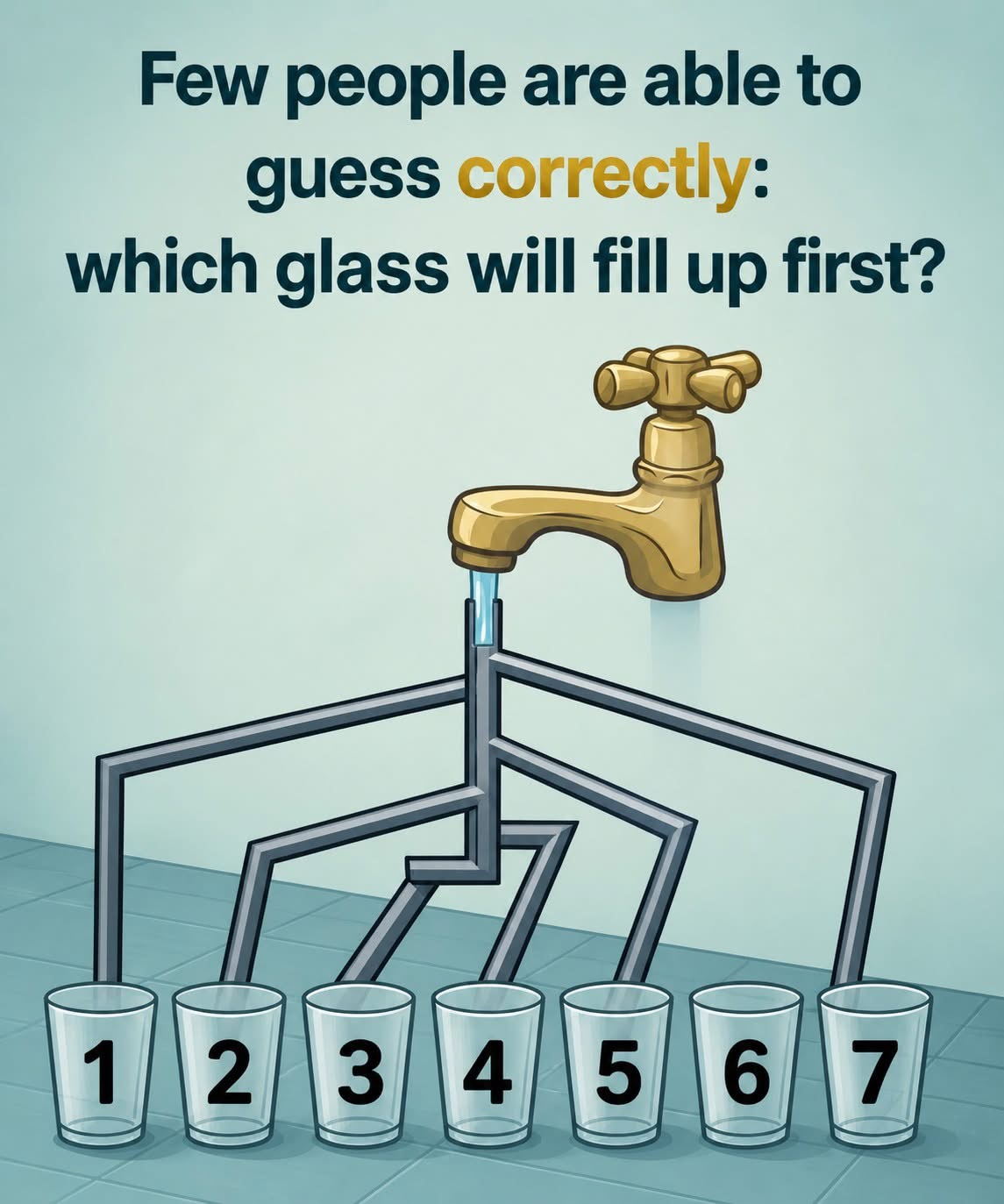
At first glance, this puzzle appears simple and even slightly obvious. A stream of water seems to flow into a system of pipes that branches toward seven numbered glasses, creating the impression that at least one of them will eventually be filled. This immediate interpretation is based on how the human brain naturally processes visual information.
When we see water and connected pipes, we expect movement to follow a logical and continuous path without interruption or blockage. Because of this expectation, many people begin solving the puzzle by tracing the water flow mentally. They follow each visible pipe, assuming that the liquid will travel smoothly through the entire system toward the glasses.
This early confidence is common in visual puzzles. The design often encourages quick assumptions, making the viewer believe that the solution is straightforward and can be reached without deep inspection or analysis.
However, a closer look reveals that appearances can be misleading. Some pipe sections that seem connected at first glance do not actually form a continuous path when examined carefully and step by step.
In several areas, the layout includes misleading alignments. Pipes may appear to meet, but small gaps or breaks prevent actual flow. These subtle details are easy to overlook during a quick observation.
There are also branches in the system that seem promising but ultimately lead to dead ends. These paths are intentionally placed to create distraction and increase the difficulty of identifying the correct outcome.
As each route is checked individually, the structure becomes clearer. Despite the visual impression of movement, there is no complete and uninterrupted pathway from the water source to any of the seven glasses.
This means that the puzzle relies more on perception than on actual flow logic. It challenges the viewer to slow down, verify connections carefully, and avoid relying solely on visual assumptions.
In the end, the correct conclusion is that none of the glasses receive water. The real purpose of the puzzle is to test attention to detail and demonstrate how easily the mind can be influenced by visual design.