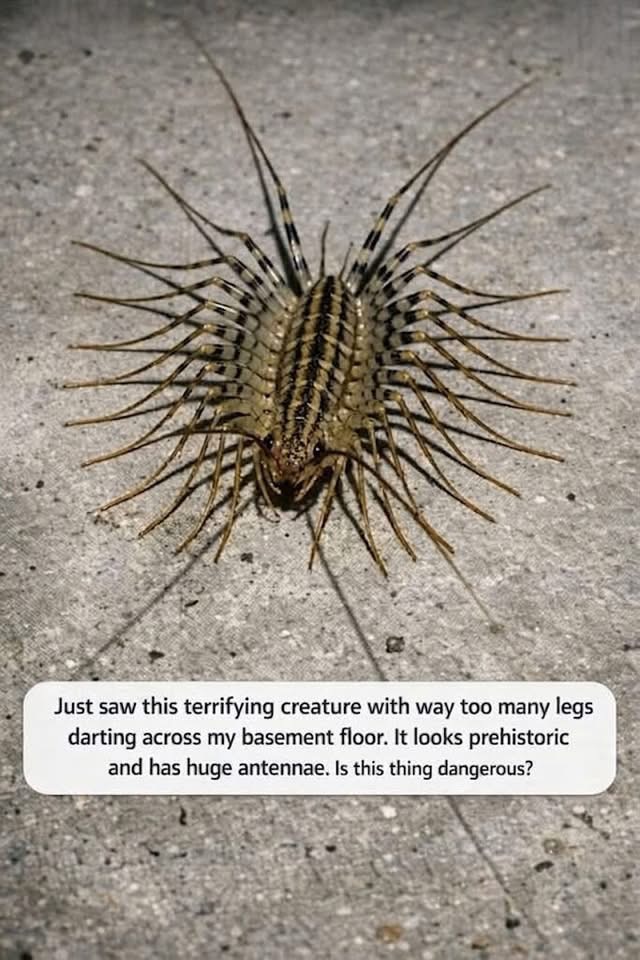
Discovering a bizarre, multi-legged creature sprinting across your cold basement floor is an absolute nightmare scenario for most homeowners. With an elongated body that looks vaguely prehistoric, an unsettling number of thrashing limbs, and extraordinarily long antennae, this stealthy invader looks more like a prop from a science fiction movie than a standard household bug. The immediate instinct for anyone witnessing this lightning-fast intruder is usually a mixture of panic, disgust, and an urgent question regarding whether the mysterious creature poses an immediate threat to the safety of your family or beloved household pets.
The multi-legged phantom darting through the dark corners of your home is almost certainly a house centipede, known scientifically as Scutigera coleoptrata. This unique arthropod possesses a yellowish-gray body that can grow up to an inch and a half in length, marked by three distinct dark stripes running down its back. What truly sets this creature apart and makes it the stuff of nightmares is its collection of fifteen pairs of long, delicate legs that create a fringed silhouette as it moves. Combined with a pair of whip-like antennae that are often longer than its actual body, the house centipede is a regular resident in damp, undisturbed areas like basements, crawlspaces, and bathrooms across urban and suburban neighborhoods.
It is entirely natural to feel an immediate wave of fear when encountering a house centipede, as its physical evolution is optimized for extreme speed and subterranean hunting. Those thirty long legs do not just move randomly; they ripple in a highly synchronized, wave-like motion that allows the centipede to travel at a staggering speed of over one foot per second. This remarkable velocity allows them to dart out of sight, scale vertical walls, and pivot around obstacles with terrifying agility. Furthermore, those massive antennae function as highly advanced sensory equipment, constantly scanning the environment for subtle vibrations, shifting air currents, and chemical trails in total darkness. While this combination of speed and sensory dominance makes them look like alien predators, it is simply nature’s way of creating an incredibly efficient hunter.
The burning question for anyone sharing a roof with these leggy specimens is whether they are actually dangerous to humans or domesticated animals. Fortunately, the reality of the house centipede is far less menacing than its outward appearance suggests. While it is true that centipedes possess venom, this chemical defense is strictly formulated to paralyze tiny target insects, not to harm large mammals. Their tiny mandibles are incredibly weak and struggle to puncture human skin under normal circumstances. In the exceptionally rare scenario where a house centipede actually bites a human, the sensation is typically described as a minor annoyance, resulting in localized redness and a brief stinging sensation that completely fades within a few hours without requiring any medical intervention.
For curious cats and dogs that might stumble upon a centipede in the dark, the risk remains minimal. House centipedes are strictly evasive creatures that prefer to flee from danger rather than engage in a fight, meaning they will actively seek out the nearest crack or crevice to escape an inquisitive snout. Bites on pets are almost unheard of, though it is always a smart practice for homeowners to keep a casual eye on any interactions between their animals and local wildlife as a standard household precaution.
The most surprising twist in the story of the house centipede is that they are actually highly beneficial allies to have inside your home. These creatures are voracious carnivores, acting as nature’s ultimate built-in pest control service. Their daily diet consists entirely of the annoying, destructive, and genuinely problematic insects that most homeowners spend hundreds of dollars trying to eradicate. House centipedes actively hunt down spiders, cockroaches, silverfish, termites, ants, and even bed bugs. By quietly patrolling the dark basements and hidden crawlspaces of your home, a single centipede can effectively keep populations of far worse pests completely in check, maintaining a balanced indoor ecosystem completely free of charge.
Understanding why these hunters chose your specific basement in the first place is the key to managing their presence. Like any predator, house centipedes are drawn to environments that fulfill their three basic survival requirements, which are consistent moisture, absolute darkness, and an abundant supply of food. A typical basement provides all three of these elements perfectly. The naturally cool and damp air helps prevent the centipede’s body from drying out, the low light conditions mimic their natural outdoor habitats under rocks and logs, and the presence of smaller insects ensures a non-stop buffet.
If the sheer sight of a house centipede is simply too much for your nerves to handle, removing them safely and humanely without relying on harsh chemical sprays is incredibly straightforward. Remaining calm is essential, as the centipede is completely terrified of you and is actively trying to find an exit. Utilizing the classic cup and card method allows you to trap the creature securely from a distance. Simply place a clear glass over the centipede, gently slide a stiff piece of cardboard underneath to seal the opening, and transport the traveler outside to a shaded, moist garden bed far away from your home’s foundation.
To permanently discourage these many-legged hunters from setting up camp inside your living spaces, you must focus on altering the environmental conditions that attracted them and their prey in the first place. Running a dehumidifier in damp basements and ensuring proper ventilation in bathrooms will eliminate the moisture they need to survive. Meticulously sealing structural cracks in walls, gaps around pipes, and repairing damaged window screens will block their primary entry points. Finally, keeping storage areas organized and vacuuming regularly eliminates the dark hiding spots and small insect populations that serve as their primary food source. By taking these eco-friendly preventative steps, you can create a healthier, more secure home environment while naturally encouraging centipedes to hunt elsewhere.