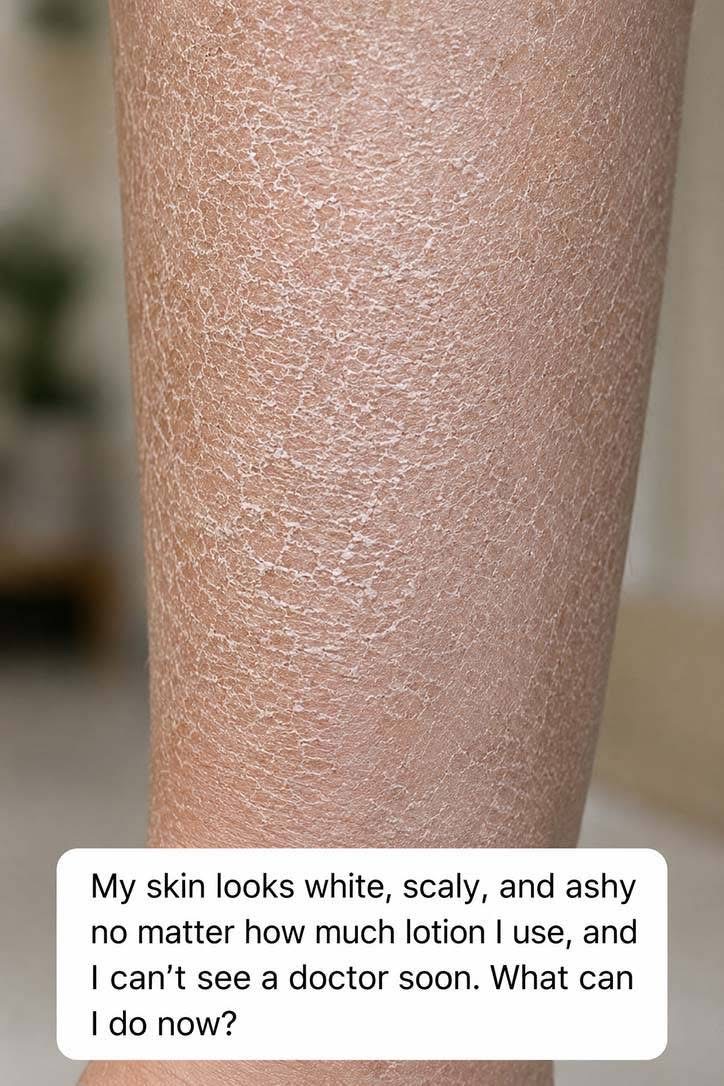
There is a specific kind of frustration that comes with standing in front of a mirror, watching your skin turn white, scaly, and ashy just minutes after you’ve applied a thick layer of moisturizer. For many, it feels like an endless battle against an invisible force that is constantly siphoning moisture out of the body. You buy the luxury bottles, you try the viral oils, and yet the “scales” remain, leaving you feeling self-conscious and physically uncomfortable. When your skin begins to look like a parched desert landscape despite your best efforts, it is a sign that you aren’t just dealing with simple dryness—you are dealing with a compromised skin barrier that has lost its ability to protect itself.
Understanding why your skin has turned into a flaky, ashy map begins with recognizing the biological structure of the skin barrier. Think of your skin as a brick wall; the cells are the bricks, and lipids—natural oils—are the mortar that holds them together. When that mortar is stripped away, moisture escapes through the cracks, and irritants from the environment seep in. This condition, often referred to as xerotic or asteatotic eczema, is particularly common during the transition to colder months when the air loses its humidity. Without that protective seal, your skin begins to shrink and crack, resulting in the white, scaly appearance that no amount of superficial lotion can fix.
The first step in reclaiming your skin’s health is identifying the “silent saboteurs” in your daily routine. Many of the habits we associate with cleanliness are actually the primary culprits behind chronic dryness. The most common offender is the long, steaming hot shower. While hot water feels relaxing on a cold morning, it acts as a solvent, melting away the very lipids your skin needs to stay hydrated. Similarly, harsh soaps and foaming cleansers contain surfactants that are designed to cut through grease, but they cannot distinguish between unwanted dirt and the essential oils your skin produces. Over-scrubbing with loofahs or rough towels only adds mechanical trauma to an already fragile surface.
To see real change, you must shift your mindset from “moisturizing” to “repairing.” This starts with the water temperature. Switching to lukewarm water and limiting your time in the shower to under ten minutes can have a transformative effect within just a few days. Instead of reaching for a bar of soap that leaves your skin feeling “squeaky clean”—a sensation that actually indicates you’ve stripped your barrier—opt for gentle, fragrance-free cleansers that are formulated for sensitive skin.
The most critical moment for your skin happens in the three minutes immediately following your shower. This is the foundation of the “Soak and Seal” method, a technique used by dermatologists to treat severe dryness and eczema. Instead of rubbing your skin dry with a towel, lightly pat yourself so that a thin layer of moisture remains on the surface. While the skin is still damp, you must apply a thick, occlusive barrier. This is where many people fail: they use thin, watery lotions that evaporate almost instantly. For ashy, scaly skin, you need the “heavy hitters”—creams or ointments that contain ceramides, glycerin, hyaluronic acid, or urea. Ceramides are particularly vital because they act as the “mortar” we discussed earlier, physically replenishing the lipids that have been lost.