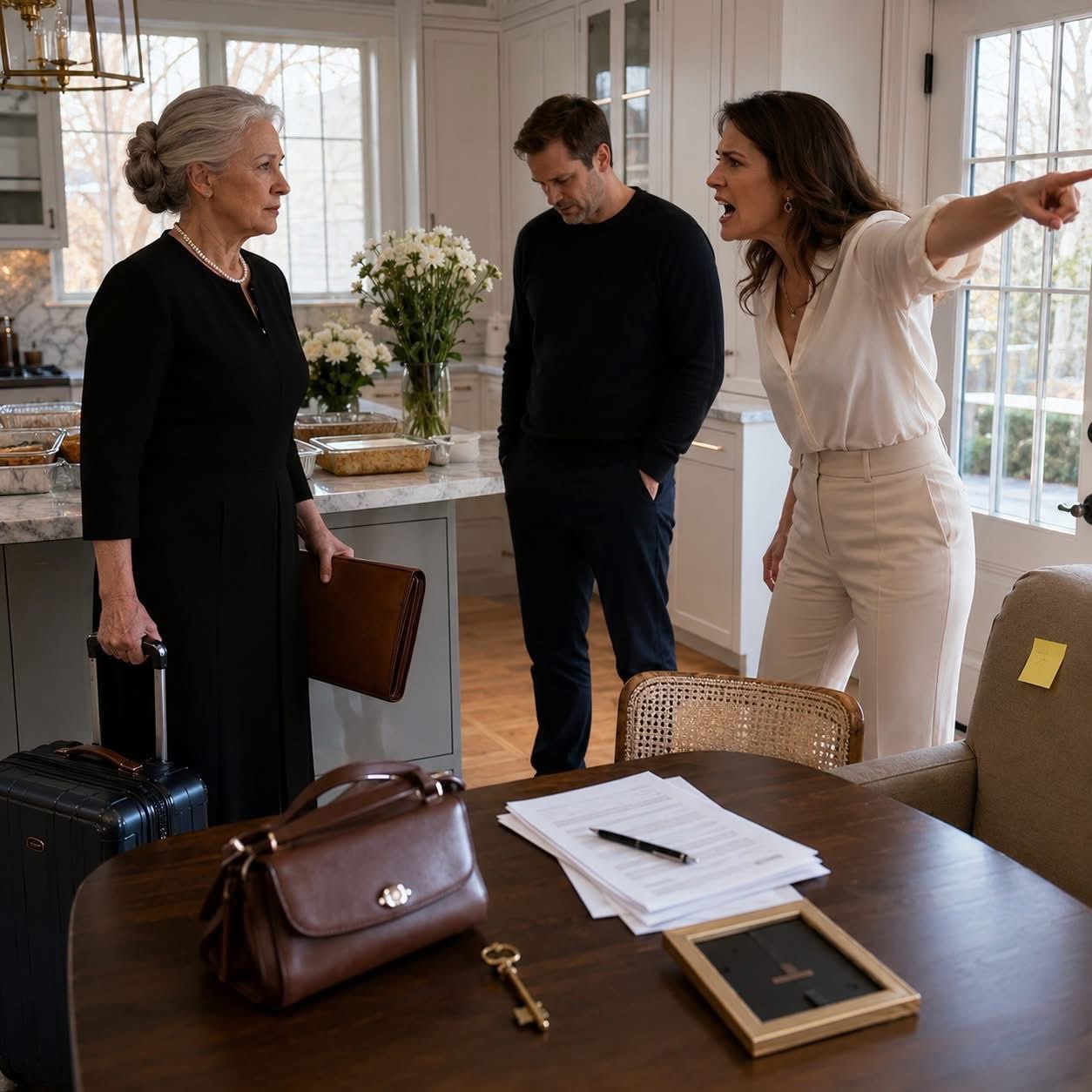
My daughter-in-law told me to get out five days after we buried my husband.
Not suggested it. Not implied it. She looked me in the eye in my own living room and said, “Now that he’s gone, cry, pack your things, and go live on the streets.”
I said, “Okay.”
That was all. Just okay.
I felt my hand tighten around the small brass key in my coat pocket, the one Daniel had pressed into my palm three weeks before he died while whispering, “Keep this safe, Maggie. Don’t tell anyone.”
So I kept my face blank.
Vanessa blinked. She had expected a fight. She wanted me to scream or beg or give her something she could use later to paint me as unstable. Robert stood behind her with his hands in his pockets, staring at the floor like a child waiting for permission to leave the principal’s office.
My son. Forty-two years old. He could not look at me.
We had buried Daniel that morning.
March in White Plains is cold, the kind that slips through your coat no matter how many layers you wear. I had stood at the graveside in my old navy wool coat, the one I bought in 1998, and watched them lower him into the ground.
Forty years of marriage. Forty years of waking at four-thirty to make his coffee before my shift. Forty years of packing lunches and ironing shirts and sitting in hospital waiting rooms and holding his hand through his parents’ decline and raising Robert while Daniel built his career.
Nobody mentioned any of that at the service.
Vanessa had hired a professional eulogist. We need someone who can speak properly, she said. Not just ramble about old stories. The man talked for twelve minutes about Daniel’s business acumen and mispronounced his name twice. Daniel Jacob Hayes, not Haze. I did not correct him.
Now we were back at the house on Maple Avenue, the Victorian I had scrubbed and maintained for four decades, and Vanessa was already redecorating the narrative.
“This house needs to be sold,” she announced.
My sister Linda was on the couch, nodding along. My own sister, sixty-five, flown in from Ohio not to comfort me but to position herself for whatever scraps might fall.
She noted that the market was good. She said Vanessa’s wedding china was in a box by the door marked DONATE.
I saw the yellow Post-it notes on the furniture already. Sell. Donate. Trash. The wedding china in a box by the door. Vanessa explaining that the will was clear, that she and Robert needed liquidity, that I understood.
I did understand.
I understood that she had been planning this since the day Robert brought her home eight years earlier. I understood that my son, who I put through college by selling my mother’s jewelry and working double shifts, had chosen this woman over me. I understood that Daniel had warned me quietly over breakfast six months before he got sick.
“Maggie, if something happens to me, don’t trust the paperwork. Wait for Mr. Brennan.”
Mr. Brennan was Daniel’s estate attorney. I had not heard from him. Vanessa said he was unavailable and that a junior associate had handled everything.
“Where will I go?” I asked.
Vanessa shrugged. Not really our problem. I was sixty-eight. I must have savings. Social Security. They had their own family to think about.
Robert finally looked up. “Mom, don’t—”
Vanessa’s hand closed around his arm. Her nails were painted burgundy. I remembered those nails tapping impatiently on the table at Christmas while I served dinner.
“Your mother is a grown woman,” she said. “She’ll figure it out.”
I said I would need a few hours to pack.
They left. I heard the car unlock.
The house went silent.
My living room. Where I had hosted Robert’s birthday parties and Thanksgiving dinners. Where Daniel and I had slow-danced on our twentieth anniversary because we were too tired to go out. Vanessa had already taken down our wedding photo and replaced it with abstract art she bought in SoHo.
I went upstairs.
Daniel’s closet had been cleared. His suits, which I dry-cleaned. His ties, which I straightened every Sunday before church. Gone, possibly donated before his body was cold.
On the bed was a stack of papers from Whitmore and Associates. Not Mr. Brennan’s firm. A Post-it note in Vanessa’s looping handwriting: Sign here, here, and here. Voluntary transfer of property to Robert J. Hayes.
Voluntary.
I sat on the edge of the bed. The mattress dipped in the same spot where Daniel used to sit and take off his shoes. I could still smell him. Old Spice and the faint peppermint of the lozenges he kept in his coat pocket.
My hand found the key.
Brass. Small. The number 447 stamped on one side.
Daniel had given it to me in the hospital three weeks before the heart attack. He was lucid that day, more lucid than he had been in months, and he held my hand and made me repeat it back to him.
Manhattan Trust on Forty-Seventh Street. Don’t tell anyone.
I had nodded, thinking he might be confused, medicated. But he made me say it back.
“Good girl,” he said, and closed his eyes.
Two days later, he was gone.
I picked up the pen.
Here is the thing about being sixty-eight and invisible. People underestimate you. They see an older woman in a cheap coat and assume you are weak. They assume you will crumble and beg and have no options.
I signed the papers. All three pages. My signature was steady.
Then I packed two pairs of jeans, three sweaters, my prescription bottles, my Bible, the quilt my mother made me, and the photograph of Daniel and me on our wedding day. The frame was tarnished.
In my purse, tucked into the zippered pocket, was the brass key and a business card, creased and faded.
Donald P. Brennan, Esq. Estate Planning and Trusts.
Daniel had slipped it into my purse two months before he died. I had forgotten about it until that moment.
I left the signed papers on the kitchen table. I did not leave a note. The front door closed behind me with a soft click.
I walked six blocks to the East Side Motel on Route 119. Sixty-seven dollars a night, cash. Room 12 on the second floor, orange bedspread, brown carpet, a window overlooking the parking lot.
I sat on the bed and did not unpack. I just sat there with my hand resting on the brass key.
Vanessa thought she had won.
But forty-eight hours after Daniel died, I had received a single text from a blocked number.
Mrs. Hayes, do not sign anything until we speak. D. Brennan.
I had deleted it immediately, afraid Vanessa might see it, but I remembered.
At five o’clock that evening I called the number on the card.
The man who answered said simply, “Brennan.”
“This is Margaret Hayes,” I said. “Daniel’s widow. I think we need to talk.”
A pause.
“Mrs. Hayes. I’ve been waiting for your call. Come to my office tomorrow morning. Nine o’clock. Bring the key. Don’t tell anyone.”
I didn’t sleep much that night.
Mr. Brennan’s office was on the fourth floor of a brick building wedged between a jewelry shop and a deli. No elevator. I climbed slowly, my knees aching. The door had frosted glass with gold lettering.
He was younger than I expected, maybe fifty-five, graying at the temples, navy suit, nothing flashy. His office was small and crowded with filing cabinets.
He told me he had handled Daniel’s estate planning for thirty-two years. Investments, asset protection, specific instructions made quietly over decades.
He told me Daniel had been careful. Secretive. He had not wanted certain people to know the full scope of things.
Certain people, I said. You mean Robert and Vanessa.
He opened a folder.
The document I signed transferred the house on Maple Avenue to Robert, free and clear. I had waived all claims. My sister witnessed it.
“That’s illegal, by the way,” Mr. Brennan said. “Changing the locks while you were still a resident. You could contest it.”
He paused.
“But you won’t. Because you’re smarter than they think. And because what Daniel left you makes that house look like pocket change.”
He slid a single sheet of paper across the desk.
Primary assets held in irrevocable trust. Margaret Louise Hayes, sole beneficiary. Investment portfolio. Offshore accounts. Real property, 785 Park Avenue, Penthouse 18B. Cash reserves.
Total estimated value: twenty-eight million dollars.
I stared at the page.
We had lived in a house worth less than a million. We drove a 2011 Honda. We shopped at Stop & Shop. I clipped coupons.
“How?” I asked.
Daniel had inherited a stake in his father’s manufacturing company in 2003. He sold it quietly, invested aggressively, and kept everything out of view. He did not want Robert to know. Or Vanessa. He told Mr. Brennan directly, and I quote, my son married a predator. If she finds out, she’ll drain him dry.
“Why didn’t he tell me?”
Mr. Brennan’s expression softened.
“He tried. Multiple times. He said you always refused to talk about money. You told him you trusted him to handle it and you didn’t need to see statements. So he handled it. And he protected you.”
I remembered.
Daniel trying to sit me down with papers and me waving him off. Honey, I don’t need to see all that. You’ve always taken care of us.
I thought I was being trusting. I felt like a fool.
“The penthouse,” I said. “I didn’t know we owned one.”
He had bought it eight years ago. Cash. He was planning to surprise me for our fortieth anniversary. Then he got sick.
I went to the bank that same day.
Box 447 held a stack of papers, a USB drive, and a sealed envelope with my name in Daniel’s handwriting.
I opened the envelope first.
Maggie, if you’re reading this, I’m gone. And I’m sorry.
I’m sorry I didn’t tell you sooner. I’m sorry I made you think we had less than we did. I was scared. Scared that if Robert knew, Vanessa would take everything. Scared you’d think I didn’t trust you. I did. I just wanted to protect you from the fight I knew was coming.
Everything in this box is yours. The penthouse, the money, all of it. I bought it because I wanted us to have a place that was just ours. No memories of raising Robert. No ghosts. I wanted to take you there on our anniversary and say this is our second act, Maggie, just us. I ran out of time.
Don’t let them bully you. Don’t let Vanessa take what you’ve earned. You gave me forty years of love, and I gave you this. Use it however you want. Be free.
I love you. Daniel.
I sat in that sterile vault room and cried for the first time since he died.
Room 12 became my world for three weeks.
I read everything in the safe-deposit box. Investment statements. Property deeds. And buried at the bottom, a stack of letters.
Twenty-three of them, written over forty years and never sent.
The first was dated May 1985. I was seven months pregnant with Robert.
Maggie, you’re asleep right now, one hand on your belly. I’ve been sitting here for an hour watching you, and I need to write this down even though I’ll probably never give it to you. If something happens to me, I need you to know you are the only person in this world who deserves everything I have. Not my brother. Not my parents. You.
You work yourself to exhaustion. You never complain. You never ask for anything. When I got promoted and brought home champagne, you cried because you were happy for me. Not because you wanted something for yourself. Just happy for me.
I don’t know how I got this lucky.
If I die, promise me you won’t let anyone take advantage of you. You’re stronger than you think. Stronger than I’ll ever be.
I read that letter three times.
The others were similar, written after long trips, from a hospital bed after his appendectomy in 1998, all saying the same thing in different words.
You deserve more. I’m sorry I don’t say it enough.
He had known. Even then, he had known I would need proof.
I called Mr. Brennan. I’m ready, I said. Ready for what? To move forward.
The next morning I transferred five million dollars into a new personal account. Then I stood outside 785 Park Avenue for the first time.
The doorman opened the door before I reached it.
I told him I was Margaret Hayes and that I owned 18B.
His expression did not change. “Of course, Mrs. Hayes. Welcome home.”
The elevator opened directly into the penthouse. No hallway. Just a vestibule and a single door.
The apartment was empty. Hardwood floors. Floor-to-ceiling windows. The living room overlooked Central Park. It smelled like cedar and dust. Three bedrooms, four bathrooms, a kitchen with appliances still wrapped in plastic.
He had been waiting for me.
In the master bedroom there was one thing. A framed photograph on the windowsill.
Our wedding day. The same photograph I had packed in my suitcase. He had kept a copy.
I sat on the floor and cried until my ribs hurt.
When Robert called that evening to say Vanessa wanted my mother’s emerald ring, claiming it was family property, I said no. Simply and completely. He pushed. I said tell Vanessa if she wants the ring, she can come ask me herself.
Vanessa texted: We know about the bank visit. Don’t think you’re smart.
She was bluffing. Daniel had made sure of that.
Still, I did not sleep well. Mr. Brennan told me the next morning to stop being afraid of her. You have twenty-eight million dollars, he said. She has a leased Audi and a husband she’s manipulating. You’ve already won. Now make her feel it.
He told me to buy something she cared about and then take it away.
Robert and Vanessa rented a two-bedroom at the Ashford in downtown White Plains for thirty-four hundred dollars a month. The building had been for sale for six months. The owner was underwater and desperate.
I made an offer through a shell LLC Mr. Brennan set up. Four point two million, all cash, close in two weeks.
They accepted in forty-eight hours.
On June first, I became Robert and Vanessa’s landlord.
They did not know.
On June fifteenth, the management company sent a standard thirty-day notice to vacate. New ownership, restructuring, professionally signed.
Vanessa called me that night screaming. Did you do this?
I told her calmly that I lived in a motel and didn’t own any buildings. I told her to check the deed if she wanted, it was public record.
She hung up.
I sat on the edge of the bed in Room 12 with my hands shaking. Not from fear. From something that felt a great deal like power.
Three days after the eviction notice, Robert called to say he had lost his job. His biggest client had gone bankrupt. Sixty thousand owed, company doing layoffs.
He asked if he could borrow money.
I said no.
He said please.
I said you have Vanessa. She’ll figure it out.
He said she didn’t have money, that her parents had cut her off years ago.
I told him he had made his choice. He chose her. He let her throw me out of my home and he stood there and said nothing.
He said quietly, I’m sorry.
I said I know. But sorry doesn’t pay rent.
That night, Vanessa sent: You’ll regret this.
I opened my laptop and searched property listings in Westchester County. I found a small colonial in Tarrytown. Three bedrooms, clean, five hundred twenty thousand. I made an all-cash offer and closed in three weeks.
On June thirtieth, the day before their eviction, I called Robert.
There’s a house at 429 Willow Street in Tarrytown, I said. It’s yours if you want it. Rent-free.
He was stunned.
There’s one condition.
He went quiet.
Vanessa doesn’t come with you.
He said he couldn’t, that she was his wife.
Then you’re both homeless, I said. Your choice.
The next morning I went to the penthouse.
I stood at the window looking down at Central Park and thought about Daniel. About the life he wanted to give me. About the life I had lived instead. Small and quiet and grateful for scraps.
I wasn’t that woman anymore.
I called Mr. Brennan.
I want to sell the house in White Plains, I said. The one Robert took. Donate the proceeds to Saint Vincent’s nursing scholarship fund.
Done. Anything else?
I asked him to prepare divorce papers for Robert. Not my filing. His. Everything ready so that when Robert was ready to choose, I could make it easy.
Mr. Brennan was quiet for a moment. Then he said, “You’re not who I expected.”
Neither am I, I said.
Robert showed up at the motel on July third, unshaven and red-eyed.
He looked around the tiny room, the sagging bed, the stained carpet, and his face crumpled.
“Jesus, Mom. You’ve been living here for three months?”
“You knew,” I said.
He put his head in his hands.
He told me Vanessa was pregnant.
I kept my voice calm and asked when the last time was that she let him go to a doctor’s appointment with her.
He said she wanted privacy.
I called Mr. Brennan in front of him. I need a private investigator today. Someone who can verify a pregnancy.
Robert asked her to take a blood test at a real clinic, framing it as an insurance requirement for a new apartment. She agreed, either believing it or confident enough to bluff through.
The results came twenty-four hours later. She was not pregnant. The hCG levels were zero. Never was, not two months ago, not yesterday, not ever.
Robert called me crying. Full sobs, the kind that sound like choking.
“I chose her over you,” he said. “I let her destroy you. And she was lying the whole time.”
I didn’t say I told you so. I just listened to my son fall apart.
When he whispered what do I do, I told him to leave her. That Mr. Brennan had divorce papers ready, that I would pay for the lawyer, that the house in Tarrytown was still his.
“Mom, why are you doing this?”
I thought about Daniel’s letters.
“Because you’re still my son,” I said. “And because I loved you before I loved anyone else in this world. But Robert, this is the last time. You choose her again, you walk away from this, you lie to me once more, and I’m done. Do you understand?”
“Yes.”
“Say it back.”
“This is the last time.”
“Good. Now go pack your things. Don’t tell Vanessa where you’re going. Just leave.”
Vanessa filed for divorce three days later. She claimed emotional abuse, financial manipulation, and alienation of affection caused by a controlling, vindictive mother-in-law. Her lawyer was Whitmore and Associates, the same cut-rate firm that handled the house transfer.
Mr. Brennan buried them in paperwork. Robert’s checking account balance, three hundred forty dollars. Credit card debt, twenty-three thousand in both names. Six weeks of unemployment.
She hired a private investigator who followed Robert for two weeks and photographed him grocery shopping and going to job interviews and eating dinner alone.
Nothing.
She tried to subpoena my bank records. The judge denied it. I wasn’t a party to the divorce.
On August twenty-second, Vanessa signed the papers. No settlement. No alimony. Half the credit-card debt and the leased Audi.
Robert called me from the courthouse steps. It’s over.
Come home, I said. I’m making dinner.
Spaghetti and store-bought sauce. Daniel used to say my specialty was edible.
Robert ate two plates and said it was the best meal he’d had in months.
We sat at the small kitchen table and for the first time in years it was easy. No Vanessa critiquing or eye-rolling. Just my son and me eating pasta and not talking about anything important.
He had found a job. Assistant manager at a construction supply company in Tarrytown. Forty-two thousand a year. He started Monday.
He pushed his food around his plate.
“Mom, can I ask you something? Where did you get the money for this house?”
I told him his father had left me some things. More than I expected. I used it to make sure he had a second chance.
“How much?”
“Enough.”
“Mom.”
“Robert.”
I set down my glass.
“Right now you need to focus on your job and your life and proving you can stand on your own. When you’ve done that, when I’m sure you’re solid, then we’ll talk about the rest. Not before.”
He nodded. “Okay.”
In November I moved into the penthouse.
I kept Room 12 paid through December, just in case. But I brought my things. The quilt. The photograph. Daniel’s letters.
I hired a decorator named Patricia who listened when I said simple, comfortable, nothing flashy. She filled the space with soft couches and warm rugs and bookshelves and lamps that made the rooms feel golden.
It started to feel like a home.
On Thanksgiving I cooked dinner at Willow Street. Robert brought wine. We sat at the table he bought secondhand and he said grace for the first time since he was a child.
“Thank you for this food, for this home, and for second chances. Amen.”
We sat on the porch afterward. The air was cold and the sky was clear.
“Are you happy?” he asked.
I thought about it. Really thought about it.
About Daniel. About the motel. About the letters and the money and every choice I had made.
“I’m getting there,” I said.
He smiled. “Good. You deserve it.”
On December fifteenth, six months to the day after Robert moved into Willow Street, I invited him to the penthouse.
He arrived in a pressed suit, looked around at the furniture and the view, and said whose place is this.
Mine.
I handed him an envelope. Inside was a copy of Daniel’s letter from 1985, the estate summary, and a single key.
He read in silence.
When he finished, his hands were shaking.
“Twenty-eight million.”
“Twenty-six now,” I said. “I’ve been busy.”
He looked at me.
“You’ve had this the whole time? Since March? And you lived in a motel?”
“I needed to see who you’d become without money. Without Vanessa. Without me bailing you out.”
I folded the letter carefully.
“Your father left this to me because he knew I’d protect it. Protect you, even from yourself.”
Robert sat down on the couch and covered his face with his hands.
I held up the key. The one to the house in Tarrytown.
“This is yours. Legally. Completely. You’ve earned it.”
He took it and stared at it.
“What about the rest?”
“The rest is mine for now. Maybe forever. I haven’t decided.”
I smiled.
“But you don’t need it, Robert. You never did. You just needed to believe in yourself.”
He stood and crossed the room and hugged me.
Not a polite hug. A real one. The kind he used to give me when he was small and scared and needed to know I’d keep him safe.
“I love you, Mom.”
“I love you too.”
We stood at the window looking out at the city. The sun was going down, casting gold across the buildings, and Central Park stretched below us in the early winter light.
“What happens now?” Robert asked.
I thought about Daniel’s letters. About the life he had wanted to give me. About the forty years I had spent being useful and invisible and grateful for scraps. About Room 12 and the orange bedspread and the coffee from the vending machine and the moment in the vault when I first understood that Daniel had seen me, had always seen me, had spent thirty years quietly building something just for me.
“Now,” I said, “we live.”