The lease hit the dining table before I fully understood what it was.
Not a folder, not a receipt, not one of the household management papers Katherine sometimes dropped near me with the wordless expectation that I would handle whatever needed handling. A lease. The paper made a crisp, small sound against the wood, and for a moment the whole apartment went still except for Brad stirring sugar into coffee he had already stopped drinking.
It was eight-twelve on a Tuesday morning. Five days after our wedding.
I remember the specific time because my iPad was still open to quarterly financial reports, the espresso machine had just finished cycling and was beginning to cool behind me, and what I was looking at on the table was the first real crack in a marriage, delivered with the smell of burnt coffee and Katherine Thompson’s perfume.
She had not knocked. She never knocked. Katherine walked into any room the way some people treat doors, as a courtesy other people observed. Her coat was the kind of beige that requires a dry cleaner on a first-name basis. Her Hermes bag landed on the chair beside me with the thud of something expensive deployed as a statement. Then her eyes moved over my navy suit, my laptop bag, the heels I had lined up by the door, and finally my face, and she looked at me the way certain women look at something they have already decided does not belong where they found it.
“Put away your ridiculous little office toy, Emma,” she said.
I looked down at the iPad in my hand. I used it to review accounts, contracts, payroll structures, acquisitions, investor reports, and every other thing she had never asked about because it was more comfortable to believe I worked some harmless, decorative kind of job. Office toy.
Brad sat at the far end of the table, staring at his espresso cup.
He already knew. I understood that later. At the time I still believed there had to be a line he would not let her cross, some inherited instinct toward basic loyalty that would emerge under enough pressure. I had been wrong about several things in those five days, but I was most wrong about that.
Katherine slid the document closer with two manicured fingers. My married name was printed under Tenant: Emma Thompson. The monthly rent was listed at fifteen hundred dollars. The owner line read Thompson Family Trust.
I read it once, then again, with the particular unhurried patience of someone who has spent years reading documents that other people hoped she would misunderstand.
“This apartment belongs to the Thompson family,” Katherine said, and she was smiling, a soft smile that she had probably used before and found effective. “You are living here now. You will pay fifteen hundred dollars a month in rent.”
I looked at Brad.
He lifted his coffee cup. He did not drink.
Katherine continued because silence made her brave. “A woman from your background should consider that generous. Most people in your position would be grateful just to breathe air in this building.”
The refrigerator hummed. A car horn rose and faded somewhere far below on the street. Brad’s spoon scraped the inside of the porcelain cup once, twice, three times.
I said his name, keeping my voice level, and I asked whether he was letting his mother charge his wife rent to live with him.
He sighed. Not a guilty sigh. An annoyed one, the kind that signals not that something has gone wrong but that someone is being inconvenient. That was worse than anything he could have said.
“Stop being hysterical, Emma,” he told me.
My hand went still on the table.
He looked at me then, and the face I had married had been replaced by something older, something that had been shaped by years of living in proximity to Katherine, something I recognized only now that it had fully emerged. “Mom is right,” he said. “You work some little dead-end job and act like you built an empire. You hit the jackpot marrying into the Thompsons. We gave you a lifestyle you never could have afforded, so stop with the blue-collar pride and show some gratitude.”
There it was. Not confusion, not the result of pressure, not a weak man being pushed in the wrong direction. The truth. They had not misjudged me by accident. They had constructed an entire version of me that made their behavior feel reasonable, and Brad had been living inside that construction long enough that it had become belief.
I want to explain how I had gotten here, because the story does not begin with a lease on a Tuesday morning. It begins eighteen months earlier at a charity dinner where a man spilled red wine on his shirt cuff, laughed at himself before anyone else could, and spent the rest of the evening asking questions that suggested he was actually listening to the answers.
That was what I liked first. Not the family name, not the apartment, not any of the things that Katherine later decided I had been pursuing. His ability to look foolish for thirty seconds without panicking. It suggested a kind of confidence I found genuinely attractive, the kind that does not require an audience’s approval to sustain itself.
He asked about my work that night. I told him I was in financial consulting. I said I had my own clients. I said I valued my privacy professionally and personally, which was not false modesty but a considered position developed over years of watching what happened when people knew too much about your leverage too early. What I understand now is that he heard only the parts of those answers that fit the version of me he was already building. When I said financial consulting, he heard office assistant. When I said clients, he heard small accounts managed from a desk. When I said I lived in Lincoln Park, he assumed rental. When I said I valued privacy, he heard nothing at all.
I do not think he did this deliberately. That is the part that is hardest to hold onto without letting it become an excuse for him. I think he simply heard what was easiest to hear, and I think Katherine had been teaching him what was easy to hear about women like me for his entire life.
She had been measuring me from the first evening we met. At the rehearsal dinner, she asked whether my parents were still working people, and she delivered the word working with the particular inflection of someone using a neutral term they know is not neutral. At a family brunch the morning after the wedding, she corrected the way I held a champagne flute, leaning over to physically adjust my grip in front of four relatives who pretended not to watch. When I brought homemade lemon bars to a family lunch early in our relationship, she displayed them on a separate plate from the catered desserts and described them to the room as “charming in a budget way.” Each time, Brad squeezed my knee under the table and said that’s just Mom, and each time I let him say it, which was also a choice I had made and would eventually need to account for.
But there is a point at which that’s just Mom stops being an explanation and becomes a description of the man who will never defend you.
The lease was not the first insult. It was simply the first one with signatures and a monthly payment structure.
I folded the paper once, then again, lining the corners with the kind of precision that hands develop when they need something to do while the mind works. Katherine watched me with the patient attention of someone expecting tears. Brad watched with the attention of someone expecting obedience. I gave them neither.
“Then I’ll move back to my apartment in Lincoln Park,” I said.
Brad’s spoon stopped against the cup. Katherine laughed, a bright, ugly sound that bounced off the high ceilings.
“Let her go, Brad,” she said. “If she wants to run back to whatever little dump she came from, let her. Some people need poverty to teach them manners.”
I stood up. The room felt suddenly clean. Not peaceful exactly. Clean, the way a room feels after something that had been in it for a long time is finally removed.
I packed only what was mine. My work bag. My passport folder. Two suits. My grandmother’s bracelet. The wedding shoes I had already begun to quietly resent. Brad followed me to the bedroom doorway but did not come inside, and he did not touch me.
“Emma, don’t be ridiculous,” he said.
I took my garment bag from the closet. “You called me hysterical five minutes ago,” I told him. “Pick one.”
His jaw tightened. Katherine remained at the table, looking pleased with herself in the way that people look when they believe they have successfully closed a negotiation. The lease sat on the wood beside her coffee cup. I left it there because it was never my document. It was evidence of what they believed they owned.
By the time I reached the lobby, my car service was at the curb. I had not used it during the five days I spent at Brad’s apartment, because I had not wanted his family asking questions I was not ready to answer. That sounds foolish now. At the time, being underestimated felt like a kind of insulation, a way of moving through the world without people knowing how much access they were being denied. I had maintained that posture for years, and it had served me well in specific contexts: men who talked too freely when they assumed I was an assistant, investors who explained my own figures back to me without noticing I had built them, vendors who sent different prices to my male employees and warm, discounted prices to me, as if my gender were a coupon. You learn what people actually are when they believe you do not matter. Katherine had shown me everything I needed to see. So had Brad.
I spent two days at The Pinnacle. My own bed, my own reports, my own coffee made on my own schedule. Brad texted fourteen times across those two days. He was angry first, then offended, then confused, then sorry in the soft, incomplete way people are sorry when consequences arrive before real understanding. Katherine did not text. She organized.
That was her true language. Not conversation, not apology, not reflection. Organization. The management of other people’s perceptions. She had been doing it for decades in rooms I had no access to, and on Sunday morning she attempted to do it at mine.
My building concierge called at nine and four minutes. He said there was a large visitor party expected, twenty-five names arriving together. I set down my coffee and looked at the wall for a moment. Twenty-five. I told him to let them in.
He paused before answering. “Are you certain, Ms. Henderson?”
“Yes,” I said. “They are expected.”
I knew exactly what Katherine was doing, because I had spent enough time watching how she operated to understand her architecture. Humiliation requires an audience. In a private room, cruelty is just cruelty. In front of witnesses, people like Katherine mistake it for authority, for the exercise of a social power that confirms who belongs and who does not. She had built her version of me over eighteen months, and now she was going to bring twenty-five people to see the evidence.
She rented a minibus. I found that out later from one of Brad’s cousins, who told me with the particular discomfort of someone who had been complicit in something and needed to name it to someone who would listen. Katherine had gathered relatives, cousins, aunts and uncles, and two family friends with the kind of social curiosity that accepts an invitation to witness someone else’s embarrassment and calls it support. She told them they were staging an intervention. She told them I was living in conditions beneath the Thompson standard. She told them Brad needed to see what he had actually married before I dragged him somewhere he could not recover from.
On the minibus, she made jokes about broken elevators and unpaid utilities. Several people laughed. Brad, from what I was told, did not. He would later offer this silence as evidence of conscience, which I found unconvincing, because silence is not the same thing as refusal, and he had spent five days demonstrating that he understood the difference and had chosen to ignore it.
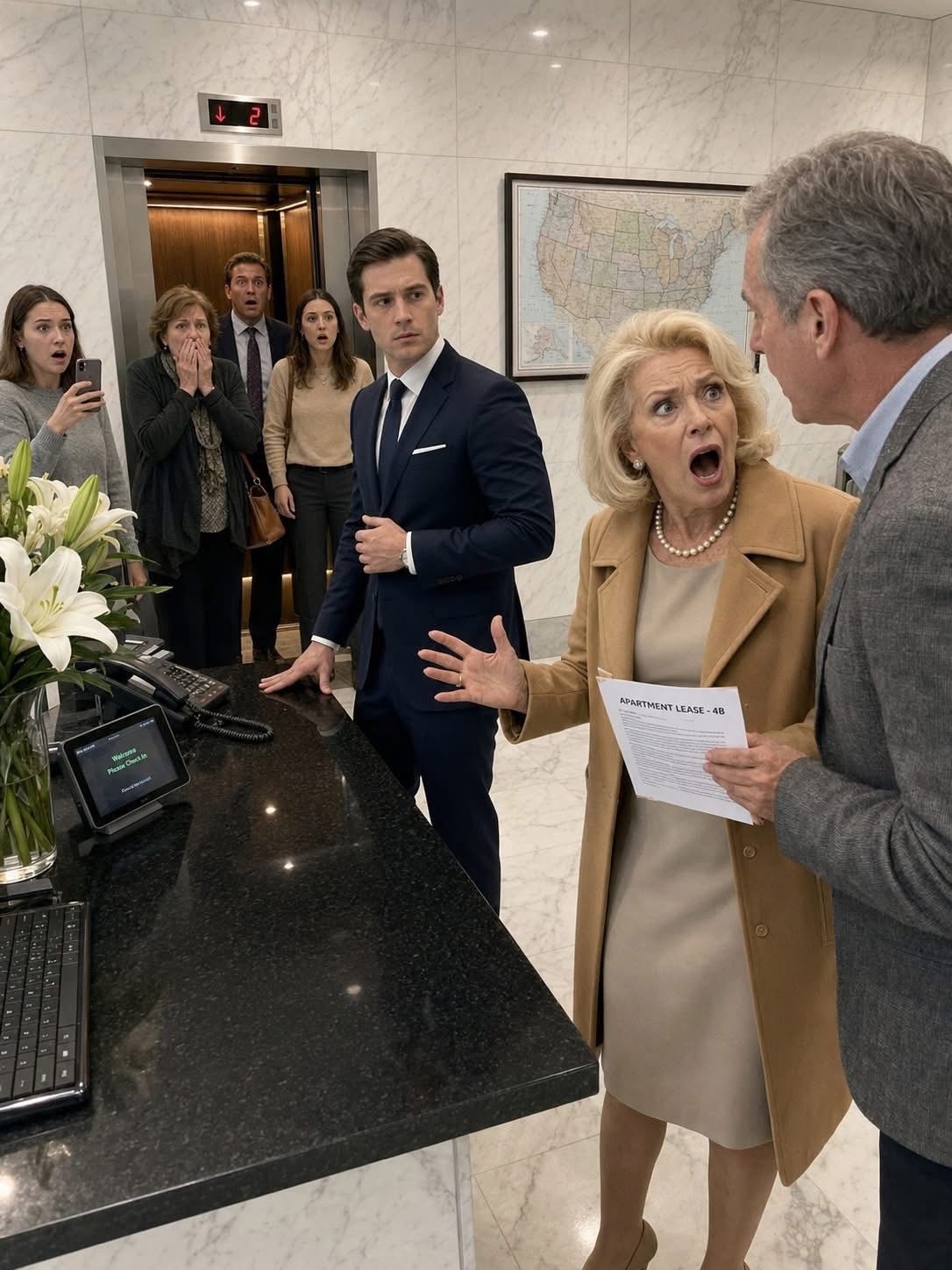
The minibus arrived at The Pinnacle at ten thirty-eight. The building is glass and black stone, set behind a private drive, with uniformed security at the curb and lobby flowers that are replaced before they have time to show age. I was upstairs when they arrived, watching the security feed from the console beside my kitchen. Katherine stepped out of the bus first. Her smile faltered for a half second when she took in the entrance, then she reassembled it, because that is what she did, and she walked inside.
The lobby smelled faintly of lilies and polished stone. I had chosen this building for specific reasons. Private elevator access. Staff who were paid well enough to be discreet. Residents who did not ask questions because most of them had reasons not to. Katherine turned it into a stage anyway. She moved to the black granite concierge desk with twenty-five people streaming in behind her, and she asked, in a voice calibrated to carry, to be pointed to the service elevator for the help.
That sentence alone could have been the end of the marriage. Not because she said it, but because Brad was standing beside her and did not step away from it.
The concierge checked the terminal. I know what he found because he showed me the screen afterward. No Emma Thompson. No guest profile under that name. No leased unit. Only my legal ownership file under Emma Henderson, my name before the wedding, the one I had never officially changed because I had not yet decided whether to.
He kept his expression neutral. “Madam,” he said, “I have no resident listed under Emma Thompson.”
Katherine lit up with the specific brightness of someone who believes they have just been handed what they came for. “I knew it,” she said. “She lied because she was ashamed. How pathetic.”
That was the last moment she believed she was winning.
Brad spoke then, his voice small enough that the lobby microphone barely registered it. He said to try the maiden name. Emma Henderson. The concierge typed. His fingers slowed. Not from confusion, but because my profile carried an owner designation, a private elevator authorization, and a note I had added that morning: large family party expected, do not refuse access, escort to penthouse.
He stood up from his terminal. He buttoned his jacket. Then he came around from behind the desk, and the shift in body language changed the air in the lobby in a way that was visible even on the security feed. Katherine saw it before anyone else did. Her mouth moved, but no sound came out.
“Ms. Henderson left instructions for her guests to be escorted upstairs via the private elevator,” he said.
Nobody laughed. The lobby absorbed the silence. One aunt lowered her sunglasses slowly. A cousin who had been holding up his phone to record the scene turned it toward the floor. Brad stared at the terminal. Katherine tried to introduce the folded lease into the situation, holding it up as though paperwork could reverse what was happening, and then she said there must be a mistake, I was her daughter-in-law, and the concierge did not argue with her. That was his particular skill. He simply turned the monitor a degree or two in Brad’s direction so he could read the authorization himself.
Owner Authorization. Emma Henderson. Twenty-five guests. Time entered: 9:04 a.m.
Brad’s color left his face all at once.
He said, quietly enough that his mother turned to look at him: “Mom. What did you do?”
For once, Katherine had no clean answer.
The private elevator doors were brushed steel, and the interior was mirrored on three walls. I had never specifically thought about that detail before, but standing in my kitchen watching the feed, I understood what those mirrors meant for the next forty seconds. They would have to look at themselves. Not at me, not at the building, not at their collective certainty about what they were going to find. At themselves, twenty-five people in good clothes who had rented a bus to attend someone’s humiliation and were now riding toward the opposite.
I was in the foyer when the doors opened. I had changed into jeans, a white blouse, and flat shoes, deliberately, because I did not want armor. I did not want performance. I wanted to be simply myself in my own home, which was the entire point.
The apartment behind me was not staged. Floor-to-ceiling windows stretched over the city on two sides and the lake was visible in the distance, a flat grey shine under the morning sky. The long oak dining table was clear. The kitchen island had grocery bags on it because I had made myself breakfast and had not troubled myself to put everything away for an audience that had no right to one. On the entry table sat a folder I had asked building management to leave there: original purchase records, insurance documents, the residence profile. Nothing theatrical. Just enough truth to stop the performance.
Katherine stepped out of the elevator first and looked around her. Her lips parted. Brad stared past her. One uncle said, quietly and without any particular tone, “This is yours?”
“Yes,” I said.
The word was quiet. It did not need help.
Katherine gave a short, brittle laugh and said that obviously they had no way of knowing I was renting something so extravagant.
“I’m not renting it,” I said.
I opened the folder and turned the first page so she could see my name. Emma Henderson. Sole owner. Purchased before I met Brad.
Brad made a sound then. Not a word, just a sound, as though something had released pressure it had been holding for too long. Katherine reached for the nearest chair and missed the back with her hand before she found it. The relatives had gone perfectly still, and I noticed in that moment the difference between an audience and witnesses. An audience watches for entertainment and holds no obligation afterward. Witnesses understand they may be asked what they saw. The room had become the second, and everyone in it knew it.
Brad took a step toward me. “Emma,” he said, “why didn’t you tell me?”
There are questions that deserve patience, and there are questions that do not, and I knew immediately which kind this was. I asked him what exactly I should have told him. That I was not poor enough for his family to abuse? He flinched. Good. Some sentences are meant to leave a mark.
Katherine’s eyes filled quickly, which surprised me only because I had never seen her direct tears toward anyone but her own interests. “My dear,” she said, and the words came out soft, borrowed-sounding. “There has been a terrible misunderstanding.”
“No,” I said. “There has been perfect understanding.”
I picked up the lease she had carried from the bus and held it in my hand. “You understood I was beneath you. You understood Brad would not defend me. You understood twenty-five relatives would make shame feel official.” I set it back down. “That is not a misunderstanding. That is a plan.”
Nobody moved. The refrigerator hummed in my kitchen. A paper grocery bag sagged gently on the island. Somewhere far below, a siren passed and dissolved into traffic.
I looked at Brad. “You had five days of marriage before your mother turned me into a tenant,” I said. “And you agreed.”
His face broke in the way faces break when they have been holding something that is too heavy for too long. “I didn’t know about the bus,” he said. “I didn’t know she was bringing everyone.”
“But you knew about the lease.”
He closed his mouth. That was answer enough.
Katherine wept then, carefully, the way she did most things, with an awareness of how she appeared while doing it. She looked around the room, perhaps expecting someone to move toward her, but nobody did. Status is contingent. It requires people to believe it is safe to stand near you, and in that room, at that moment, nobody was certain it was.
One cousin said, in a voice that had lost most of its composure, that Katherine had told them I was living in a bad situation. Katherine said she had been misinformed. I asked by whom. Brad looked at the floor.
The truth was not complicated. They had invented a poor version of me because it made their generosity feel real. They had treated my silence as confirmation of that version. They had mistaken privacy for shame and confusion for gratitude, and they had done it not because they were stupid but because it served them to do it.
Katherine straightened as much as she could and said we were family, and surely we could move past one ugly morning.
“One?” I said.
I reminded her of the rehearsal dinner. The question about my parents being working people, delivered in that tone. The champagne flute correction in front of relatives. The lemon bars displayed on a separate plate and described as budget. The way she introduced me to distant cousins and family friends as Brad’s little office girl. She was introduced to a stranger that way at their club, and she smiled and shook the stranger’s hand without correcting it.
Her face tightened with each item. Brad grew smaller with each one.
People who have done harm tend to want forgiveness to begin at the moment they are caught. They forget that the harm started long before anyone was watching, and that the watching does not retroactively make it worse. It only makes it visible.
I walked to the dining table and set down two papers. The first was Katherine’s lease. The second was the moving receipt from Brad’s apartment, everything I owned removed, keys returned, shared accounts separated as far as they could be separated in five days. Nothing I said was raised above a conversational volume. There was nothing to shout about. These were simply the facts of what had happened and what I had already decided.
Brad looked at the receipt. “You moved out completely,” he said, and it was not quite a question.
“Yes.”
“We just got married.”
“I know.”
That was the saddest part, and I want to be honest about that. Not the fraud of the relationship, not the lease, not the minibus full of relatives, but the simple and terrible fact that it was only five days since we had stood in front of people we loved and made promises that I had meant. The grief of that sat underneath everything else like cold water under ice, and I felt it even as I stood in my own home saying words that were necessary and correct.
Brad came closer, then stopped when I stepped back. He said my name. He said he had been stupid. He said he had let his mother get in his head.
“No,” I said. “You let her say out loud what you already believed.”
His eyes reddened. Katherine said she was sorry, softly, and for one moment the words almost looked true. I looked at her for a long time before I answered.
“I believe you are sorry this happened in front of all of them,” I said. “That is not the same thing as being sorry it happened.”
An uncle cleared his throat and said they owed me an apology. That small sentence broke something loose in the room, and the relatives began to speak, overlapping and awkward, several voices saying several versions of the same thing: they should not have come, it felt wrong on the bus, they had only agreed because Katherine described it as helping. One cousin said he had laughed at the broken elevator joke and he was not proud of that. Another said she had known from the moment she walked into the lobby that something was wrong and she had not said so.
Katherine asked me not to tell anyone outside the family. Brad asked to speak privately. A cousin asked me to understand that he had only come because he genuinely believed I was in trouble and needed someone. They all wanted a smaller version of what had happened, a mistake, a misunderstanding, a bad morning that could be smoothed down with enough goodwill and reframing.
I let them finish. Then I said that they had come here to watch me be humiliated, and the only reason they felt ashamed was because the wrong person ended up exposed. Nobody answered, because there was nothing to answer.
I asked the concierge to bring the elevator back.
Katherine looked at me from the chair when the doors opened. “Emma,” she said. “What happens now?”
I looked at Brad. Then at the lease, still sitting on my dining table where I had set it. Then at the city beyond the windows, grey morning light on glass and water.
“I don’t know what happens to the marriage,” I said. “But I know what happens today. You leave my home.”
The words did not feel triumphant. They felt like the correct application of a fact. The relatives filed back into the elevator in the particular quiet of people who have seen something they will carry with them for a long time. Some apologized again as they passed. Some could not look at me. Katherine stopped at the threshold like she was composing something final to say, and then said nothing. Brad was last. He stood in the foyer with the lease in his hand, the document that had been intended to locate me as a tenant, as a person whose presence in a room was contingent on payment, and it sat in his hands now like proof of something he would need to think about for a long time.
He asked if he could call me that evening. I said no. The following day? No. He looked at me and asked what he was supposed to do. I told him to start by asking himself why he had thought any of it was normal.
He stepped into the elevator and the doors closed.
The lobby was quiet in my apartment for the first time all week, quiet in the way that belongs specifically to you and not to whatever has just departed. I went to the kitchen island and unpacked the grocery bags. Eggs, coffee, a loaf of bread. Ordinary things, the kind that steady you not because they are significant but because they are yours and they are real and they require nothing from you except that you be present.
Brad called for several weeks. Katherine sent flowers twice. The first arrangement came with a handwritten note that read like a press release, full of careful language and qualified regret. The second had a single line: I was cruel. I am sorry. I did not respond to either one, and I cannot tell you with certainty whether I ever will. That is a question I am still holding.
I have kept the lease. It sits in a folder with the visitor authorization and the moving receipt. Not because I need to reread it, but because memory does a particular thing to people who have hurt you: over time, it softens them. It rounds the edges, supplies possible good intentions, quietly edits the record. On the days when that happens, I open the folder. I read my name under Tenant. I read the monthly amount. I remember the sound the paper made when it hit the table, and Brad’s spoon in his cup, and Katherine’s smile.
They came that Sunday to find a quiet woman who would pay for the privilege of being condescended to. They found the owner of the room. Those are not the same woman, and they never were.
The only thing that changed was that they finally had to see it.