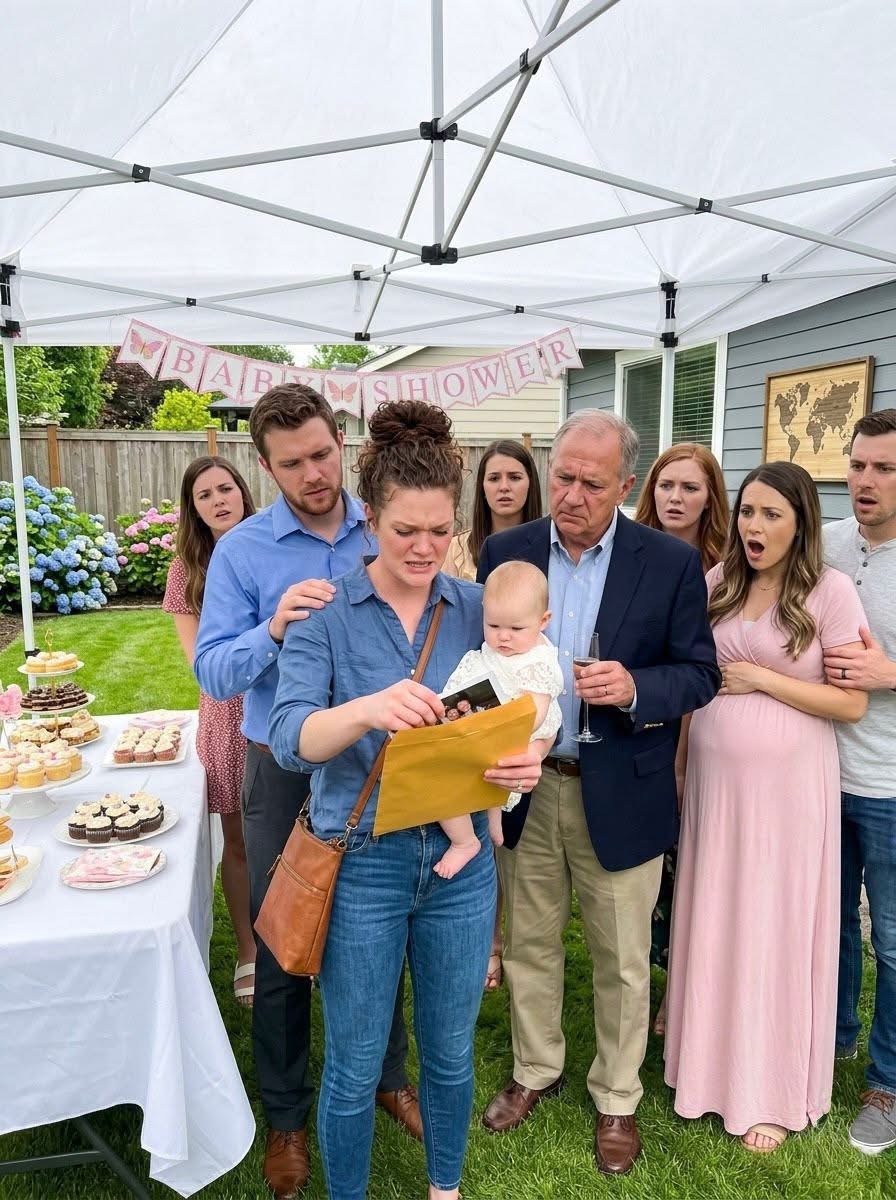
The champagne caught the sunlight before Olivia heard her father say a word.
He stood beneath the white rental tent in Madison’s backyard with a crystal glass lifted high and a smile so wide and so practiced it could have convinced anyone watching that this was the happiest afternoon of his life. Pink ribbons swayed from the tent poles. Hydrangeas crowded the fence in heavy clusters that nodded in the breeze. A dessert table sagged beneath cupcakes, lemon bars, and custom sugar cookies shaped like tiny rattles, each one iced in pale pink with a precision that suggested someone had been paid well to make sugar look like love.
People were smiling the soft, misty way people smile when a family is being celebrated in public, when the light is golden and the napkins match and everyone has agreed, without discussing it, that this moment is beautiful and that their job is to confirm its beauty by being present and emotional and grateful for the invitation.
Olivia stood at the back of it all with her seven month old daughter pressed against her shoulder.
Isabella wore a lace trimmed dress and one sock that kept slipping halfway off her foot no matter how many times Olivia tucked it back. She was Olivia’s first child. She was her father’s first grandchild. And he had never met her.
Not because he lived far away. Not because illness or estrangement or some dramatic rupture had placed a barrier between them. He lived twenty minutes from Olivia’s house, in the same suburb where she had grown up, in the same zip code where her daughter had been born seven months earlier at a hospital whose parking lot he could have reached in the time it took to finish a cup of coffee. He had not met Isabella because he did not know she existed.
And he did not know she existed because Olivia’s younger sister, Madison, had made sure of it.
Olivia was thirty two, married to a man named Carlos, and living the kind of life that looked stable from the outside because nobody could see how carefully she held it together from within. There was a mortgage on their modest split level house. A minivan payment. Grocery receipts folded into her wallet, daycare forms clipped to the refrigerator, a diaper bag that seemed to gain weight every time she picked it up. She worked in corporate operations, which meant her days were filled with people who needed miracles delivered on deadlines and who treated her competence as a natural resource rather than a skill that deserved acknowledgment.
She was not reckless. She was not loud. She was the daughter who arrived early, remembered birthdays, wrote thank you notes by hand, and brought a casserole to family gatherings even when she had been hurt too many times to want to walk through the door. Carlos once told her that keeping the peace was both her gift and her injury. He was right about that, and the fact that she recognized the accuracy of the observation without changing her behavior was itself a form of proof.
That afternoon, standing at the back of Madison’s celebration with her daughter on her shoulder and a cream envelope in her purse, Olivia felt the old injury open one final time.
Her father’s voice carried across the yard with the warm, expansive confidence of a man who believes he is saying something important. “I’ve waited so long for this,” he said, lifting his glass toward Madison’s pregnant belly as though toasting a miracle he had personally been promised.
Half the guests laughed through tears. A few women pressed napkins beneath their eyes. Madison lowered her chin in the exact way she always did when she wanted an audience to see humility, a gesture Olivia had been watching since childhood and had never once believed.
Madison was five years younger, prettier in the way people praised out loud, and gifted at making every room organize itself around her feelings. She did not dominate through volume or aggression. She dominated through a kind of emotional choreography that was so graceful most people did not realize they were being directed. She cried at exactly the right moments. She laughed at exactly the right volume. She touched people’s arms when she spoke to them and maintained eye contact that felt intimate rather than invasive, and she had spent her entire life perfecting the art of being the daughter everyone noticed while Olivia became the daughter everyone relied on, which sounds similar but is not.
Nobody in the family had ever sat Olivia down and explained that Madison mattered more. That would have required a honesty none of them possessed. Instead, the preference expressed itself through a thousand small decisions that accumulated over decades. Madison got the car at sixteen because her school was farther away. Madison’s college tuition was covered because she had so much potential. Madison got a country club wedding because these things matter to her. Olivia and Carlos got folding chairs in the backyard of their first rental house, borrowed string lights, and her father kissing her cheek while saying, “Simple suits you, sweetheart.”
Olivia had smiled. She told herself it was fine. It was not fine. But she had learned early that wanting fairness in this family was classified as difficulty, and she had trained herself into someone who was easy to love around. Easy to invite when helpful. Easy to forget when inconvenient.
Then she got pregnant.
She and Carlos had been trying for almost two years. There had been doctor appointments, quiet drives home, careful budgeting, and hope so fragile Olivia stopped speaking it aloud because saying it seemed to invite disappointment the way leaving an umbrella at home invites rain. When the test showed two pink lines, she sat on the bathroom floor and cried so hard Carlos rushed in thinking something terrible had happened. Nothing terrible had happened. For once, something purely and completely beautiful had.
She told Madison at twelve weeks. They were sitting in one of those expensive salad restaurants Madison loved, where the drinks came in glass bottles and everyone appeared to have been styled by a professional before arriving. Olivia placed a hand over her stomach and said the words, and Madison squealed and hugged her and got tears in her eyes with the instantaneous, photogenic emotion of a woman who has spent years calibrating her reactions to produce maximum effect.
Then she grabbed Olivia’s wrist and said, “Let me tell Dad. I know exactly how to make it special.”
That sentence was the first door closing. Olivia did not hear it at the time. She heard only a sister offering to help, which was what Madison’s manipulations always sounded like before you understood their architecture.
The changes began softly, the way erosion begins, with movements so small you do not notice the ground shifting until you look up and discover the landscape has been rearranged. Family dinners moved to different times. Olivia found out afterward from photographs in a group text. Her father’s birthday dinner was rescheduled, and Madison said she thought someone else had told Olivia. Sunday brunches became too spontaneous to coordinate. Madison told relatives that Olivia was exhausted. Hormonal. Needing space. She said it with the gentle, concerned tone of a sister protecting a pregnant woman’s privacy, and that tone was what made it work, because people do not question concern that sounds tender. They accept it the way they accept weather, as something natural that requires no examination.
Madison volunteered to organize the baby shower. She built a Pinterest board. She started a planning chat. She sent photographs of floral arrangements and dessert tables and those pink rattle cookies. Then every proposed date collapsed. Their father was busy. An uncle had a work conflict. A cousin had a recital. Someone got sick. Someone forgot. The shower kept moving forward on the calendar like a mirage that recedes as you approach, until eventually it was not postponed but simply gone, absorbed into the general noise of family scheduling as though it had never been real in the first place.
Carlos noticed before Olivia did. He noticed that Madison’s emergencies always coincided with moments when Olivia and Carlos planned to visit her father. He noticed that Madison never confirmed whether their father had seen the ultrasound photos. He noticed that whenever Olivia tried to discuss the baby directly with her father, he responded as though everything reached him through fog, delayed and distorted, the way information sounds when it has been filtered through someone who is controlling the flow.
Olivia defended Madison longer than she should have. That was the hardest thing to admit later. Trust does not always resemble faith. Sometimes trust looks like refusing to believe that someone you love could be that deliberate, because accepting the deliberateness would require you to reclassify the entire relationship, and reclassification is a kind of grief that arrives without a funeral.
Then Isabella was born. Seven pounds, two ounces. Full head of dark hair. A furious little cry that filled the delivery room like an announcement. A grip so strong that Olivia laughed through her own tears the first time those tiny fingers closed around hers.
She called her father from the hospital. The first call went to voicemail. The second time, Madison texted back. Dad is overwhelmed right now. Let me tell him in a special way.
Olivia was exhausted, stitched, wearing a hospital bracelet, and shaking after two days of labor. She believed her sister. She sent photographs. She mailed announcements. She dropped off an invitation to Isabella’s coming home gathering at Madison’s house because Madison said she was heading to their father’s that afternoon and would hand deliver it.
Two weeks later, Olivia sent a christening invitation. Then professional baby photographs. Then a framed print for his office. Nothing came back. No call. No visit. No confusion. Only excuses delivered by Madison with the seamless reliability of a system designed to intercept. Dad was busy. Dad was traveling. Dad’s phone had been acting up. Dad said they would do something soon.
When Isabella was six weeks old, Olivia stopped by Madison’s house after a pediatric appointment. She was not looking for a confrontation. She was too tired for one. She wanted only to ask, face to face, whether Madison had actually passed anything along.
Madison was not home. Her housekeeper let Olivia in because Olivia had been there a hundred times before and the housekeeper saw no reason to question the sister who always brought casseroles.
The house smelled like lemon cleaner and expensive candles. Isabella slept in her car seat at Olivia’s feet. Olivia stood in Madison’s home office waiting, and her eyes fell on the trash can beside the desk.
It was overflowing. Right on top sat the invitation to Isabella’s coming home gathering. Olivia recognized her own handwriting across the front. Under it was the hospital announcement, still sealed. Under that was the christening card, also sealed. Three pieces of mail that represented the most important moments of Olivia’s life, thrown away like catalogs from stores Madison did not shop at.
Olivia did not scream. She did not throw anything. She stood perfectly still while the air conditioning hummed and a wall clock ticked and somewhere down the hall the housekeeper ran water in the sink, and she felt her body go cold in the particular way bodies go cold when the mind has not yet caught up to what the eyes have seen.
She took photographs of everything. Not because she had a plan. Because some instinct she had inherited from years of being doubted told her that proof would matter when the time came, because in a family trained to question her pain, her word alone would never be enough.
That night, after Isabella fell asleep, Olivia spread the photographs across the kitchen table. Carlos sat across from her. He looked at each image. He looked at her phone. He did not ask whether she was overreacting. He did not suggest a harmless explanation. He said, “Now we know.”
Those three words changed the architecture of her silence from something imposed into something chosen.
Once they knew, more truth came loose with the inevitability of a structure losing its fasteners one by one. Madison’s husband Derek casually mentioned that Madison was selling some old family jewelry to help furnish the nursery. He showed Olivia a listing on his phone. It was their grandmother’s art deco ring, the one Olivia had loved since she was ten, the one Madison had told their father Olivia did not want. Olivia saved the listing and the timestamp and stopped pretending this was only about missed invitations.
Carlos’s cousin helped recover deleted messages from an old device Olivia had nearly discarded. There were texts Madison had sent to relatives explaining that Olivia was overwhelmed and did not want visitors. There were messages implying Olivia might not return to work after maternity leave. There was even a social media account built to sound like Olivia, quiet and distant and grateful for the privacy she had never requested. The lies were not messy. That was what made them worse. They were precise.
The message Madison never meant to send arrived on a Tuesday evening while Olivia was folding laundry. A text clearly intended for someone else, accidentally delivered to the sister it described.
Olivia is here with that baby again acting like anyone cares. Dad won’t even know she exists until my kid is at least five.
Olivia read it once. Then again. Then she locked her phone so hard her palm stung. Carlos found her ten minutes later sitting on an upturned laundry basket in the utility room while the dryer buzzed beside her. He took the phone from her hand. When he read the message, his face changed into something worse than anger. Stillness. The stillness of a man who has just understood the full scope of what his wife has been enduring and who is deciding, quietly and permanently, that it will not continue.
That was when Olivia stopped waiting for the family to correct itself.
A guilty relative eventually admitted there had been a family group chat for almost two years that included more than forty people. Daily plans, photographs, updates, celebrations. Madison’s pregnancy had received enthusiastic attention in that chat months before she was even showing. Isabella’s birth had received nothing, because every time Olivia’s name appeared, Madison answered first with one of her carefully constructed deflections. Olivia is busy. Olivia needs space. Olivia has been distant. It was like watching someone bury you one pleasant sentence at a time while smiling at the people holding the shovels.
So when Madison invited Olivia to the backyard celebration, Olivia understood the cruelty embedded in the invitation. Madison did not want her included. She wanted her present. A witness to her own replacement, seated in the audience while the daughter who stole seven months stood on stage accepting applause.
Carlos asked in the car whether Olivia was sure. Isabella kicked her remaining sock halfway off in the car seat. Olivia looked at her daughter in the mirror and said, “If I don’t do it today, she keeps stealing time.”
The cream envelope was already in her purse. It was not thick. It held only what was necessary. A photograph of the trash can with the discarded invitations visible on top. A screenshot of the jewelry listing. The text from Tuesday evening. A printed timeline with dates, calls, and invitations that were sent and never delivered. No speeches. No manifesto. Just proof, arranged in the order events occurred, because dates have a power that emotions do not, and Olivia had learned that in a family trained to dismiss her feelings, only facts would survive the scrutiny.
Under the tent, her father finished his toast. He talked about becoming a grandfather. He mentioned bedtime stories he planned to tell. Toys he had already started buying. A nursery he was assembling in his guest room. Each detail landed in Olivia’s chest like a stone dropped into water, sinking past the surface and settling into the place where old pain lives alongside new pain and the two become indistinguishable.
Her daughter had a crib from a clearance sale and a dresser Carlos repaired in their garage. Isabella had been loved fiercely but not publicly, not by the people who should have rushed toward her the moment she existed.
Madison caught Olivia’s eye during the toast. The corner of her mouth lifted with the private satisfaction of a woman who believes the performance is going exactly as planned.
Then their father turned toward Olivia.
For one suspended second, she thought he had finally seen Isabella. She thought his eyes would drop to the baby and widen with the recognition she had been waiting seven months to witness. Instead, he smiled the teasing, oblivious smile of a man who has no idea he is about to step on a landmine someone planted in his path, and said, loud enough for every guest to hear, “So, Olivia, when are you finally going to make me a grandfather?”
The yard froze. Forks hovered over cake plates. A plastic cup crinkled in someone’s grip. An aunt looked down at the grass as though studying it might excuse her from the moment. The pink ribbons kept moving. The music kept playing. Nobody moved.
Carlos’s hand found the small of Olivia’s back. Isabella made a soft sound against her shoulder. Madison looked at Olivia over the rim of her smile.
Olivia reached into her purse. Her fingers closed around the cream envelope.
“Seven months ago,” she said.
Her voice was not loud. It did not need to be. The music suddenly felt intrusive, and Carlos stepped away long enough to lower the speaker volume, and when he returned the yard was wrapped in a silence so complete you could hear the hydrangeas brushing against the fence.
Her father blinked. “What?”
“Seven months ago. Her name is Isabella. She was born seven pounds, two ounces. You were invited to meet her.”
A murmur moved through the tent like wind through tall grass.
Madison whispered, “Olivia, don’t.”
That was the first honest sentence Madison had spoken all afternoon, the only one stripped of performance, propelled by genuine fear rather than calculated sweetness.
Olivia pulled the first photograph from the envelope and held it up.
“This is the invitation to Isabella’s coming home gathering. I found it in Madison’s office trash can.”
Her father stared at the image.
Olivia pulled the second photograph. “This is the hospital announcement I mailed. Still sealed.”
Then the third. “The christening card. Also sealed. All of them thrown away.”
The woman nearest the dessert table covered her mouth. Madison’s face had gone the particular shade of pale that appears when someone who has been managing appearances for years watches the management fail in public.
“She’s twisting this,” Madison said, and her voice had the bright, defensive quality of a woman reaching for her usual tools and finding them insufficient for the first time.
“No,” Olivia said. “You did that part yourself.”
She pulled out the printed text message. The paper trembled once in her hand, then steadied. She held it toward her father.
He read it. At first his expression showed only confusion, the way a person looks when they are reading words whose individual meanings are clear but whose arrangement has not yet produced comprehension. Then the sentence assembled itself.
Dad won’t even know she exists until my kid is at least five.
His champagne glass lowered. The liquid trembled against the rim.
Derek read over Madison’s shoulder. “Madison,” he whispered, and his voice carried the weight of a man who is realizing that the woman beside him has been performing a version of herself he has been watching without understanding. “What did you do?”
Madison turned toward their father with tears building. On schedule. Perfectly calibrated. “Dad, I was trying to protect you.”
Olivia had heard that sentence in various forms her entire life. Protecting people was Madison’s favorite costume, the language she used whenever her behavior needed to be reframed as selflessness rather than strategy.
Their father looked at Olivia. Then, for the first time that afternoon, he truly looked at Isabella. Not past her. Not through her. At her. Isabella stared back with solemn brown eyes and one fist curled in Olivia’s blouse, unaware that she was the center of a reckoning that had been building since before she was born.
Something moved across his face that Olivia had waited seven months to see. Not joy. Not yet. Regret. The particular kind of regret that arrives when a person understands they have been manipulated into missing something irreplaceable, and that the manipulation succeeded because they were willing to be steered.
Madison reached for his arm. He stepped back. The movement was small, but beneath the tent, surrounded by forty people holding plates and cups and the remains of their assumptions about this family, the step registered like a shift in gravity.
Olivia handed him the timeline. Dates. Phone calls. Invitations sent. Messages intercepted. A chronological record that transformed a family feeling into a document, because feelings can be argued with and documents cannot.
He read until his hand began to shake.
“Is this true?” he asked Madison.
She opened her mouth. Nothing came out.
Derek let go of her arm. That broke her more visibly than the question had.
Carlos spoke. “She called you from the hospital. Twice.”
The silence of forty people realizing simultaneously that they had helped make a lie believable is a particular kind of silence. It is not the silence of shock or the silence of sympathy. It is the silence of complicity being recognized, and it fills a room the way cold fills an unheated house, gradually and completely.
Her father set his champagne glass on the dessert table. It clicked against the plastic surface hard enough to make someone nearby flinch. Then he walked toward Olivia.
Carlos shifted half a step, protective by instinct. Olivia did not move.
Her father stopped in front of Isabella.
His eyes filled.
“May I?” he asked.
It was the question Olivia had wanted for seven months. It arrived late. Late things still carry weight, but the weight is different from what it would have been on time, heavier in some places and lighter in others, shaped by the absence that preceded the arrival.
Olivia looked at her daughter, then back at him.
“Not yet,” she said softly.
His face crumpled.
Madison made a wounded sound, as though Olivia had been cruel. But Olivia had learned something during the seven months her sister stole. A boundary feels cruel only to people who benefited from its absence. To the person who draws it, a boundary feels like the floor finally holding.
Her father nodded. He accepted the answer without argument, without asking her to be the bigger person, without mentioning family unity or forgiveness or any of the words people use when they want the injured party to resume absorbing the cost of other people’s behavior. He simply nodded, and that small act of acceptance, the willingness to stand in the consequence without trying to negotiate his way out of it, was the first thing he had done in years that made Olivia believe repair might be possible.
The party did not recover. Guests drifted into quiet clusters. Some checked their phones with the desperate focus of people who need a reason to look away from what they have just witnessed. A cousin approached Olivia with tears in her eyes and whispered, “I’m sorry. I should have called you.” Olivia did not comfort her. That was new. Comforting the people who had failed her had been her default setting for so long that not doing it felt like learning to use a different hand.
In the days that followed, the family chat changed. Not because everyone became courageous overnight. People rarely transform that quickly. But proof has a way of making cowardice inconvenient, and the photographs Olivia had taken in Madison’s office made it difficult for anyone to maintain the pretense that the situation was a misunderstanding.
An aunt added Olivia to the group chat without consulting Madison. Three relatives sent apologies that were careful and late and insufficient. One uncle admitted he had wondered why Olivia never responded to invitations she had never received.
Her father called the next morning. Olivia almost let it ring through to voicemail. Carlos sat beside her at the kitchen table while Isabella banged a plastic spoon against her high chair tray with the focused intensity of a percussionist who has found her instrument.
“You don’t have to answer,” Carlos said.
“I know.”
That was why she did. Because the choice was hers, and making it freely was different from making it out of obligation.
Her father cried. Not the polished, photogenic crying of his toast at the party. This was ugly and breathless, the crying of a man who has been forced to see himself through the eyes of the child he failed and who cannot reconcile the image with the story he told himself about who he was.
He said he had failed her. He said he had believed the wrong daughter because believing Madison had always been easier. He asked if he could come over.
Olivia looked at Isabella, who had sweet potato on her sleeve and no awareness that she had become the center of a family’s reckoning with its own dishonesty.
“Not today,” Olivia said.
A long silence.
“Okay,” her father said.
That mattered. He did not argue. He did not ask her to be reasonable. He did not suggest that enough time had passed or that dwelling on the past was unhealthy or that the family needed to move forward. He said okay, and the word landed with the modest, unglamorous weight of a man choosing, perhaps for the first time, to let his daughter set the terms.
A week later, he came to their house. Not to Madison’s. Not to a restaurant where everyone could perform normalcy over appetizers. He came to Olivia’s split level with the repaired dresser in the nursery and the minivan in the driveway and the diaper bag hanging from the kitchen chair.
He brought no toys. No grand gesture. Just a framed copy of the baby photograph Olivia had mailed to his house months earlier, the one Madison had intercepted and never delivered.
“I printed it myself,” he said, and his hands trembled as he held it out.
Isabella was sitting on the living room rug with a soft block in her lap. Her father lowered himself to the floor slowly, with the careful, humbled posture of a man entering a room he knows he has not yet earned the right to occupy.
“Hi, Isabella,” he said.
The baby looked at him with the frank, unimpressed assessment that infants bring to every new face. Then she held out the block.
He took it like it was something sacred.
Olivia turned toward the kitchen before he could see her cry. Carlos followed and leaned against the counter beside her.
“You okay?”
“No,” she said. Then she looked back at the living room, at her father sitting on the floor with her daughter, holding a soft block in one hand and wiping his eyes with the other. “But I think I will be.”
Madison attempted to recover the narrative in the weeks that followed. She sent messages characterizing Olivia’s actions as a public humiliation staged while she was pregnant. She said stress was dangerous for the baby. She said she had made mistakes but Olivia had been cruel. Olivia did not respond to every message. That was another new practice. Silence, when chosen rather than imposed, has a different texture entirely. It is not the silence of someone who has been erased. It is the silence of someone who has decided that the conversation does not require her participation.
The grandmother’s ring was removed from the listing. Her father brought it over in a small velvet box. Olivia opened it and saw the art deco setting she had loved since childhood, and she understood that the ring mattered not because it was beautiful but because Madison had known exactly what it meant to her and had taken it anyway, the way she took everything, not out of need but out of the compulsion to ensure that whatever Olivia valued would pass through Madison’s hands first.
Olivia closed the box and placed it on the shelf beside Isabella’s framed hospital photograph. “Thank you,” she said. It was not forgiveness. It was acknowledgment. There is a difference, and the difference matters, because forgiveness is a gift you give when you are ready and acknowledgment is a courtesy you extend because the gesture deserves recognition even when the person making it has not yet earned the larger thing.
Over the following months, her father learned to be a grandfather in ordinary ways. He came on Saturday mornings with coffee for Olivia and Carlos. He sat on the living room floor while Isabella crawled over his shoes. He learned which snacks she liked and which song made her clap. He stopped asking when Olivia would attend family events and started asking what would make her comfortable. Sometimes he got it wrong. Sometimes the old anger rose in Olivia so quickly it frightened her. But this time she did not swallow it to keep everyone else at ease. She said what hurt. He listened. That was new for both of them.
Madison gave birth in the fall. Olivia sent a small gift through Derek. A blanket and a card that said congratulations. No speech. No revenge disguised as generosity. She did not go to the hospital. She did not owe Madison a public performance of grace. Her own daughter had already paid enough for this family’s comfort.
At Isabella’s first birthday, Olivia hosted a small party in their backyard. Grocery store cupcakes. Folding chairs. A cooler full of drinks. A banner Carlos hung slightly crooked over the patio door. Her father arrived early. He brought ice. He helped set up chairs. When guests arrived, he introduced Isabella as his granddaughter without hesitation, without apology, without making the moment about his regret.
Olivia watched from the kitchen window as Isabella toddled toward him in a pink dress with both hands lifted for balance. He crouched down and opened his arms.
This time, Olivia did not stop him.
Isabella walked straight into his embrace, and he held her with the careful, overwhelmed tenderness of a man who understands that the child in his arms represents not just the future but the evidence of everything he nearly lost because he trusted the wrong daughter’s version of the truth.
Olivia stood in the kitchen doorway watching them. Carlos came up beside her and put an arm around her shoulders. The yard was small. The cupcakes were ordinary. The banner was crooked. Nothing about the scene would have impressed anyone accustomed to country club celebrations and custom sugar cookies and tents with pink ribbons swaying from the poles.
But everything in that yard was real. Every chair was there because someone who loved Isabella had carried it out and unfolded it. Every cupcake was there because Olivia had chosen them herself, not because a caterer had been hired to make the desserts look like a photograph. Every guest was there because they had been invited by a mother who wanted her daughter surrounded by people who would show up not for appearances but for the child.
That was the thing Madison never understood, and perhaps never would. The celebration Olivia built for Isabella’s birthday was smaller and simpler and less expensive than anything Madison would have arranged, and it was also more honest than anything that had ever happened under a tent in Madison’s backyard. Because honesty does not require hydrangeas or champagne or sugar cookies shaped like rattles. Honesty requires only that the people in the room mean what they say and have not been manipulated into attending by someone who controls the guest list the way a director controls a cast.
An entire family had once taught Olivia that being easy to overlook was the price of being loved. That the quiet daughter who arrived early and brought casseroles and never complained was performing her role correctly, and that the role itself was the reward. She had believed that for thirty two years. She had arranged her life around it, folding herself smaller and smaller to fit inside the space they left for her, which was never quite large enough and always located behind Madison.
Her daughter would not learn that lesson.
Not quietly. Not politely. Not ever.
Olivia did not expose her sister to win a party or to punish her or to stage the kind of dramatic confrontation that makes for satisfying stories and unsatisfying lives. She exposed her because seven stolen months were enough. Because a baby is not a prop in someone else’s performance. Because being the peaceful daughter had cost too much. Because the cream envelope in her purse contained nothing more dramatic than the truth, arranged in chronological order, and the truth turned out to be powerful enough to make an entire tent full of people go silent and stay that way.
Isabella’s sock slipped off again. Olivia bent to retrieve it from the grass, and when she straightened, she saw her father watching her from across the yard with an expression she had spent her whole life waiting to see.
Not the distracted warmth he reserved for Madison. Not the teasing, surface level affection he defaulted to when he did not know what else to offer. Something deeper. Something that had been earned through months of showing up on Saturday mornings and sitting on the floor and learning which song made a baby clap. Something that looked, finally, like seeing.
Olivia tucked the sock back on Isabella’s foot, kissed her daughter’s forehead, and walked into the afternoon.