My name is Natalie Richards.
I am twenty-two years old, and I used to believe a diploma could finally make my father look at me like I mattered.
He flew in from the Chicago suburbs at the last minute, sat four rows back in a dark suit that had no business being worn in California sunshine, and watched me the entire morning like I was a decision he was still calculating whether to reverse. When my friends screamed my name from the lawn, he clapped exactly three times. When strangers leaned over to say you must be so proud, he nodded with the careful neutrality of a man approving a formality that had nothing to do with him personally.
I noticed all of it. I had been noticing all of it my entire life.
My mother Diana sat beside him in a yellow dress she had bought specifically for today, the kind of optimistic color you wear when you are trying to believe a day will be better than your instincts are telling you it will be. She kept touching the strap of her purse the way she always did when something in the room was about to go wrong and she could feel it coming but had no way to stop it.
My two brothers sat on her other side. Marcus, nineteen, who had spent the flight here telling me he was proud of me in a dozen different ways because he sensed he needed to say it enough for two people. And Drew, sixteen, who was still young enough to believe our father’s moods were weather, not character.
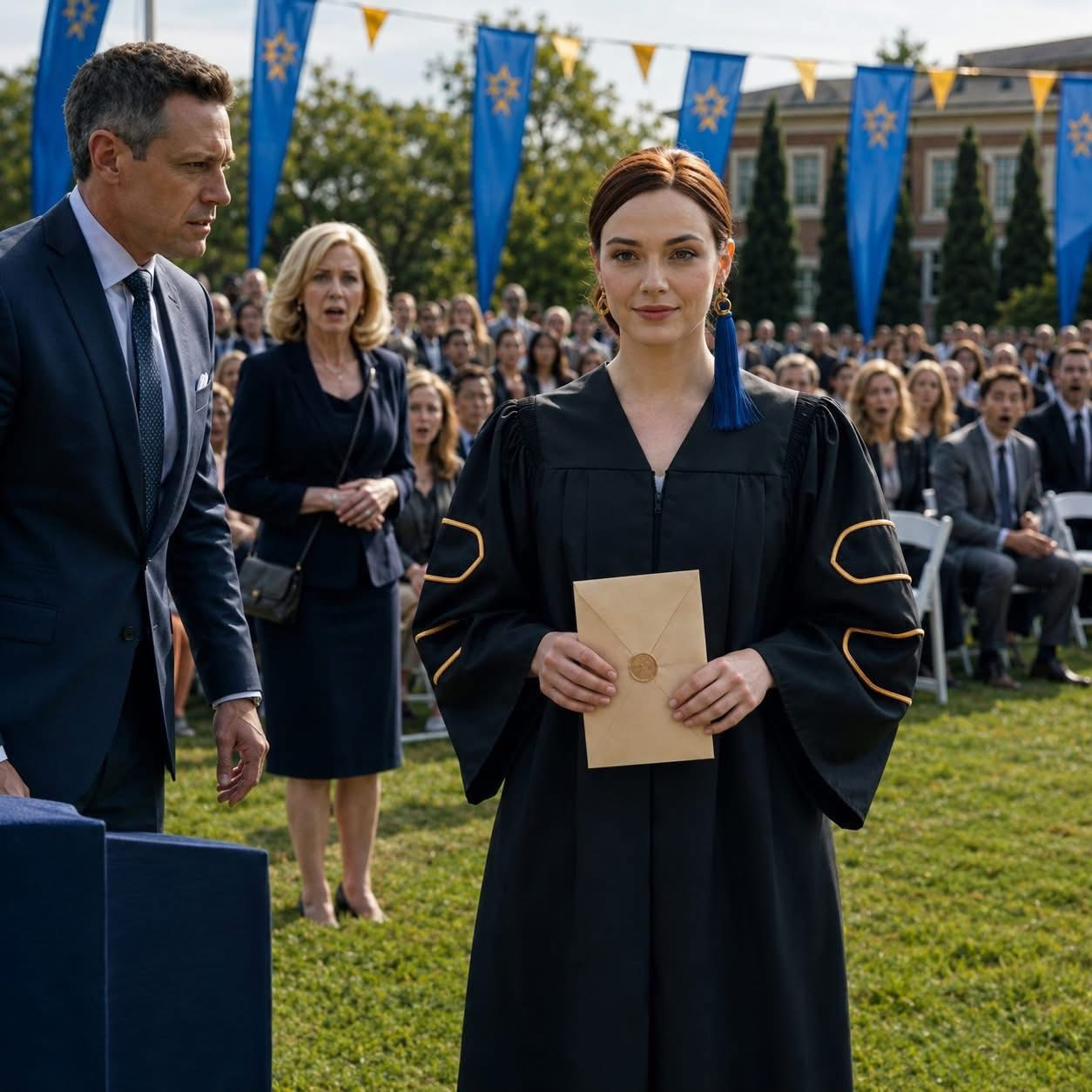
The Bay breeze moved the blue and gold banners overhead and the dean was wrapping up, thanking the faculty, asking the families to hold their applause until all names had been read, speaking the words that every graduation speaker speaks, the ones about the world being ready for you, about doors opening, about the hard work finally meaning something tangible and real.
I had my tassel on the left side of my cap. My gown smelled like plastic wrapping from the rental bag. My heels kept sinking slightly into the grass between the folding chairs, and I had a headache starting at my left temple from the afternoon light.
None of that mattered. I had worked four years and three jobs and two scholarships to be standing on that lawn in that gown on that particular afternoon.
I had earned this day.
My father stood up during the open remarks.
The dean had invited a few words from family, the usual gesture at smaller ceremonies, the kind of moment meant for a tearful mother or a proud grandfather with a prepared note card. My father stood up the way he stood up in boardrooms, with a smoothness that announced he expected the room to wait for him.
“I won’t be supporting her anymore,” he said, his voice carrying easily in the warm air, pleasant as someone reading a weather report. “And she should stop telling people she’s a Richards. She’s not even my real daughter.”
The silence lasted about two seconds.
Then the air changed, the way it does when something has been said in a public space that cannot be unsaid, and every person in that lawn becomes simultaneously aware that they are witnessing something they will be describing to other people later tonight.
Phones lifted. Heads turned. The woman to my mother’s left put her hand over her mouth. Someone’s father near the back said what the heck under his breath, loud enough to carry.
I felt my stomach drop the way it drops in elevators, that brief free-fall sensation of the floor no longer being where you expected it.
But my cheeks stayed dry.
That surprised even me. I had imagined this moment in various versions, late at night, in the months since I had understood what he was capable of, and in my imagination I had always felt more. More trembling, more heat, more of the childlike devastation that his cruelty had produced in me when I was younger and still believed his approval was something I could earn.
Standing on that lawn in my graduation gown, I didn’t feel devastated.
I felt the particular cold clarity of a person who has been waiting for something to finally arrive so they can stop waiting.
I looked at my mother.
Diana Richards, née Calloway, who had spent my entire life softening my father’s edges, calling cruelty stress, calling silence safety, turning his moods into weather reports she delivered to us children as warnings rather than indictments. She had loved me in every way she knew how and had failed me in the one way that mattered most, which was the way of speaking the truth out loud when speaking it would have cost her something.
Her hand was frozen on her purse strap. Her face had gone pale in a way I had only seen once before, five years earlier, on a Tuesday in July when I was seventeen and the summer had cracked open to reveal something underneath it that changed the way I understood every room in our house.
I need to tell you about that Tuesday.
My father’s study was the one room in our house where you did not go without being invited. It was his room in the way that certain men make certain rooms theirs, through a combination of closed doors and the particular silence that accumulates when a space is used primarily for things that are not discussed. I had been in there perhaps a dozen times in my life, always briefly, always supervised.
On that July Tuesday, my father was in Chicago for three days, and my mother had taken Drew to his orthodontist appointment, and Marcus was at soccer practice, and the house was mine in the complete way houses rarely are.
I was looking for printer paper.
I know how that sounds. I was looking for printer paper for a history assignment, and the printer in my room had run out, and I knew there was a ream of it somewhere in my father’s study because I had seen it there once before.
The top drawer of his desk was unlocked.
Inside the printer paper was a manila folder, and on the front of the folder in my father’s handwriting was a single word followed by a name that I recognized.
I stood there for what felt like several minutes.
Then I took out my phone and photographed every page in that folder, put everything back exactly as I had found it, took the printer paper, closed the drawer, and went back upstairs.
I sat at my desk for a long time before I could bring myself to look at the photographs.
The document was a paternity test, the kind administered through a private laboratory, timestamped from when I was three years old. The results confirmed what my father had apparently suspected and apparently confirmed and apparently kept sealed in a locked drawer for fourteen years without ever telling anyone, including my mother, including me.
According to that document, Robert Richards was not my biological father.
According to that document, my biological father was a man named Thomas Calloway.
My mother’s brother.
I sat at my desk for a very long time after reading that.
Then I started doing what I would spend the next five years continuing to do. I built a file. Not out of malice and not out of any clear plan for what I would do with it, but out of the instinct that a seventeen-year-old develops when she understands for the first time that the adults around her have been operating on information she has been denied, and that information is about her, and that one day someone is going to try to use it as a weapon.
I wanted to have the weapon first.
Thomas Calloway had died in a car accident when I was eighteen months old, which meant he had never known, or if he had known, he had never been given the chance to act on it. My mother had been twenty-three when she was pregnant with me. The timeline, when I pieced it together over the following months from photographs and old letters and my mother’s rare unguarded comments about those years, suggested a period of considerable chaos in a young woman’s life before she had settled into the stability of marriage and motherhood and careful silence.
I never confronted my mother.
I thought about it. I rehearsed the conversation dozens of times. But every time I got close to it, I saw her face the way it looked when she was managing my father, that particular careful patience of someone who has learned that the wrong word at the wrong moment costs more than the truth is worth, and I understood that she was afraid of him in ways that had nothing to do with physical danger and everything to do with the kind of power that accumulates over twenty years of dependency, and I could not bring myself to add to what she was carrying.
But I kept the photographs.
I had them printed and sealed in an envelope, and I kept the envelope in the back of a drawer in my dorm room at Berkeley, and every time I thought about throwing it away, I thought about my father’s face, the way he looked at me like I was a decision he had not yet finalized, and I kept it.
Standing at that graduation podium, I understood with complete clarity why I had kept it.
Not to hurt him.
Not exactly.
But because I had always known, somewhere under everything, that he was going to pick a moment. A public moment, a witnessed moment, a moment when I could not step away without looking like I was running. He was that kind of man. He had always been that kind of man. He had chosen my graduation because it was the one day when the performance of family was visible and attended and recorded, because hurting me in front of witnesses gave him something private humiliation never could.
He had wanted me to stand there and receive it.
I walked to the podium.
My heels pressed into the grass with each step and the microphone stand was slightly too tall for me and the afternoon sun was directly in my eyes and none of it mattered. I wrapped my fingers around the microphone the way I had practiced, in my dorm room, alone, speaking to a wall, rehearsing not the words but the steadiness, the particular tone that sounds like calm because it actually is.
“If we’re doing honesty today,” I said into the microphone, “then let’s do all of it.”
My father’s jaw tightened. It was a small movement but I had been reading his face my entire life.
My brothers were staring at the grass. Marcus had his hand pressed flat on his knee the way he did when he was trying not to show that he was terrified.
My mother was not breathing.
I reached into my graduation gown and removed the envelope.
I had been carrying it against my chest since that morning, tucked inside the gown, the paper warm from my body heat. I held it up in the afternoon light and let the front rows see it, and I watched my mother’s face very carefully because I needed to know, before I said anything else, whether she recognized it.
She did.
Her lips parted. Her hand released the purse strap. For one moment the careful management dissolved completely and she looked at me the way I had been waiting my entire life for her to look at me, without the mediation of my father’s presence, without the filter of what was safe to show.
She looked terrified and sorry and certain all at once.
She recognized the envelope because she had always known there was a document. She had always known that somewhere in that study there was a piece of paper with her history on it, and she had spent twenty-two years waiting for the moment it surfaced, and that waiting had shaped everything.
My father took one step toward the aisle.
Not aggressive. Controlled. The movement of a man who is accustomed to controlling rooms and has just realized that this particular room is no longer his to control. There was something new in his expression and I cataloged it carefully because I had never seen it there before.
Fear.
Not of me specifically. Of the envelope. Of the thing the envelope contained and what it meant for the story he had been telling himself and everyone else for twenty-two years, the story in which he was the wronged party, the reluctant provider, the man who had been deceived and had stayed anyway and deserved credit for his endurance.
“For years,” I said, looking directly at him, “you have held one story over my head. A story about biology. About what that means for belonging, for family, for who gets to use whose name.”
I held the envelope up slightly.
“You decided today was the day to tell it publicly. You picked my graduation because you knew I couldn’t walk away without everyone watching me walk away.”
I paused.
“That was a miscalculation.”
I looked at my mother.
She was crying now, silently, the kind of crying that happens when the body has been holding something for so long it simply cannot continue.
“Mom,” I said, and my voice changed, shed something, became the voice I used only when it was just the two of us and my father was not in the room. “I’m not doing this to hurt you. I need you to know that.”
She nodded. A small, destroyed nod.
“I’m doing it because he made a choice to do it in public, and the only way I know how to answer that is in public.”
I slid my thumb under the seal of the envelope.
The crowd was completely silent. Three hundred people on a Berkeley lawn on a beautiful May afternoon, not one of them moving.
I pulled out the pages.
There were two of them. The laboratory document and a short note I had written myself and paper-clipped to the front, two sentences that I had drafted and revised and redrafted over the course of five years and had finally gotten right.
I looked at my father.
“This is a paternity test,” I said. “You had it done when I was three years old. You have known the results for nineteen years. You kept it in your desk and used it to decide how to treat me and you never told me, never told my mother, never gave either of us the chance to understand our own lives with accurate information.”
My father had stopped moving toward the aisle. He was standing very still in the way that men stand when they have run the calculations and realized every available move costs something they are not prepared to pay.
“I am not going to read the results into a microphone,” I said.
A murmur moved through the crowd. Confusion, and then something else as people began to recalibrate.
“Because the results are not the point. The person named in this document is dead. He died before I was two years old. He never knew about me, and I never knew about him, and nothing I say at this podium is going to change either of those things.”
I looked at the pages in my hand.
“What I am going to say is this. My father has spent twenty-two years in possession of information about my life that I was entitled to. He used it to keep me small. He used it to justify his distance, his conditions, his cruelty. And he used it today because he wanted to humiliate me in the one public moment that was supposed to be mine.”
I set the pages down on the podium surface.
“So here is my answer to that.”
I looked out at the crowd, at three hundred strangers and my family and my friends and the dean, who was standing off to the side with an expression that suggested nothing in his thirty years of academic ceremonies had prepared him for this particular afternoon.
“I am a Richards by name and I am releasing that name today. Not because he told me to. Because I earned my own.”
I picked up my diploma from where it sat on the podium corner, still in its leather case from the formal presentation.
“My name on this diploma is Natalie Richards. Next year, it will be Natalie Calloway. In honor of a man I never met, who was my mother’s brother, who died young, who deserved to know he had a daughter, and who I am choosing to claim instead of being claimed by.”
I heard my mother make a sound. Not crying. Something beyond crying, the particular release of a person who has been holding a breath for two decades.
“I’m not erasing anyone’s history,” I said, my voice steadying. “I’m writing my own.”
I looked at my father for the last time.
He looked diminished. That was the only word for it. He had walked into that ceremony as the kind of man who commands rooms, who announces things, who decides the shape of other people’s days. He looked smaller now than I had ever seen him, not because I had destroyed him but because the secret he had been using as a private weapon had been placed in the open air where secrets lose most of their power.
“I want to thank UC Berkeley,” I said, turning back to the microphone for the last time, shifting my voice into something lighter, something that acknowledged the three hundred people who had not come here for this and deserved to have their afternoon restored to them. “I want to thank every professor who told me the work mattered. I want to thank Marcus and Drew, who are my brothers in every way that counts, because we chose each other through all of it.”
Marcus was crying openly now. Drew had his arm around their mother.
“And I want to thank my mom,” I said. “Who did the best she could with what she had. Who gave me everything she knew how to give. Who I am going to have a very long conversation with after all of this.”
A laugh moved through the crowd, scattered and relieved, the laughter of people who have been held in tension and have just been given permission to release it.
“Congratulations, class of 2024,” I said. “Now let’s get out of the sun.”
The applause started slow and then grew, the way applause does when people are not sure whether to clap and then decide collectively that yes, this is something that deserves it.
My father left during the applause. I saw him in my peripheral vision, moving up the outside aisle toward the parking area, alone, his dark suit disappearing between the folding chairs. He did not look back.
He would call me six weeks later, from a number I did not recognize because I had blocked his. He would leave a voicemail that was measured and careful and fell short of the specific words that would have made it mean something. I would listen to it once and then not again for a long time.
But that was later.
What happened immediately after was that my mother walked onto the lawn in her yellow dress, and Marcus was behind her, and she put both arms around me before I had fully stepped down from the podium, and she held on in the fierce wordless way of someone who is making a promise with their body because they cannot yet trust their voice.
I let her.
After a while she pulled back and looked at my face and said, “I’m so sorry.”
“I know,” I said.
“Not just for today.”
“I know, Mom.”
She held my face in her hands the way she had when I was small, before everything had gotten so complicated, before the years of management and silence had built up between us. She looked at me like I was something she was seeing clearly for the first time, or perhaps seeing again after a very long absence.
“Thomas would have loved you,” she said, and her voice broke on the last word.
I didn’t answer that. I just held her for another moment while the crowd moved around us and the Bay breeze kept the banners moving overhead.
Marcus eventually pulled me sideways into his own version of the same hug, big and clumsy and exactly right, the hug of a brother who had known something was wrong for years and had not known how to fix it and had simply stayed close as his substitute for fixing it.
“You were so calm,” he said into my hair. “How were you so calm?”
“I practiced,” I said.
He laughed, surprised, and the laughing made things feel more ordinary, which was what I needed.
We went to dinner afterward, my mother and Marcus and Drew and two of my closest friends from Berkeley, a Mexican place near campus that was loud and crowded and required no emotional processing. Drew ate two full orders of chips before anyone else had ordered food, which was something he had been doing since he was eight and which I found, in that moment, extraordinarily comforting.
My mother sat beside me and we talked carefully at first and then less carefully as the meal went on and the day began to settle into something that could be held at a slight distance. She told me about Thomas in pieces, the first real account I had ever heard, a portrait of a young man assembled from an older sister’s grief, funny and impulsive and reckless in the way of people who do not expect to die young and therefore do not moderate themselves.
“He had your laugh,” she said. “I’ve always known that.”
“You should have told me,” I said. Not harshly. Just factually, the way you state things when you have made your peace with them but still need them acknowledged.
“I know,” she said. “I was afraid.”
“Of what he would do?”
“Of losing everything. The house, the boys. The life I had built that felt like the only thing keeping us all together.”
I looked at her across the restaurant table, this woman who had chosen fear over truth for twenty-two years and had paid for it every single day in the currency of watching her daughter be treated like a conditional gift.
“We’re still together,” I said.
She cried again at that, briefly, and then Marcus made a joke about the chip situation and Drew defended himself loudly and the table became a normal family dinner for a few minutes, which was the best thing that had happened all day.
The legal name change took four months. Natalie Calloway. My mother’s name before her marriage, the name she had given up, the name of the brother she had lost and never properly mourned because grief requires speaking the dead person’s name out loud and she had spent too long not speaking his.
She had her own name change finalized six months after mine. Diana Calloway. She told me she was going back to who she had been before, and I told her that was exactly the right way to think about it.
The envelope is in a filing box in my apartment now, along with the rest of the documents from those years. The laboratory results are still folded inside. I have read them perhaps a dozen times since that afternoon, and each time they tell me the same thing they always told me, which is that biology is a fact and family is a choice and the two are related but not identical.
Thomas Calloway was my biological father. He died before he knew about me, which means he never chose me and never failed to choose me. He exists in my life now the way good mysteries exist, as something to be curious about rather than something to solve. My mother fills in the portrait a piece at a time. I have photographs. I can see the laugh she mentioned. It is disorienting and interesting and mostly good.
Robert Richards has not attended any family event since graduation. This is a loss for Drew primarily, who is still young enough to want a father who shows up, and I feel that loss on his behalf even as I do not feel it on my own. Marcus came to understand, over the months after the ceremony, the full shape of what had been happening in our family, and he processed it the way Marcus processes most things, through long runs and longer silences followed by very direct conversations. He called me one Sunday in October and said I should have done that years earlier, and I told him I had done it exactly when I was ready, and he said fair point.
My diploma hangs on my apartment wall. UC Berkeley. Natalie Richards, the name I graduated under.
Below it, on a small shelf, is a framed photograph of a man I never met, laughing at something outside the camera’s frame, twenty-seven years old and three years away from a car accident he did not know was coming. My mother gave me the photograph. She said it was the one where he looked most like himself.
I think he looks like someone who did not know how to be small.
I have been told I have that quality too.
I think that might be the best thing I have ever inherited.