My parents threw me out into a storm at fifteen because they believed my sister’s lie.
Three hours later, a police officer called them to the hospital. My father walked through those emergency room doors and stopped dead when he saw the woman sitting beside my bed, because he recognized her. Everyone in academic circles recognized her. She was Dr. Rebecca Lawson, dean of graduate studies at Ohio State University, one of the most respected figures in educational equity research in the country.
She was also the woman who had hit me with her car when I stumbled into an intersection at eleven o’clock at night, blind with rain, nowhere to go.
She had not left my side.
My father stood in the doorway with his hands shaking.
That was the first moment.
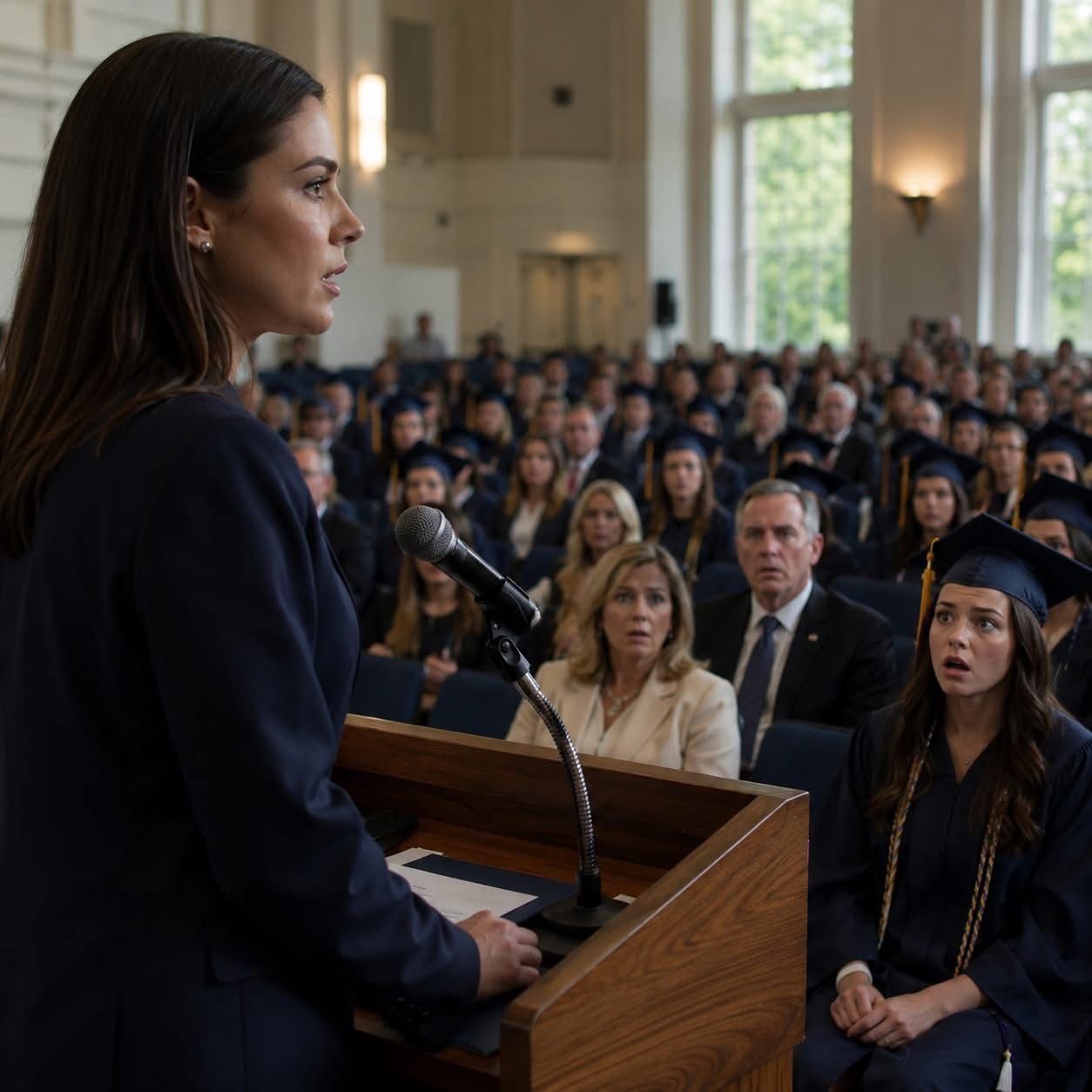
The second came thirteen years later, when I walked onto a stage at my sister’s graduation ceremony, and the room my family had spent their entire lives believing belonged to them finally stopped belonging to them.
But I need to take you back to the beginning. Because the beginning matters. It always does.
My name is Julia Ford. I am twenty-eight years old. And I learned very early that in our house, my sister Khloe’s tears carried more weight than anything I ever achieved.
When I was eleven, I won first place at the regional science fair. My project on water filtration systems had beaten over forty students. I was so proud I ran the whole way home with the blue ribbon clenched in my fist, burst through the front door, and found my mother in the kitchen.
She smiled. She pulled me into a quick hug.
Then Khloe walked in from the hallway. Eight years old, face flushed, eyes filling.
“I messed up my pirouette,” she cried. “Everyone laughed at me.”
My mother’s arms slipped away from me. She knelt and wrapped herself around Khloe while I stood there still holding my ribbon. Nobody asked to see it.
That was how it always went. Khloe needed more. Khloe was sensitive. Khloe had to be handled carefully. So I learned to shrink. To celebrate quietly in my own room with the door closed. To need less, take up less space, want less out loud.
By fourteen I had stopped showing them my report cards altogether. Straight A’s didn’t stand a chance against Khloe’s emotional storms.
When I was accepted into a prestigious summer science program, full scholarship, two weeks working alongside real researchers, my father barely glanced up from his phone. That’s nice, Julia. Khloe burst into tears. Why does she get to leave? That’s not fair. My mother placed a hand on her shoulder and looked at me. Julia, maybe you could skip it this year. Your sister needs you here.
So I didn’t go. They called it family unity. I called it learning, again, to be smaller.
The lies started when Khloe was twelve.
First, small things. My sweater ending up on her bed while she denied touching it. Money missing from my mother’s wallet, fifty dollars, and Khloe telling them she had seen me near it that morning. I had left for school early. My father called me into his study, and when I said I hadn’t taken it, he said I was accusing my sister of lying, and that was worse than the theft itself.
I lost my phone for a month. The science program I had been promised for the following summer disappeared.
I stopped defending myself after a while. What was the point? They chose her tears over my truth every single time, and the choosing was so effortless it had stopped feeling like a choice to them at all. It had become simply the way things were.
By the time I was fifteen, I had narrowed my life down to a strategy for surviving two more years. I spent time at the library, at school, anywhere that wasn’t that house. I told myself I just had to hold on until college. I was wrong.
That October there was a boy in my AP chemistry class named Ethan Parker. Nice, friendly, terrible at balancing equations. He had asked me for help a few times. One afternoon at my locker he stopped to thank me and asked if we could study together for the midterm.
I said yes. It was that simple and that unremarkable.
What I did not know was that Khloe had been filling a notebook with his name.
I saw her face when Ethan walked away from me in the hallway. About twenty feet away, completely still, watching. Her face was pale. Something moved behind her eyes that I did not understand then the way I understand it now.
That night at dinner she barely spoke. Just moved her food around her plate. My mother kept glancing at her. I told myself it was nothing.
Silence from Khloe was never harmless. I know that now. It was always a warning.
On Thursday of that week, Dr. Rebecca Lawson came to our school as a guest lecturer for my biology class. She spoke about educational equity, about systems that fail students who lack support. I stayed after to ask questions because I always stayed after to ask questions, because school was the one place where my mind felt like something worth having. She watched me carefully while I spoke, then handed me her card.
You have a sharp mind, Julia. Don’t let anyone make you doubt that.
I thanked her and tucked the card into my bag. I had no idea I was holding the reason I would survive.
The storm warnings started that weekend. A serious one. People were boarding windows and stocking supplies. At home, Khloe still wasn’t speaking to me, wouldn’t look at me. I remember thinking, maybe this weekend will just be quiet.
Friday night, the rain came early. By evening the wind was picking up. We ate dinner in near silence. Then around eight I heard it. Loud, sharp, uncontrolled crying from downstairs.
My father’s voice came up sharp. Julia. Get down here now.
My stomach dropped on every step.
Khloe was on the couch, face buried against my mother’s shoulder. My mother was stroking her hair. My father stood near the fireplace, arms crossed, face flushed.
Then Khloe lifted her head. Her eyes were red, swollen, tears streaming. She looked at me, and for just one second something slipped, something cold and precise behind the performance. Then the performance returned.
She told them I had been spreading rumors at school. About her and Ethan. That I had been bullying her, making her life miserable.
My mind went blank. Then she pulled out her phone and showed my mother a screenshot of a group chat, messages with cruel things attached to my name, my account. I still don’t know exactly how she did it. A fake account, a stolen login, some version of a twelve-year-old’s calculating patience. But it looked real enough.
Then she yanked up her sleeve.
A dark purple bruise bloomed across her arm.
I stared at it.
I never touched you, I said.
Then you must have done it yourself, I said. I don’t know why I said it. The words just came out because they were true and I was desperate for someone in that room to consider that possibility for even one second.
The room went cold.
Her eyes widened. Fresh tears spilled.
You think I would hurt myself just to frame you?
Yes, I shouted. Because this is what you do. You lie. You’ve been lying about me for years.
My father’s fist came down on the mantelpiece. I’ve heard enough.
I tried to explain. I begged them to listen. I said her name in every tone I had left, soft then urgent then broken.
My mother said, quietly and with a specific weight that only a mother’s disappointment can carry: I thought we raised you better than this.
Khloe collapsed into sobs again. Perfect, convincing, fragile.
Then my father looked at me like I was something broken.
Something is wrong with you, he said. You’re sick.
The word hit harder than anything else he could have chosen. Not wrong. Not bad. Sick. Something defective. Something that needed to be removed rather than corrected.
I need you out of my sight. Outside.
The storm was at full force. Thunder shaking the windows, rain hammering the glass.
Dad, it’s storming.
I don’t care. His voice was flat and merciless. I don’t need a sick daughter like you in this house.
I turned to my mother. Searched her face for one sign that this had gone too far.
She tightened her arm around Khloe and looked away.
That was my answer.
I got my jacket on with hands that could barely manage the zipper and walked out.
Through the glass of the front door, I caught one last glimpse before it closed behind me.
Khloe was watching me.
She wasn’t crying anymore.
She was smiling.
The rain hit me like a wall. Within seconds I was completely soaked through. I stood on the porch for a moment waiting for the door to open again. Maybe he would realize. Maybe he would call me back.
The door stayed closed.
So I walked.
No destination. Just away. Away from that house, away from Khloe’s lies, away from parents who had looked at me and seen something too broken to keep. My phone battery was at eight percent. I tried calling two friends. No answers. Everyone was home and warm and safe on a Friday night.
Everyone except me.
The library was dark and locked. The bus station was two miles away. I kept walking. Each step heavier, my shoes soaked through, teeth chattering, the particular cold that gets into bones and stays there.
I thought about turning back. Knocking. Begging.
Then I heard his voice again. Sick daughter.
Maybe he was right. Maybe there was something wrong with me.
I was still in that thought when I crossed the intersection.
The light was green. I am sure the light was green. But the rain was blinding, the wind was roaring, and the car came from somewhere I could not see until the headlights blazed straight at me.
The horn screamed. The brakes shrieked. I tried to move.
I wasn’t fast enough.
The impact threw me. I hit the hood and then the pavement and the pain was the kind that consumes everything, blinding and absolute. Rain poured into my mouth and my eyes. The world tilted and went wrong.
I heard a car door slam. Footsteps running through water.
Oh my God. Oh my God.
A woman’s voice. Hands on my shoulder, careful and gentle.
Sweetheart, can you hear me? Don’t move. Just stay still. I’m calling 911.
She pressed her hand to my shoulder, rain pouring between us.
What’s your name?
I tried to answer. Nothing came.
My parents, I whispered.
What’s their number?
They don’t, I started. I coughed and tasted blood. They don’t want me.
Her expression changed instantly. What?
They kicked me out, I said, each word slow and heavy. Said I’m sick. Don’t want me anymore.
She stared at me in the rain. Something moved through her eyes that I didn’t have the consciousness left to read clearly.
You’re going to be okay, she said, but her voice was shaking. I promise you’re going to be okay.
In the distance, sirens.
Her face was the last thing I saw before everything went black.
I don’t remember the ambulance. The first thing I remember is the sound of machines, the smell of antiseptic, fluorescent lights.
And her voice.
Talking to a nurse. She has a severe concussion. Possible internal bleeding. She needs monitoring. And then: I’m staying. I’m not leaving her alone.
I drifted. In and out. And then new voices. Familiar ones.
We’re Julia Ford’s parents.
My father. Strained.
Mr. and Mrs. Ford.
And then her voice again, different now. Controlled and precise.
I’m Dr. Rebecca Lawson.
A pause. Recognition landing.
You’re the dean at Ohio State, my mother said.
And I’m the one who hit your daughter tonight, Dr. Lawson said, her tone carrying something sharp underneath the composure. I’m staying until I know she’s safe.
My father tried to manage the situation the way he managed everything, through authority and forward momentum.
She ran into the road in the middle of a storm. In severe weather.
Dr. Lawson’s voice cut him off.
She’s fifteen years old.
Silence.
Why was she alone out there?
No one answered.
Mr. Ford, she said, each word deliberate. I asked you a question.
He said it was a discipline issue.
A discipline issue, she repeated slowly. Then sharper. What kind of discipline issue ends with a child alone in a storm?
Khloe’s voice then, small and carefully fragile. Julia is making things up. She was barely conscious.
She wasn’t making anything up. Dr. Lawson’s voice cut clean and certain through the room. I need to speak with a social worker.
My father tried to stop it. My parents’ voices rose. The word private. The word family. Dr. Lawson said the moment you put a minor out into a storm it stopped being private.
Then I felt her hand find mine. Warm and steady.
I’m not leaving, she said quietly, just for me. Not until I know she’re safe.
A new voice entered. Firm and official.
Mr. Ford, we’re going to need to ask you some questions.
I managed to open my eyes the barest flicker. Blurred shapes. My father’s outline. Khloe behind him.
Dr. Lawson saw it immediately. She’s waking up. Everyone out. Now.
Everyone left.
She leaned close.
You’re safe now, she whispered. I promise. You’re safe.
I wanted to believe her. The word safe felt like something I hadn’t held in a very long time.
She stayed. For four days she stayed.
My parents came once, on the second day. They brought clothes and a few school assignments. They stood at the end of my bed like strangers in a waiting room, and my mother said they were glad I was okay, and my father nodded, and that was the entirety of it. No question of whether I wanted to come home.
Khloe didn’t come at all.
On the fourth day, a social worker named Angela Brooks came with kind eyes and a calm voice and asked me about my home, my family, the night of the storm.
This time I told the truth. All of it. Years of it.
Angela listened and wrote things down and looked at me and said, Julia, you have options. You don’t have to go back.
Then there was a knock at the door.
Dr. Lawson stepped in.
She can stay with me, she said.
I stared at her. Why would you do that? You don’t even know me.
She sat on the edge of my bed.
Because someone once did the same for me. She said it quietly, without performance. When I was seventeen, my family turned me away. A teacher took me in.
Her hand found mine.
You’re brilliant, Julia. Don’t let anyone convince you you’re broken. Don’t let anyone dim that.
I made my decision in that hospital room.
I chose something different.
The next six months I barely recognized my own life. Rebecca’s home was quiet and orderly, full of books and plants and soft music. She gave me a bedroom and told me I could make it mine. I transferred schools. Started over. No one knew about Khloe, about my parents, about being the sick daughter.
I was just Julia. Focused. Capable. Finally able to breathe.
She insisted I call her Rebecca. Over time she became something I didn’t have a word for until I understood that the word was mother. Not by biology. By choice. The kind of choice that means more because it doesn’t have to be made.
She introduced me to university lectures, academic panels, dinners where people talked about policy and real change. Education is freedom, she would say. Knowledge is something no one can take from you.
So I worked. Straight A’s weren’t just grades anymore. They were proof. Proof that I wasn’t broken. Proof that I wasn’t what they said I was.
I heard things about my old family in pieces through people we had known. Khloe was still the center of everything, still the one they chose. My parents had taken down every photograph of me in the house.
Good, I thought. Let them erase me. I’m building something better.
College came. Full scholarship. Education policy and social justice. I wanted to understand why some kids were supported and why others fell through gaps that no one talked about. I knew exactly which side I had come from.
Graduate school. Then a research position at Rebecca’s university. Then, at twenty-five, the idea that became my work.
A scholarship program for students like me. Kids who had been pushed out. Kids who just needed one person to believe in them.
I called it the Second Chances Scholarship.
The first year was mostly rejection. Empty inboxes and nights questioning whether any of it would hold. Rebecca helped me shape the proposals, refine the structure, make it something funders could take seriously.
Then things shifted. Funding from three organizations. A pilot at one university, then two, then five. By twenty-seven, we had awarded over two hundred thousand dollars. Forty-seven students. Forty-seven second chances.
People started noticing. Interviews. Conferences. I told my story every time, just enough of it. A fifteen-year-old girl who was told she didn’t belong. No names. No details. Just truth without the specifics.
Then one afternoon my colleague Daniel Hayes knocked on my office door.
Julia, you’ve been nominated as a keynote speaker for a graduation ceremony.
Which university?
Riverside State.
My stomach tightened.
That’s my sister’s school, I said.
He blinked. You have a sister?
Not anymore. But yes. She’s graduating this spring.
He offered to decline for me. I asked him for the theme of the speech.
Resilience. Educational equity. The president specifically requested you.
I thought about Khloe sitting in her cap and gown, telling everyone about her perfect life, her supportive parents, the story where I never existed. My parents in the audience, proud and certain they had made the right choice.
And me standing on that stage.
Not for revenge. For closure.
I worked on the speech for two weeks. Drafted it, cut it, rewrote it, read it aloud to Rebecca at the kitchen table until it was exactly right. No anger in it. No trembling. Just truth, delivered with the professional steadiness of a woman who had learned the difference between processing pain and weaponizing it.
I accepted the invitation.
I did not tell my family.
The morning of the ceremony I dressed with intention. Navy suit, clean and structured. Rebecca’s grandmother’s pearl necklace, which she had pressed into my hands the night before.
In case you need a reminder of where you belong, she said.
I stood in front of the mirror. Nothing like the soaked, shaking fifteen-year-old who had been called sick.
I was ready.
The campus was beautiful, brick and green lawn and late spring light. Students in caps and gowns moved in clusters, laughing, taking photographs. The air had the particular quality of days that feel like they matter before you know why.
I arrived early, met President Walsh, walked the building. Backstage was the usual organized chaos of an event about to begin.
I picked up a program. Scanned the names.
Row three. Khloe Ford, Bachelor of Arts, Communications.
My heart thudded once against my ribs.
Rebecca arrived a few minutes later in a deep emerald dress. She pulled me into a tight hug.
You’ve got this.
I know.
She took her seat in the front row, slightly right of center, where I could see her from the stage.
The auditorium filled. Hundreds of voices layering over each other. Somewhere in that crowd my parents were finding their seats, reading nothing in the program, expecting a speaker they had never heard of.
They had no idea.
President Walsh touched my shoulder. Five minutes.
I walked to the wings. From there I could see the podium, the rows of graduates, the family sections behind them. The whole architecture of a moment I had been building toward for thirteen years.
President Walsh stepped to the podium. The room settled.
Our keynote speaker has dedicated her career to ensuring that every student, regardless of circumstance, has access to opportunity. Please welcome the director of the Second Chances Scholarship Program, Ms. Julia Ford.
Applause spread through the room.
I stepped into the light.
I walked forward steadily, my heels on the stage floor, and then I saw them.
Row three.
Khloe in cap and gown, honor cords, clapping and half turned toward her friend. Then she looked up.
Her hands stopped mid-clap.
The smile left her face. Confusion first, then recognition, then something she had no category for. Her mouth parted. No words came.
A few rows behind her, my parents were still applauding, still unaware, still just part of an audience clapping for a stranger.
I reached the podium. Adjusted the microphone. Looked out across the room.
Good morning, and thank you, President Walsh, for that generous introduction.
My father’s head snapped up. He leaned forward slightly. Trying to place the voice.
My mother’s hand rose to her chest.
It’s an honor to be here today. I want to talk about resilience. About what happens when everything is taken from you and you still find a way forward.
The room settled into attention.
Let me tell you about a fifteen-year-old girl.
I kept my tone steady. Conversational.
She was told she didn’t belong. That something about her was fundamentally wrong. That she was too broken to keep.
My mother’s hand tightened around my father’s arm.
One night, during a storm, she was forced out of her home. Told to leave. Told she wasn’t wanted anymore.
A ripple moved through the audience. Subtle. Uneasy.
She walked alone for hours. No phone. No money. Nowhere to go.
Silence.
She was hit by a car.
The room stiffened.
She nearly died.
I let a beat of silence sit.
But someone stopped.
My gaze moved briefly to Rebecca in the front row. Her eyes were bright.
Someone chose to help. Someone saw potential where everyone else saw a problem.
Rebecca’s expression was the one I had seen since I was fifteen. Steady, proud, certain of something she had known from the beginning.
That person became her family. Her mentor. Her mother in every way that mattered.
A pause.
Then that fifteen-year-old girl was me.
The room fell completely silent.
My father half rose from his seat before my mother pulled him back. He was staring. She was staring. Behind them, around them, the audience held its breath.
Khloe had gone so still she looked like a photograph of herself.
I’m standing here today because of Dr. Rebecca Lawson.
I gestured to her in the front row.
She didn’t give up on me when my own family did.
The whispers began. Moving through the room in waves. People leaning toward each other. Heads turning.
She taught me that rejection isn’t the end. Sometimes it’s the beginning.
I drew one slow breath.
The Second Chances Scholarship was built from that experience. It exists for students who have been told they are not enough. Students who have been overlooked, abandoned, cast aside.
And then I looked directly at Khloe. Held her eyes.
Because being rejected doesn’t define you.
A beat.
What you choose to do afterward does.
Today that program has supported forty-seven students, I said, my voice carrying steady and clear across every corner of that room. Students like the girl I used to be.
Somewhere near the back a woman whispered, Is that really her family?
I kept going.
I learned something in the years after that night. Family isn’t always defined by blood. Sometimes it’s defined by choice. By the people who choose you when others walk away.
In the front row, Rebecca wiped at her eyes.
I also learned that you don’t need everyone to believe in you. You just need one person. One person who looks beyond the surface, beyond the accusations, beyond the lies.
Khloe’s composure cracked. Her face collapsed inward. She looked down. Her shoulders trembled. Her friends had stopped whispering. Now they were watching her, putting things together in real time.
And I learned, I said, tightening my hands slightly on the podium, that success isn’t about proving people wrong.
A breath.
It’s about building something meaningful in spite of them.
My father’s hands were covering his face. My mother was crying.
To the graduating class of Riverside State University, I said, my voice softening the way it does when you’re talking to the people who actually matter in the room. I leave you with this. Your worth is not defined by who stays.
A pause.
It’s defined by how you grow after they leave.
For one second, nothing moved.
Then one person stood. Then another. Then rows of them. Students, faculty, families. A standing ovation building from something other than politeness. The room on its feet for a reason.
My father stayed seated, pale, hands over his face. My mother stood but her clapping was weak and mechanical through the tears still falling. Khloe did not move. She sat frozen, eyes locked on her lap.
I stepped back from the podium.
President Walsh approached, visibly moved. “That was extraordinary.”
I nodded once. Then I walked offstage and into the wings.
And finally, I breathed.
The ceremony continued. Names were called. Diplomas crossed the stage.
Khloe Ford, Bachelor of Arts, Communications.
She walked across the stage with tight smile and shaking hands and the applause for her was thinner than it should have been on her graduation day. Scattered. Some people didn’t clap at all. They just watched. Her friends circled her the moment she came off the stage, speaking in urgent tones. Khloe shook her head over and over.
Whatever she was trying to explain, it wasn’t working.
After the final name, after the caps flew and the cheers erupted and families rushed forward, I slipped out through a side door.
Rebecca was waiting.
She pulled me into a hug and held on.
You did it, she said.
I did.
She stepped back and looked at my face.
How do you feel?
I thought about it honestly.
Free, I said.
Daniel appeared looking slightly stunned. He told me my family was asking to see me, standing near the side entrance. He offered to call security. I told him I would talk to them. My terms. Five minutes.
Rebecca squeezed my hand. I’ll be right here.
They were standing near a pillar. My father gray and hollow. My mother’s makeup ruined. Khloe slightly behind them, eyes red.
I stopped at a professional distance.
You wanted to talk.
My father opened his mouth twice before words came.
We didn’t know you’d be here.
I’m sure you didn’t.
You look, my mother started, and her voice broke. You look well.
I am well. Rebecca made sure of that.
We owe you an apology, my father said.
You owe me more than that. But an apology is a start.
We made a mistake, my mother said quickly. A terrible mistake.
You made a choice, I said. Every single time.
My tone stayed level. Controlled.
You chose Khloe’s lie over my truth. You called me sick. You threw me out into a storm.
I held his gaze.
That’s what parents are supposed to do. Protect their children.
We were wrong, my father said, his voice cracking. I’ve regretted that night every single day for thirteen years.
Good.
One word. Landing heavy and final.
Can we talk? my mother reached toward me. Privately? As a family?
We’re not a family, I said gently. Not cruel. Just true. You made that clear thirteen years ago.
Then Khloe’s voice, quiet and broken.
I’m sorry. I was twelve. I didn’t understand—
You were old enough to know exactly what you were doing.
I knew it. She knew it. Everyone in that space knew it.
Then one of her friends appeared at Khloe’s shoulder, looking between us with the expression of someone who has just been handed a context they didn’t know existed.
Is it true? She’s really your sister?
Khloe nodded. Couldn’t speak.
You told everyone you were an only child.
Then another voice, colder.
Last year you told us your sister died. In a car accident when you were twelve.
The words sat in the air.
You told people I was dead.
Khloe’s face flushed dark red. I didn’t, I mean, it was just easier than explaining.
Explaining what? the first girl said. That your family threw her out? That you lied about her?
I stood there and let it settle around her. I didn’t need to add anything.
One of the girls looked at me directly. I’m sorry, she said. I’m so sorry this happened to you.
Thank you, I said.
They left. Khloe watched them walk away. Whatever social architecture she had been maintaining had just shifted irreversibly.
Then she looked at me. Really looked. For the first time in thirteen years, with nothing between us.
I wanted to tell them the truth, she said. So many times.
I waited.
I was scared, she whispered. That they’d hate me. That everyone would hate me.
Khloe, I said. I don’t hate you.
She looked up, startled.
I forgive you. But I’m doing that for myself. Not for you.
A pause.
I don’t want a relationship. You made choices for thirteen years. Choices to keep lying, to keep me erased. That’s not childhood confusion. That’s who you chose to become.
She broke then, completely. Real tears, nothing performed. My mother pulled her close.
I turned to Rebecca. Can we go?
She linked her arm through mine.
Let’s go home, she said.
And we walked away.
I did not look back.
The week after graduation my phone didn’t stop. Voicemails from my father. Emails from my mother, long and scattered, full of apologies tangled with explanations. We were under so much pressure. We didn’t understand. Khloe was going through a phase.
I didn’t respond. Not yet. Work kept me moving.
Then the speech went viral.
Someone had recorded it and posted it online. Fifty thousand views. Then a hundred thousand. Comments pouring in from strangers. Then more. Education journals reached out. A national conference invited me to speak. Three more universities contacted us about expanding the scholarship program.
Applications tripled overnight.
Daniel knocked on my office door one afternoon.
You’re kind of famous now, he said. How does it feel?
Weird, I admitted. I just wanted to help a few kids.
You’re changing systems, he said.
The state board of education sent a formal recognition.
A month later, my assistant buzzed my intercom. There’s a Mr. Ford here to see you. No appointment. He says he’s your father.
I asked for five minutes. Then I told her to send him in.
He looked older than I remembered. Gray at the temples, lines deep around his eyes, shoulders slightly curved. He sat across from my desk like this was an interview, stiff and formal, which I suppose it was.
He told me Khloe had broken down the week before. Confessed everything. The fake screenshots, the manufactured bruise, all of it, deliberate and planned from the beginning.
He said they had been living with it every day. The empty room. The photographs they took down.
Then he asked me to forgive them.
Forgiveness isn’t the issue, I said. Trust is. And that’s gone completely.
He looked at me like a man holding the last thread of something.
What can I do? he asked. Just tell me what I can do.
Nothing.
I didn’t hesitate.
There’s nothing to do. It’s too late.
He cried then. Not performed, not strategic. Just a man sitting across from the daughter he had called sick and thrown into a storm, finally understanding the full weight of what that cost.
I felt something watching him. Not satisfaction. Not triumph. Something closer to grief for a version of things that could never have existed with the people we actually were to each other.
He left without an answer.
My mother called once. I didn’t pick up.
Then came an email from Khloe. Subject line: I’m sorry.
I opened it.
She wrote that she had been jealous of me since we were children. That she had snapped when Ethan chose me and planned every detail with twelve-year-old clarity and malice. That she had not expected my father to actually throw me out. That seeing me walk into that storm she had felt sick. But she was too scared and too proud to take it back.
She wrote that she had told people I was dead because it was easier than the truth. That she had lost her friends, lost a job offer, lost the carefully constructed life she had spent thirteen years building over the grave of mine.
She wasn’t asking for forgiveness. Just wanted me to know.
I read it twice. Then I wrote back.
Khloe, I accept that you were young. But you had thirteen years to tell the truth and you didn’t. You chose to keep me erased. I forgive you for my own peace. But I don’t want contact. Please respect that.
She never emailed again.
Meanwhile, the Second Chances Scholarship expanded. Ten universities. Eighty-three students funded. A corner office, a better salary, recognition from people I had once read about in textbooks.
Rebecca turned sixty that year. We threw her a party. Colleagues, friends, former students, people who had chosen her and been chosen by her in return.
A real family. Built from decision, not accident.
I raised my glass.
To the woman who taught me that family isn’t something you’re born into. It’s something you build. Thank you for choosing me.
She cried. Happy tears.
The kind that don’t hurt.
At another graduation, at another university, standing at another podium in the spring light, I looked out at rows of young faces and said the thing I had come to believe completely.
Boundaries aren’t walls. They’re doors. Doors you decide when and if to open.
After the ceremony, a young woman around twenty approached with eyes still glossy. That was my story too, she said. My family kicked me out when I was sixteen. I thought I was the only one.
You’re not alone, I told her. You’re still here. You’re surviving. And that already means more than you think.
She hugged me.
That night I drove home to the house I shared with Rebecca.
And for the first time in a long time, I felt something settle in me that I recognized as real, quiet, uncomplicated peace.
People ask if I regret that night. The storm, the pain, the hospital, the cold pavement and the headlights and the particular darkness of believing no one was coming.
I don’t.
Because everything that broke me also led me here. To this work, this life, this family built entirely from choice.
Not every story ends like mine. I know that. I was lucky. Rebecca found me. She chose me.
But luck wasn’t the only thing that changed my life.
At some point, I made a decision. A decision to stop chasing people who had already decided I wasn’t enough. To stop shrinking myself to fit inside someone else’s version of what I was supposed to be. To believe, quietly at first and then fully, that my life had value even when the people who were supposed to protect it couldn’t see that.
You don’t need everyone to choose you.
You need to choose yourself.
Because being rejected doesn’t define you.
What you build after it does.