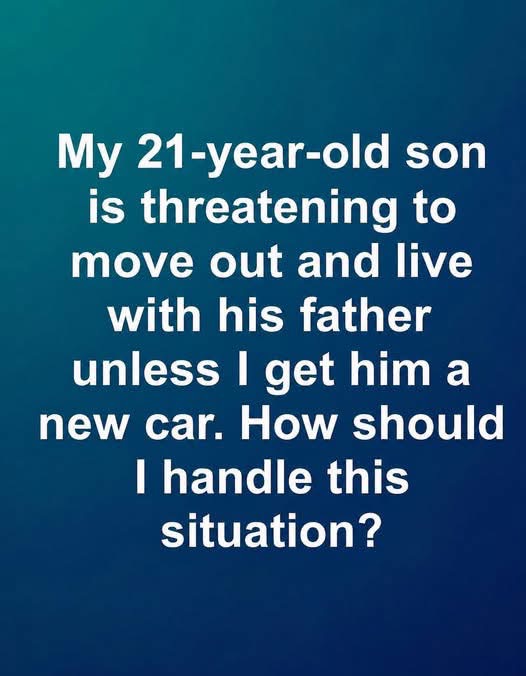
He slammed the ultimatum down like a door: **buy me a car, or I’m gone.** For a moment, the entire room seemed to shake beneath everything neither of us wanted to say—fear, anger, love, disappointment, and that quiet terror every parent feels when their child threatens to walk away. Saying yes would have been easier. I could have avoided the argument, eased the tension, and given him exactly what he wanted. But love isn’t always about making the pain disappear.
I watched my son wrestle with a truth that nearly every young adult eventually has to face: freedom isn’t something someone simply hands you. It is something you gradually earn. His demand for a car wasn’t really about metal, wheels, or getting from one place to another. It was about wanting to feel grown-up, capable, independent, and equal to his friends. I understood that feeling. I understood why the car mattered to him. But understanding his desire didn’t mean I had to surrender to the pressure behind it.
I refused to let panic, guilt, or an emotional ultimatum decide a major financial commitment.
I told him I loved him too much to confuse love with surrender.
Instead of buying the car, I offered him something different: a plan. He could save money, work part-time, consider a less expensive vehicle, and contribute toward the goal himself. We could sit down together, work out a realistic budget, and build toward the car instead of expecting it to simply appear.
He didn’t like that answer.
Not at first.
The air between us remained tense. Conversations became shorter, and there were moments when I wondered whether my boundary would push him farther away. It would have been so easy to give in just to restore peace. But I knew that if I gave him everything because he threatened to leave, I wouldn’t be teaching him independence. I would be teaching him that pressure works.
So I held the line.
And I kept loving him.
Slowly, something changed. The conversation stopped being about what I was refusing to give him and started becoming about what he could do to reach the goal himself. Instead of **“Give this to me now,”** the question eventually became, **“Help me figure out how.”**
That small change meant more to me than buying the car ever could.
Because in that moment, he wasn’t giving up on independence.
He was beginning to understand it.
Sometimes a parent’s most loving answer isn’t yes.
Sometimes it’s an honest **no**, followed by a hand held out to help them build the way forward.
**One honest “no” at a time, my son was finally learning what real freedom costs—and what it means to earn it.**