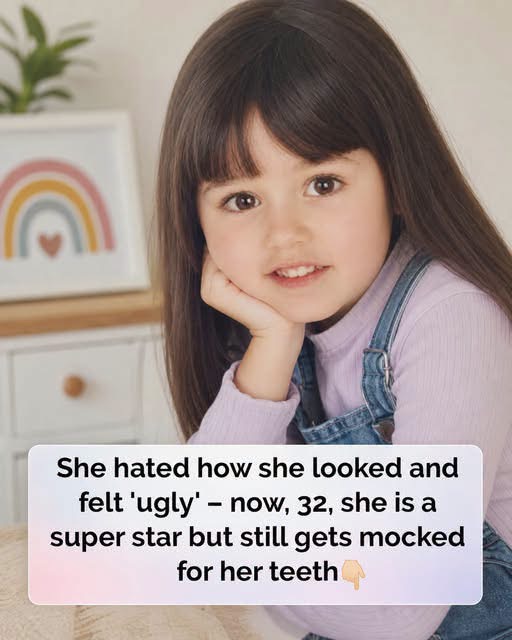
Her pain started long before the cameras ever found her.
Before the red carpets, before Netflix, before the dream roles and international recognition, Aimee Lou Wood was simply a shy, anxious girl trying to make sense of a world that often made her feel like she was somehow different. At school, classmates mocked her for her “weird” teeth, turning something as ordinary as a smile into a source of embarrassment. At home, life could feel chaotic and overwhelming, leaving her searching for some small corner of existence that she could actually control. That struggle eventually reached a dangerous place, as she battled with food and began starving herself in an attempt to regain a sense of order.
Years later, she finally broke through as an actress. Her talent carried her onto screens around the world, and Netflix helped turn her into a familiar face for millions of viewers. She had achieved the kind of success she had once only dreamed about. But fame brought an unexpected echo from her childhood. Millions of people were suddenly looking at the same feature that classmates had once laughed at. Her teeth, once a private source of insecurity, became something the public felt entitled to comment on.
Then, during a live television appearance, the joke came back in a way that felt painfully familiar.
Millions laughed at an exaggerated version of her smile. For some viewers, it was simply comedy. For Aimee, it touched something much older—the memory of being a child who had been taught, again and again, that the way she looked was something other people had the right to judge. But this time, something shifted. She was no longer the frightened girl standing alone in a classroom, wondering what was wrong with her. She was an accomplished actress who had already survived the years when other people tried to define her.
From a childhood marked by silence, anxiety, bullying, and insecurity to international fame, Aimee Lou Wood’s journey has become intertwined with the very thing people once tried to use against her. Her teeth became more than a physical feature. They became a lightning rod for public fascination, a detail strangers felt comfortable analyzing, mocking, exaggerating, and turning into entertainment.
Classmates noticed them first.
Then came audiences.
Then commenters.
Then television.
The setting changed, but the underlying message often felt painfully similar: *You are what they see.*
For years, that message had power. When you grow up hearing the same criticism repeatedly, it can become difficult to separate other people’s opinions from your own identity. A joke can begin to sound like a fact. A photograph can feel like evidence. A passing comment can stay with you for years.
Aimee refused to let that become the final chapter of her story.
Through therapy, diagnosis, and difficult self-reflection, she began understanding herself in a different way. Her anxiety, struggles with eating, and experiences of masking were not proof that she was weak or somehow broken. They were ways she had learned to survive environments that felt overwhelming. Understanding that distinction mattered. It meant she could stop treating herself as a problem that needed to be solved and start seeing herself as a person who had endured difficult things.
That shift did not happen overnight.
Healing rarely does.
It meant confronting old beliefs, recognizing patterns, and learning that she did not have to earn the right to feel comfortable in her own body. She did not have to become quieter, smaller, smoother, or more conventionally beautiful to deserve attention. And she certainly did not need to erase the features that made her recognizable in order to become successful.
Instead of “fixing” herself to fit an imagined version of Hollywood perfection, she chose another path.
She chose the work.
She chose the craft.
She chose to become a better actress, to understand her characters more deeply, and to allow her performances to speak before her appearance did. Her career became proof that audiences could connect with a person because of what she brings to a role—not because she perfectly matches an artificial standard of beauty.
And slowly, the thing that once represented shame began to represent something else.
Her gap was no longer simply a feature people noticed.
It became a symbol.
Not just of rebellion against beauty standards, but of the freedom to exist without constantly apologizing for how you look. Of refusing to let strangers turn insecurity into entertainment. Of understanding that being different does not mean being defective.
The irony is impossible to miss.
The feature people once told her to hide became one of the most recognizable parts of her image. The smile that once made her anxious became part of the face audiences associated with her talent. The thing others tried to make into a punchline became part of a much larger story about confidence, identity, and survival.
Aimee’s journey does not suggest that words stop hurting simply because someone becomes famous. They can still hurt. Public attention can still reopen old wounds, and being celebrated does not automatically erase the insecurities created during childhood.
But fame gave her something she did not have before: a platform from which to answer back.
She can no longer control what strangers say.
She can control what those words mean to her.
And perhaps that is the most powerful transformation of all.
Aimee Lou Wood does not need to become someone else to belong on screen. She does not need to hide the smile that once embarrassed her. She does not need to apologize for taking up space.
She earned that space through talent, persistence, vulnerability, and years of refusing to give up on herself.
Her gap is not a punchline anymore.
It is part of her face, part of her story, and a reminder that the things people once tried to shame us for can eventually become the very things we learn to embrace.
Not because the world suddenly became kinder.
But because she stopped allowing the world to decide who she was.