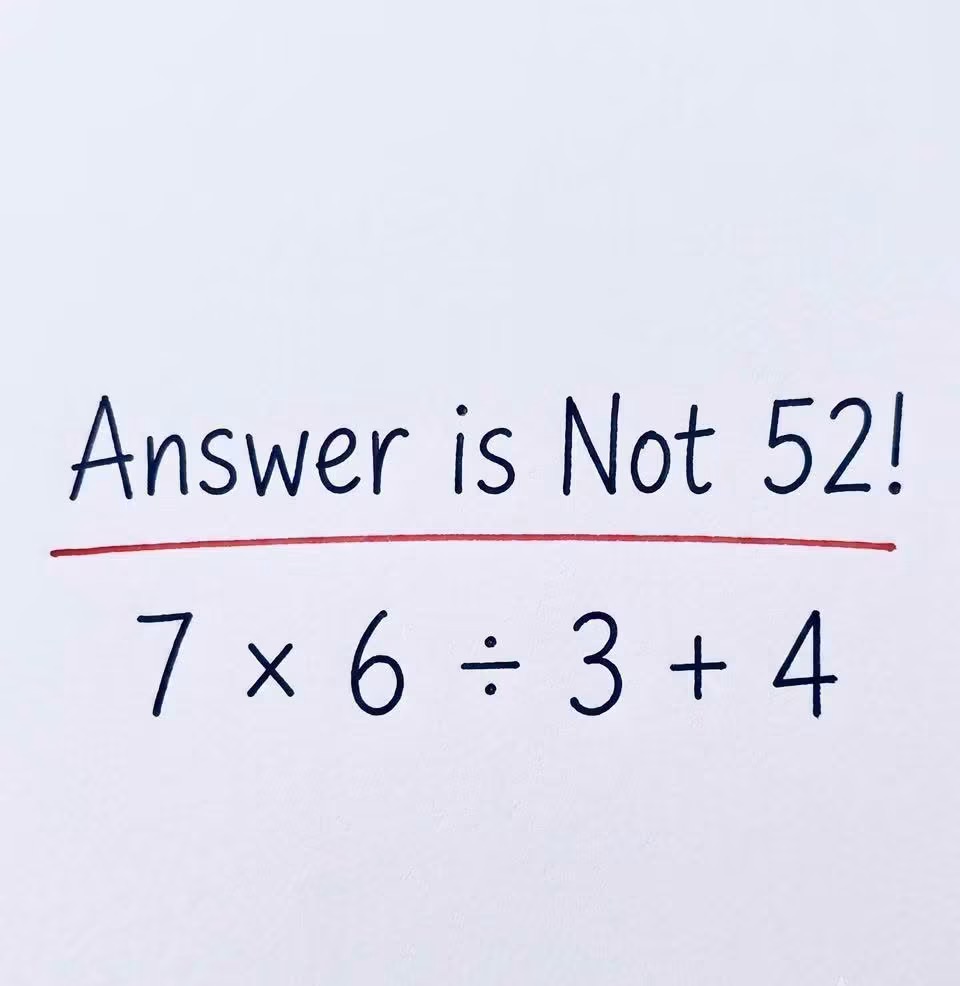
Math puzzles are a fun way to challenge the mind, practice basic arithmetic, and discover how small details can make a big difference. Some equations appear incredibly simple at first glance, yet they can lead to different answers when people overlook an important mathematical rule. One example that has attracted attention among puzzle enthusiasts is the following equation: 7 × 6 ÷ 3 + 4.
At first, you might feel tempted to calculate the numbers quickly and write down your answer. However, solving this expression correctly requires more than speed. You must understand the order of operations and apply each mathematical step in the proper sequence.
Before looking at the solution, take a moment to solve the equation yourself. Read it carefully, consider which operation should come first, and see whether your result matches the correct answer.
Understanding the Order of Operations
The order of operations is a fundamental mathematical principle that helps everyone solve expressions consistently. Without this guideline, two people could approach the same equation differently and arrive at different results.
One commonly used method is PEMDAS, which stands for Parentheses, Exponents, Multiplication, Division, Addition, and Subtraction. Another familiar version is BODMAS, which stands for Brackets, Orders, Division, Multiplication, Addition, and Subtraction.
Although the abbreviations place multiplication and division in different positions, both methods follow the same essential rule: multiplication and division have equal priority, as do addition and subtraction.
When multiplication and division appear together in an expression, you calculate them from left to right. After completing those operations, you perform addition and subtraction from left to right.
Step 1: Multiply 7 by 6.
Seven multiplied by six equals forty-two.
The expression now becomes:
42 ÷ 3 + 4
Step 2: Divide 42 by 3.
This simple distinction helps prevent common calculation errors and makes mathematical reasoning more reliable.
Challenge Your Mathematical Thinking
Puzzles like this demonstrate that even a short equation can provide an opportunity to practice concentration, logical thinking, and problem-solving skills. They are suitable for classroom activities, family discussions, or a quick mental exercise during a break.