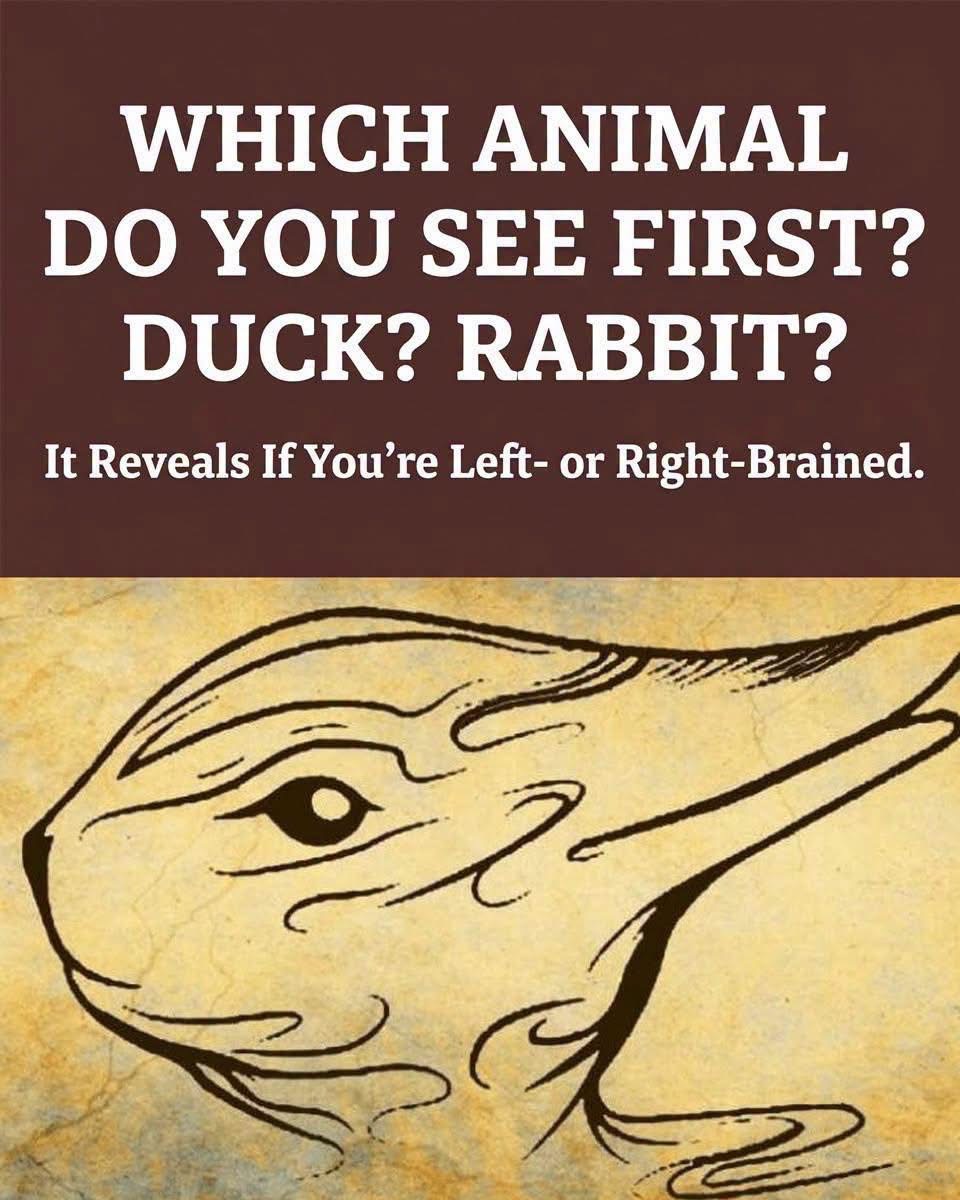
The classic rabbit-and-duck optical illusion demonstrates how differently people can interpret the same image. At first glance, some viewers immediately recognize a rabbit, while others see a duck. Interestingly, both animals are hidden within the same simple drawing.
This famous illusion has fascinated psychologists and researchers for generations because it reveals how the human brain organizes visual information. Rather than simply recording what the eyes observe, the brain actively interprets shapes using previous experiences, expectations, and attention.
Some popular interpretations suggest that people who notice the rabbit first may prefer intuitive thinking. They might focus on the bigger picture, recognize patterns quickly, and approach situations through creativity rather than detailed analysis.
Meanwhile, those who initially recognize the duck are sometimes described as logical, analytical thinkers. According to these informal interpretations, they may prefer structured problem-solving, careful observation, and examining details before reaching conclusions.
However, these personality associations are not scientifically established. Seeing one animal before the other does not reliably determine intelligence, creativity, personality, or decision-making abilities. The illusion primarily demonstrates how perception changes depending on what the brain expects to see.
One particularly interesting feature is the ability to switch between the rabbit and duck. Once viewers recognize both animals, they can often alternate between them simply by changing their attention or mentally reconsidering the image.
This process illustrates perceptual flexibility, showing how the brain can interpret identical visual information in different ways. Although switching quickly does not necessarily prove superior intelligence, it demonstrates the adaptability of human perception.
Ultimately, the rabbit-and-duck illusion reminds us that appearances are not always as straightforward as they seem. Two people can observe exactly the same image and initially reach different conclusions. By reconsidering our first impressions, we may discover alternative perspectives that were present all along. The illusion offers a simple but fascinating lesson about perception, interpretation, and the importance of keeping an open mind.