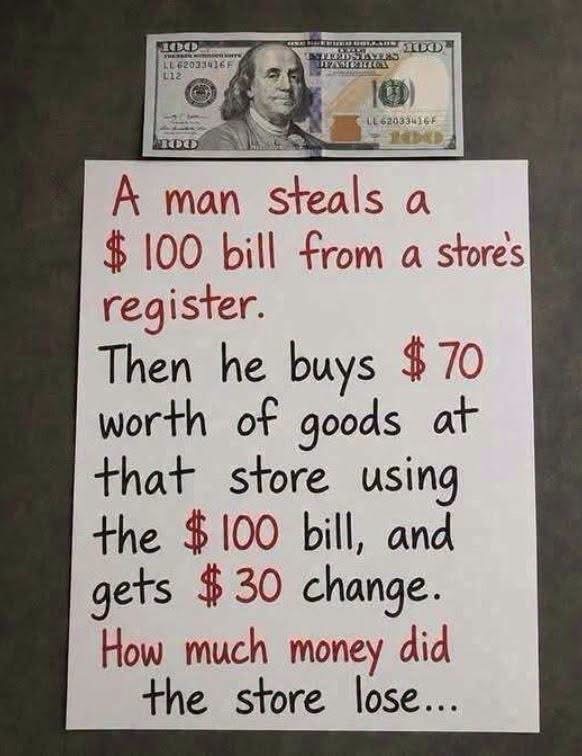
The stolen $100 bill puzzle has confused peoplefor years because the answer seems simple atfirst, but the details make it surprisingly tricky. Aman steals $100 from a store register. He thenreturns to the same store and uses that exact$100 bill to buy $70 worth of merchandise. Thecashier accepts the bill and gives him $30 inchange. The question is: how much money hasthe store actually lost?
At first, many people argue that the store lost$200. Their reasoning is that the thief initiallystole $100, then walked away with another $70in merchandise and $30 in cash. Addingeverything together seems to produce a $200loss. However, this calculation overlooks onevery important detail.
Other people believe the store lost only $100because the original stolen bill eventuallyreturned to the register. Although thisexplanation sounds reasonable, it is important tounderstand exactly what happened during thetransaction and what the thief actually tookaway.
Let’s break it down step by step. First, the thiefsteals $100 from the cash register. At this point,the store is down $100 in cash. The thief thencomes back and spends that same $100 bill onmerchandise worth $70.
When the cashier accepts the bill, the original$100 returns to the store. This means the initialcash loss is effectively canceled out. However,the store does not get its merchandise back, andthe cashier also hands the thief $30 in change.
Now consider what the thief leaves with. He has$70 worth of merchandise and $30 in cash.Together, those two amounts equal $100. That isthe total value the store has lost.
The important trick is that the original $100 billshould not be counted twice. Once it returns tothe register, it is no longer missing. Counting itas an additional loss would mean counting thesame money twice.
So, the correct answer is $100. The store loses$70 in merchandise and $30 in cash, making thetotal loss exactly $100.