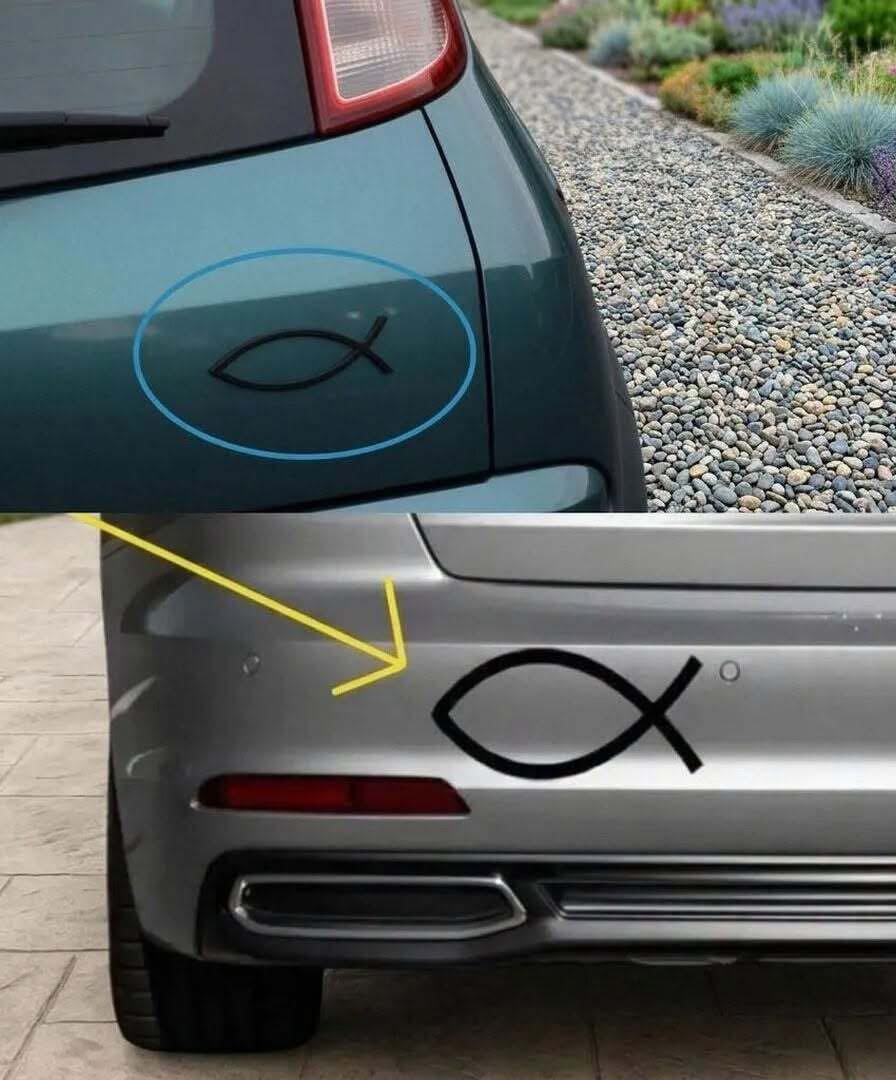
A small silver fish catches the sunlight on the back of a car, and although it looks like an ordinary decoration, its meaning reaches back nearly 2,000 years. Many drivers have spotted this familiar outline on bumpers and tailgates without knowing why people choose to display it. Known as the Ichthys, or Christian fish symbol, it has a long history connected to faith, identity, and quiet recognition. During the early centuries of Christianity, believers sometimes used the simple fish shape as a discreet way to identify others who shared their beliefs, particularly when openly expressing their religion could be dangerous. Today, the emblem appears on vehicles, jewelry, clothing, and other everyday items, but its message can be especially meaningful when seen on the road. For many owners, it represents much more than religious affiliation—it is a reminder of the values they hope to practice every day.
The symbol’s meaning becomes particularly interesting when you consider how people behave behind the wheel. A traffic jam, an impatient driver, or someone suddenly cutting into a lane can test even the calmest person’s patience. The fish emblem does not claim that its owner is always kind, forgiving, or free from frustration. Instead, it can serve as a personal reminder to pause before reacting and to treat other drivers with consideration. Someone moving slowly might be elderly, frightened, or unfamiliar with the road; another driver may be rushing because of an emergency. We rarely know what strangers are dealing with, and that small symbol encourages its owner to remember something easy to forget in stressful moments. But its message goes beyond simply being polite in traffic.
For many Christians, the Ichthys represents their faith and the teachings associated with compassion, humility, forgiveness, and respect. Its history is rooted in the early Christian community, and the Greek word Ichthys means fish. The symbol became associated with Jesus Christ and remains recognizable across Christian traditions. When displayed on a vehicle, it can quietly communicate the owner’s beliefs without requiring a conversation or public declaration. Some drivers also see it as a commitment to live according to those values outside religious settings—in workplaces, family relationships, and everyday encounters. It is not a legal badge, an insurance designation, or a claim of moral perfection; it is a personal expression of faith and accountability. And that distinction is important, because the symbol’s meaning depends on the person displaying it, not simply the decoration itself.
The next time you notice a little silver fish on the back of a vehicle, you may see it differently. For one driver, it is a connection to centuries of Christian history; for another, it is a daily reminder to practice patience and kindness, especially when circumstances become frustrating. It cannot prevent road rage or guarantee that someone will always make the right choice, but it can represent the intention to do better. Sometimes that means allowing another car to merge, resisting an angry response, or remembering that everyone on the road is trying to reach somewhere safely. The small emblem may be easy to overlook, yet the message behind it can reach far beyond the highway: character is often revealed through the ordinary choices we make when nobody is paying attention.