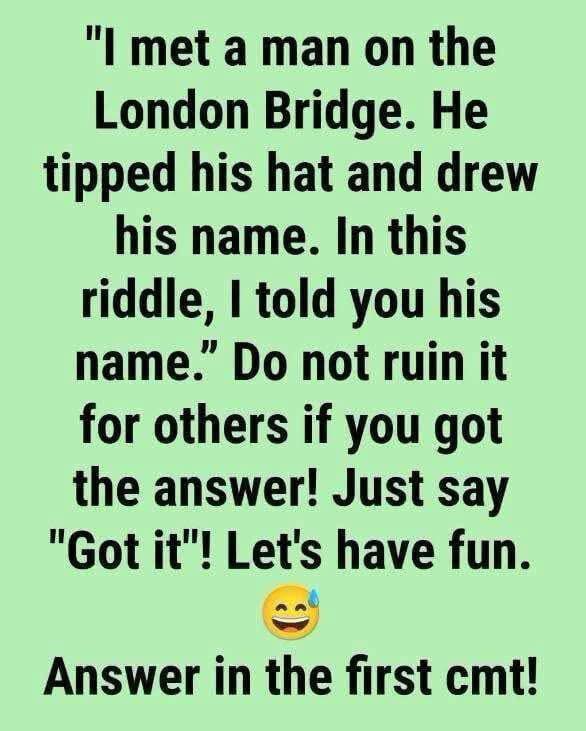
I met a man on the London Bridge. He tipped his hat and drew his name.” The encounter sounds like the beginning of a mystery, especially when the next line insists, “In this riddle, I told you his name.” But there is no missing introduction to uncover, and the bridge itself offers no special clue. The solution comes from changing how you divide the sentence, rather than imagining anything beyond it.
The man’s name is Andrew. Put “and” and “drew” together, removing the space, and the answer appears: Andrew. Read aloud, those two words can also sound like the name, making the trick particularly satisfying when someone recites the puzzle. What initially seems like an odd description of a gentleman’s actions is actually the reveal. That is the charm of this little riddle: it invites you to search for information, then shows you that you had it from the very beginning.
The puzzle starts as a short encounter on London Bridge. The narrator tells us where it happened, describes a man tipping his hat and says that his name has already been given. A first reading naturally treats the bridge as a setting and the gesture as something the stranger did. A second reading can treat the exact sounds of the sentence as part of the puzzle.
The useful stretch is the word that joins the actions and the verb immediately after it. Say those words together without emphasizing the space. The resulting sound is close to Andrew. The written version makes the move easy to check because the letters appear beside each other in the same order.
You only have to shift the boundary between words. The bridge and hat help make that boundary feel normal. They encourage a reader to imagine someone passing by and offering a greeting. In that scene, the little conjunction passes almost unnoticed.
It sounds like a simple link between one action and the next. The riddle takes advantage of precisely that ordinary reading. The phrase about drawing his name may also tempt readers to picture a signature or a drawing. Either picture sends attention away from the words themselves.
Some people tell a version in which the man draws his cane. The same answer works because the two words that hide Andrew are still side by side. You can test the trick by replacing the last noun without changing those two words. Then try the reverse.
Keep the bridge, the hat and the cane, but change the verb. The concealed name disappears. That is a useful way to see which parts of the sentence do the work. The closing line tells the listener that the name was already spoken, so the solution satisfies the promise without requiring any extra character or detail.
Once you hear it, the two readings can coexist. The first is a tiny story about a stranger on a bridge. The second is a name tucked inside the way that story was told. A listener can solve it by saying the line aloud, and a reader can solve it by tracing the letters on the page.