The human body is a remarkable result of millions of years of gradual change, shaped by environment, movement, and survival needs. While we often take our physical abilities for granted, every structure in the body carries a story about where we came from and how we adapted over time. From upright posture to finely controlled hands, human anatomy reflects an ongoing evolutionary journey. What makes this especially fascinating is that many of these changes are subtle, unfolding so slowly that they are easy to overlook in everyday life.
One of the most intriguing aspects of human evolution is that, despite our advanced technology and modern lifestyles, our bodies are still very similar to those of people who lived tens of thousands of years ago. The world around us has transformed dramatically, yet our physical form has changed only in small ways. Evolution does not rush; it works quietly across generations. Occasionally, however, we can observe signs of this process in features that are becoming less essential—structures that once served a clear purpose but are now slowly fading from common use.
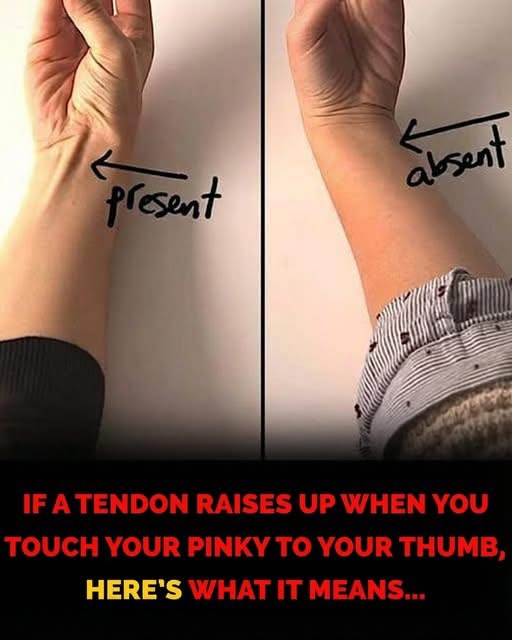
A good example of this can be found in the wrist. There is a tendon connected to a muscle known as the palmaris longus, which plays an important role in animals that rely heavily on their forearms for movement, such as primates that swing between trees. This muscle helps provide grip strength and flexibility, making it valuable for climbing and navigating branches. As species adapted to different ways of moving—particularly life on the ground—the need for this muscle diminished. In humans, who no longer depend on forearm-driven movement for survival, the tendon has become less important and is now absent in a noticeable percentage of the population.
What makes this especially interesting is that you can easily check whether you have this tendon yourself. By placing your forearm on a flat surface with your palm facing up, touching your thumb to your pinky finger, and gently lifting your hand, you may see a thin band appear in the center of your wrist. If it does, the tendon is present. If not, you are among those whose bodies no longer include it. Neither outcome affects health or strength—it simply reflects natural variation and adaptation. This small, harmless difference serves as a reminder that evolution is not just something found in textbooks or fossils. It is ongoing, personal, and sometimes visible right on our own bodies, quietly linking us to both our past and our future.