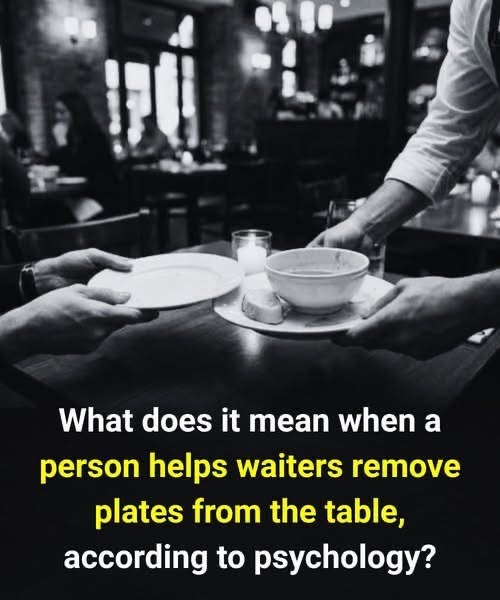
When a person reaches out to help waiters remove plates from the table—whether at a family gathering, a café, or a formal dinner—it often appears to be a small, polite gesture that barely registers in the flow of the moment. Plates are stacked, a smile is exchanged, and the meal moves on. Yet psychology suggests that even such minor actions can offer meaningful insight into personality, emotional regulation, and social preferences. Many people wonder whether this behavior signals introversion or extroversion, assuming it must align with one or the other. In reality, the answer is far more nuanced. Helping a waiter is not a simple personality giveaway but a window into how individuals manage comfort, connection, and awareness in shared social spaces. Context, motivation, and internal experience matter far more than the outward act itself.
From an introverted perspective, helping clear plates is often linked to managing social tension rather than seeking interaction. Introverts tend to be more sensitive to stimulation, including close physical proximity, unsolicited attention, and prolonged social exchanges. When a waiter stands nearby clearing dishes, an introvert may feel subtly uncomfortable remaining passive while someone else works around them. Offering help becomes a way to restore balance and reduce that discomfort. Psychologically, this behavior can serve several functions at once: it minimizes the feeling of being the center of attention, reduces the power imbalance of being “served,” and provides a clear, purposeful role in the interaction. For many introverts, usefulness equals comfort. By participating, they shorten the interaction, limit small talk, and regain a sense of control over their environment. Importantly, this gesture is rarely performative. Introverts are usually not trying to appear polite or generous to others; they are responding inwardly, using action as a tool to regulate their own emotional state and keep the social atmosphere manageable.
Extroverts, by contrast, often help waiters for almost opposite reasons, even though the behavior looks the same. Extroversion is associated with drawing energy from interaction, novelty, and engagement with people. For extroverts, helping clear plates can feel natural, even enjoyable, because it opens the door to brief conversation and shared activity. Passing dishes, making a light comment, or exchanging a smile can feel energizing rather than draining. Many extroverts see service staff not as background figures but as part of the social environment, worthy of acknowledgment and warmth. Helping becomes a way to express friendliness, teamwork, and appreciation. In some cases, extroverts also enjoy the public nature of the gesture—it reinforces their identity as approachable, considerate, and socially competent. This does not mean the behavior is insincere; rather, it aligns with their outward orientation and comfort in visible social roles. For extroverts, the act is less about easing discomfort and more about amplifying connection.
This is why the question of “who is more likely to help” ultimately misses the point. Research and observation suggest that both introverts and extroverts frequently engage in this behavior, but their motivations differ. Introverts are often driven by internal regulation: reducing pressure, avoiding awkwardness, and maintaining emotional equilibrium. Extroverts are more often motivated by external engagement: connecting, contributing socially, and enhancing the shared atmosphere. The same physical action—handing over a plate—can emerge from entirely different psychological needs. This distinction highlights a broader truth in personality psychology: behaviors are poor labels on their own. Without understanding the inner reason behind an action, it is easy to misinterpret someone’s personality. An introvert may appear socially proactive, while an extrovert may appear selfless, yet both are simply expressing their natural orientation in context-appropriate ways.
Psychologists often describe introversion and extroversion not in terms of shyness or sociability, but in terms of where mental energy is directed. Introverts tend to prioritize internal states—comfort, calm, and predictability—while extroverts orient toward external stimulation and interpersonal exchange. Helping a waiter clear plates becomes a useful illustration of this distinction. An introvert’s inner dialogue may sound like, “This feels awkward; I’ll help so it ends smoothly,” whereas an extrovert’s may be, “This is a nice moment to engage; I’ll jump in.” Neither motivation is better or more polite than the other. They simply reflect different ways of navigating the same situation. Psychology emphasizes that understanding motivation is key: two people can behave identically while experiencing the moment in completely different emotional and cognitive ways.
Beyond personality type, this gesture also signals qualities that cut across introversion and extroversion altogether. Helping clear plates often reflects empathy, consideration, and social awareness. It shows that a person notices the workload of others and responds instinctively rather than remaining detached. Such behavior is commonly associated with emotional intelligence—the ability to read situations, anticipate needs, and act in ways that support social harmony. Whether the person is easing their own discomfort or enjoying interaction, they are still acknowledging another human being’s effort. In many cultures, this small act communicates respect and equality, subtly rejecting rigid social hierarchies. It suggests someone who is attentive to the atmosphere of a room and willing to contribute to making it smoother for everyone involved.
In the end, psychology shows that helping waiters clear plates is not a reliable marker of introversion or extroversion on its own. Instead, it reveals how individuals navigate social comfort, connection, and empathy in everyday moments. Introverts may use the gesture to calm internal tension and regain balance, while extroverts may use it to express warmth and build rapport. Both paths lead to the same outward behavior, reminding us that actions are shaped by inner worlds we cannot always see. What stands out most is not the personality label but the underlying humanity of the gesture. In a world where small courtesies are often overlooked, the willingness to help—even briefly—speaks to kindness, awareness, and respect. And those qualities matter far more than where someone falls on the introvert–extrovert spectrum.