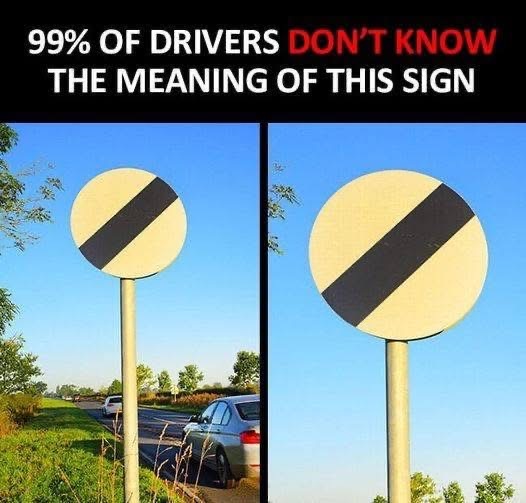
Many drivers have encountered a road sign they recognize instantly, yet still find themselves second-guessing what it actually means. A recent online discussion in the UK highlighted this familiar uncertainty, focusing on a sign that looks deceptively simple: a white circle with a single black diagonal stripe running across it.
Although it frequently appears on the driving theory test, a surprising number of motorists admitted they weren’t fully confident about its meaning once they were out on the road. The sign marks the beginning of the national speed limit, which replaces any previously posted limit. Its plain design can make it easy to misinterpret, especially when drivers expect speed signs to clearly display numbers.
Online, people joked that it meant anything from “free-for-all speed” to “go as fast as you want,” which reflects just how unclear it can feel in real-world driving situations. Others pointed out that many motorists see the sign, accelerate automatically, and assume that overtaking becomes acceptable, even when conditions don’t support it. According to the RAC, the national limit depends on both the road type and the vehicle.
Cars can travel up to 60 mph on single carriageways and up to 70 mph on dual carriageways or motorways. Larger vehicles, vans, and vehicles towing trailers must follow lower limits. In built-up areas, the standard remains 30 mph, unless signs state otherwise. Experts emphasize that speed limits are maximums, not targets. Weather, traffic, and visibility should influence the speed a driver chooses. The online debate serves as a reminder that road knowledge fades over time, and refreshing key rules can help drivers make safer decisions every day.