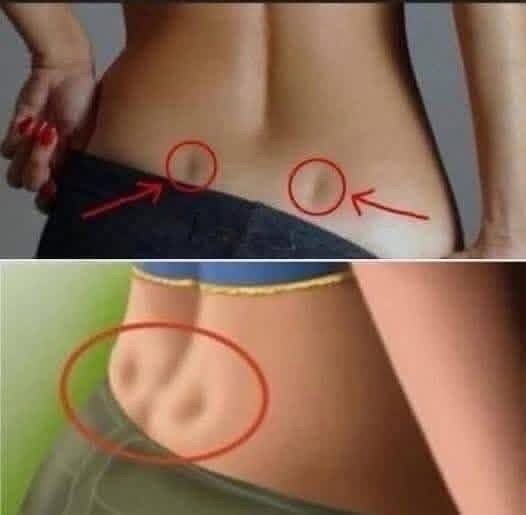
The small indentations located just above the buttocks on the lower back—commonly referred to as “dimples of Venus” in women and “Apollo holes” in men—have long captured human attention for their understated yet striking appearance. At first glance, they may seem like a minor detail, easily overlooked among the many features of the human body. Yet for those who notice them, they often stand out as a subtle marker of symmetry, balance, and natural elegance. These dimples have become widely admired not because they are dramatic or exaggerated, but precisely because of their quiet presence, gently shaping the contours of the lower back in a way that feels both natural and aesthetically pleasing.
Unlike many physical features that can be influenced or altered through exercise, diet, or lifestyle, these dimples are entirely determined by genetics. They are not the result of muscle tone, fat distribution, or physical conditioning, and they cannot be intentionally created or enhanced through training. This aspect gives them a unique status among physical traits—they are simply present or absent, inherited as part of an individual’s natural anatomical structure. Because of this, they tend to remain consistent throughout a person’s life, unaffected by changes in weight or fitness. This permanence adds to their intrigue, as they represent a fixed point in an otherwise ever-changing body.
From an anatomical perspective, the formation of these dimples is both simple and fascinating. They occur at a specific location on the lower back, where the posterior superior iliac spine—the uppermost part of the pelvic bone—lies close to the surface of the skin. In this region, a ligament connects the skin directly to the underlying bone. This connection creates a slight inward pull, forming the characteristic indentation that is visible from the outside. Because there is minimal muscle and fat covering this area, the dimples remain clearly defined and are not easily obscured. Their symmetry often mirrors the natural alignment of the pelvis, contributing to their visual appeal.
The presence of these dimples has often been associated with balance and proportion, qualities that have been valued in human aesthetics across cultures and throughout history. The name “dimples of Venus” itself reflects this long-standing association with beauty. Venus, the Roman goddess of love and beauty, symbolizes ideals of harmony and attraction, and the naming of these dimples suggests that they have been admired for centuries as a subtle yet meaningful feature. Similarly, the term “Apollo holes” for men draws on the figure of Apollo, often associated with physical perfection and artistic representation in classical mythology.
Art and sculpture provide further evidence of this enduring fascination. Throughout history, artists have paid close attention to the human form, seeking to capture not only its overall shape but also its finer details. In many classical works, the lower back is depicted with careful attention to contour and symmetry, sometimes subtly emphasizing the presence of these dimples. Their inclusion in art reflects a broader appreciation for the natural lines and proportions of the body, where even the smallest features contribute to the overall sense of harmony.
Despite their aesthetic appeal, it is important to understand that these dimples do not serve a known functional purpose. They are not indicators of strength, fitness, or health, nor do they provide any confirmed physiological advantage. Some theories have suggested that their location—near important nerves and blood vessels—might be associated with improved circulation or sensitivity in the pelvic region. Others have speculated about possible links to physical responsiveness or vitality. However, these ideas remain largely anecdotal and are not supported by strong scientific evidence. From a medical standpoint, these dimples are simply a structural feature, a natural result of the body’s anatomy rather than a marker of function.
The persistence of such theories, however, highlights an interesting aspect of human perception. People often seek deeper meaning in physical traits, especially those that are visually distinctive or culturally associated with beauty. The dimples of Venus are a perfect example of this tendency. Because they are relatively uncommon and visually appealing, they invite interpretation and speculation, becoming more than just a physical characteristic. They become symbols—of attractiveness, of uniqueness, and sometimes even of hidden qualities that go beyond the visible.
In modern culture, these dimples continue to hold a certain allure. They are often noticed in contexts where the lower back is visible, such as in fashion, photography, or fitness imagery. Their presence can draw attention not through boldness, but through subtlety, enhancing the natural lines of the body in a way that feels organic rather than imposed. This subtlety is part of what makes them so compelling—they are not designed to stand out, yet they often do.
At the same time, it is important to recognize that the absence of these dimples is just as natural as their presence. Because they are determined by genetics, they vary widely among individuals, reflecting the diversity of human anatomy. Their presence does not imply superiority, just as their absence does not imply deficiency. They are simply one of many ways in which bodies differ from one another, each variation contributing to the richness of human diversity.
This perspective is particularly important in a world where physical appearance is often subject to comparison and judgment. Features like the dimples of Venus can sometimes become idealized, leading to unrealistic expectations or unnecessary pressure. Understanding that they are purely genetic and not linked to effort or lifestyle can help shift the focus away from comparison and toward appreciation. It reinforces the idea that beauty is not a single standard, but a collection of diverse traits that vary from person to person.
The fascination with these dimples also speaks to a broader human tendency to notice and value detail. In a world filled with constant visual input, small features can take on significant meaning, capturing attention in ways that larger or more obvious elements do not. The dimples of Venus exemplify this phenomenon, showing how even the most subtle aspects of the body can inspire curiosity and admiration.
Their continued presence in cultural conversations, whether in art, media, or everyday observation, reflects their enduring appeal. They are not a passing trend, but a feature that has been recognized and appreciated across different eras and societies. This continuity suggests that their appeal is rooted in something fundamental—perhaps an appreciation for symmetry, or a recognition of the natural patterns that shape the human body.
Ultimately, the dimples of Venus offer a compelling example of how anatomy, culture, and perception intersect. They are a physical feature shaped by genetics and structure, yet they carry meanings that extend far beyond biology. They have been interpreted as symbols of beauty, admired as artistic details, and discussed as points of curiosity, all while remaining a simple and natural part of the body.
In this way, they remind us that the human body is not just a collection of functional parts, but also a source of aesthetic and cultural significance. Every feature, no matter how small, contributes to the overall picture, shaping how we see ourselves and how we are seen by others. The dimples of Venus, with their quiet presence and enduring appeal, illustrate how even the simplest details can hold lasting fascination, bridging the gap between physical form and human perception.
Whether viewed as a genetic trait, an artistic detail, or a subtle marker of individuality, these dimples continue to captivate attention. They do so not through exaggeration or spectacle, but through their natural integration into the body’s design. In a world that often emphasizes change and transformation, they stand as a reminder of the beauty that exists in what is simply given—unchanged, unforced, and quietly enduring.