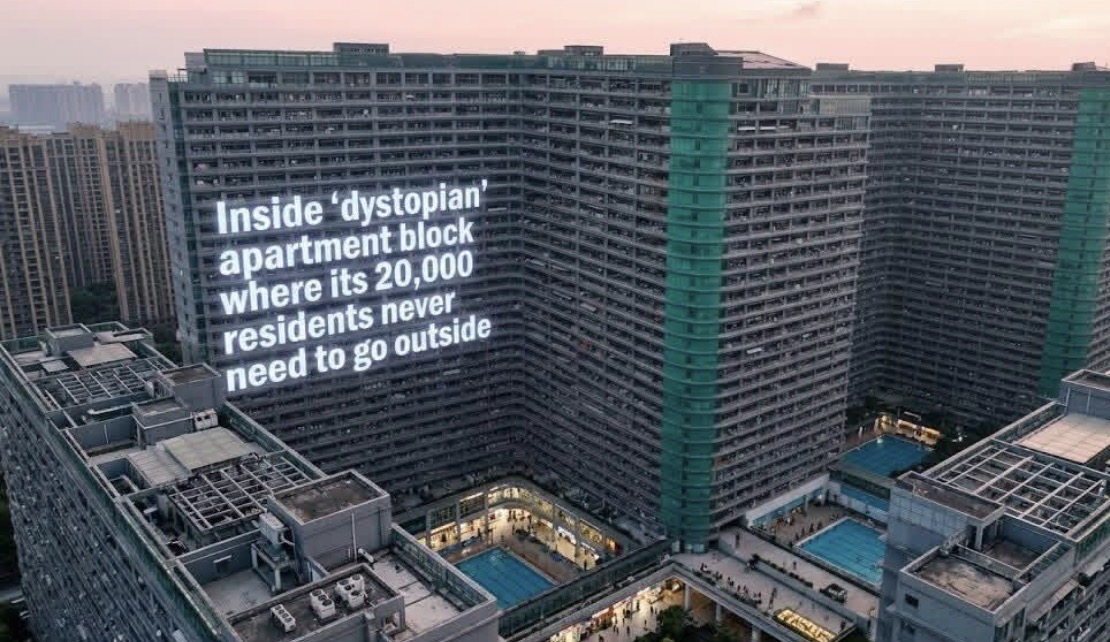
In Hangzhou, the Regent International Apartment Complex has captured global attention for its immense scale and striking design. Rising approximately 675 feet into the skyline, the building curves in a sweeping S shape, dominating the surrounding urban landscape. Designed by Alicia Loo—known for her involvement in Marina Bay Sands—the project represents one of the boldest experiments in high-density residential architecture. Built to accommodate up to 30,000 people, it stands among the most densely populated housing structures ever conceived, pushing the boundaries of how cities can vertically organize human life.
Today, nearly 20,000 residents live within this enormous structure, forming a self-contained community unlike any traditional neighborhood. Inside, the complex offers a wide range of amenities designed to meet daily needs without requiring residents to step outside. Gyms, convenience stores, salons, food courts, and small offices are all integrated into the building’s interior. The concept is simple yet radical: eliminate long commutes and make everyday life accessible within minutes, often just an elevator ride away. This model reflects a broader shift in urban development across China, where space constraints and rapid population growth are driving cities to rethink how residential environments are structured and experienced.
Supporters of Regent International argue that it represents a forward-thinking solution to some of the most pressing challenges facing modern cities. By concentrating thousands of residents into a single vertical structure, the building reduces the need for urban sprawl and helps preserve surrounding land. Advocates highlight its potential environmental benefits, noting that dense living can reduce transportation emissions and improve overall efficiency. In this sense, the complex is often viewed as a prototype for sustainable urban living—an example of how architecture can adapt creatively to the realities of population expansion while minimizing its ecological footprint.
However, critics raise important concerns about what life feels like inside such a densely populated environment. Despite the proximity of neighbors, some residents may experience a sense of isolation, as social interaction does not automatically follow physical closeness. Apartments can be relatively small, privacy may be limited, and reliance on indoor spaces is significant. These conditions raise questions about mental and physical well-being, especially when access to natural elements like sunlight, fresh air, and open green spaces is restricted. For some observers, the building’s efficiency comes at the cost of comfort and emotional balance.
While certain units include balconies or access to shared garden areas, many residents depend primarily on interior communal spaces. This has sparked a broader discussion among architects and urban planners about the meaning of livable design. Can convenience truly replace the psychological benefits of open space? Is it possible to create a sense of freedom within a structure that houses tens of thousands of people? These questions are becoming increasingly relevant as cities around the world face similar pressures. The debate extends beyond Regent International, touching on the future of housing itself and the balance between density and human experience.
Ultimately, Regent International stands as both a remarkable achievement and a complex symbol of modern urban ambition. It demonstrates how architecture can respond boldly to real-world constraints, offering innovative solutions to overcrowding and land scarcity. At the same time, it reveals the social and emotional challenges that arise when so many lives are concentrated within a single structure. As Hangzhou continues to grow and evolve, this towering complex remains a powerful reminder that the future of cities will depend not only on efficiency and scale, but also on the ability to create spaces where people can truly feel at home.