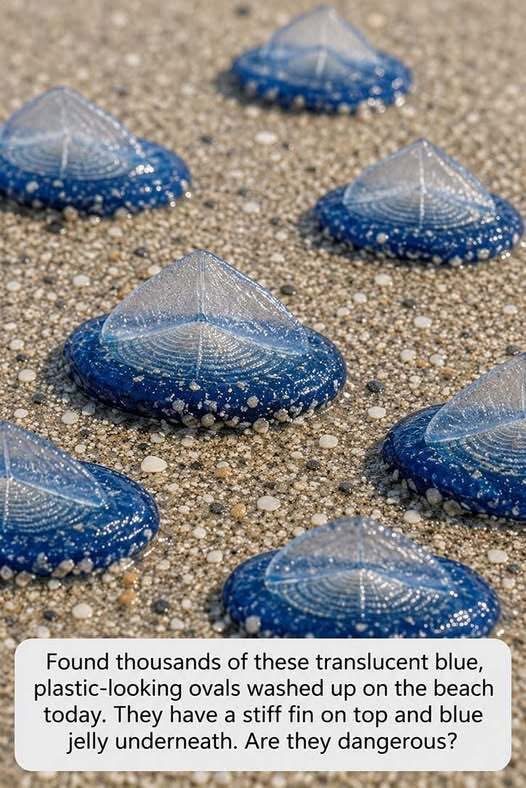
If you’ve ever walked along a beach after a powerful storm and noticed thousands of strange blue objects scattered across the sand, you probably did a double take. At first glance, they look artificial—almost like pieces of translucent blue plastic washed ashore by the tide. Their rigid, clear sails and bright blue bodies can easily convince people they are looking at marine pollution or the aftermath of an environmental disaster.
Many beachgoers react with alarm.
“What are these?”
“Are they dangerous?”
“Did a cargo ship spill plastic into the ocean?”
The truth is far more fascinating than most people expect.
Those mysterious blue creatures are known as Velella velella, commonly called “By-the-Wind Sailors,” and they represent one of nature’s most remarkable examples of survival through specialization.
The Ocean’s Tiny Sailboats
Despite their jelly-like appearance, Velella velella are not true jellyfish. They belong to a group of marine animals known as hydrozoans and are distant relatives of the famous Portuguese Man o’ War.
What makes them especially unusual is that each Velella is not a single animal at all.
Instead, every individual is actually a floating colony composed of hundreds or even thousands of tiny specialized organisms called polyps. Each polyp performs a different function. Some capture food. Others reproduce. Some help with digestion. Together they function as a single living unit, much like the organs of a human body work together to support a single person.
This cooperative structure allows them to thrive in one of the most challenging environments on Earth—the open ocean surface.
A Masterpiece of Natural Engineering
The anatomy of a By-the-Wind Sailor appears simple, but every part serves a critical purpose.
At the center is a flat, oval float filled with gas that keeps the colony perfectly buoyant. This float allows the creature to remain directly at the air-sea interface, where it can drift across enormous distances.
Rising from the center is its most distinctive feature: a transparent triangular sail.
Made from chitin—the same strong material found in crab shells and insect exoskeletons—the sail catches the wind and propels the colony across the ocean surface.
The brilliant blue coloration is equally important.
Far from being decorative, the color serves multiple survival functions. It helps camouflage the animal from predators looking down from above while also protecting it from harmful ultraviolet radiation from the sun. Living permanently at the ocean surface exposes Velella to intense sunlight, making this natural protection essential.
Nature’s Left-Handed and Right-Handed Sailors
One of the most extraordinary aspects of Velella biology is something many people never notice.
Not all Velella are built the same.
Some have sails angled to the left.
Others have sails angled to the right.
Scientists often describe them as left-handed and right-handed sailors.
This adaptation plays a crucial role in their survival. Because Velella cannot actively swim, they are entirely dependent on wind and ocean currents for movement. If every individual sailed in the same direction, entire populations could be blown onto coastlines and wiped out.
Instead, nature evolved two separate sail orientations.
When winds blow, left-handed colonies drift slightly one way while right-handed colonies drift slightly the other. This helps distribute populations across vast stretches of ocean and reduces the risk of mass extinction from a single weather event.
For most of the year, this system works remarkably well.
But occasionally nature has other plans.
Why Millions Suddenly Wash Ashore
Mass strandings of Velella typically occur during spring and summer when strong storms alter normal wind patterns.
Powerful onshore winds catch their sails and begin pushing entire populations toward land.
Because they have virtually no ability to resist the wind, millions can be driven onto beaches within a matter of days.
The result is one of the ocean’s most spectacular natural events.
Entire coastlines can become covered with a shimmering blue blanket stretching for miles.
To unsuspecting visitors, the sight can look alarming.
In reality, it is simply a dramatic reminder of how strongly weather influences life in the marine environment.
Are They Dangerous?
This is the question almost everyone asks.
Because Velella are relatives of the Portuguese Man o’ War, many people worry that touching one could cause severe pain.
Fortunately, the answer is reassuring.
Velella do possess tiny stinging cells known as nematocysts, which they use to capture microscopic plankton and other tiny prey drifting through the water.
However, these stinging cells are extremely weak compared to those of their infamous cousin.
For most people, touching a Velella with intact skin causes little or no reaction at all.
Still, caution is recommended.
The toxins can remain active for a short period after the animals wash ashore. If someone handles a fresh specimen and then touches their eyes, nose, lips, or another sensitive area, they may experience irritation, burning, or mild pain.
For that reason, marine experts recommend observing them rather than handling them directly. If curiosity wins out, wearing gloves is a smart precaution.
What Happens After They Reach Shore?
Once stranded on the beach, Velella face a harsh environment.
Unable to return to the ocean on their own, they quickly begin drying out under the sun.
Within a few days, their vibrant blue color fades. Their soft tissues disappear, leaving behind only thin, transparent shells scattered across the sand.
Eventually, even these remnants break down and return to the environment.
The dramatic blue invasion that seemed impossible to ignore vanishes almost as quickly as it appeared.
A Reminder of Nature’s Complexity
Mass Velella strandings often leave a lasting impression on those fortunate enough to witness them. They serve as a reminder that some of the most extraordinary events in nature happen quietly, without headlines or warning.
What looks like pollution is actually a living colony.
What appears to be a simple jellyfish is actually a highly organized community of organisms.
And what seems like a disaster is often nothing more than nature following ancient patterns shaped by evolution, wind, and ocean currents.
The next time you spot thousands of blue sails scattered along a shoreline, take a closer look.
You may not be seeing debris at all.
You may be witnessing one of the ocean’s most remarkable travelers finally reaching the end of an extraordinary journey across the sea.