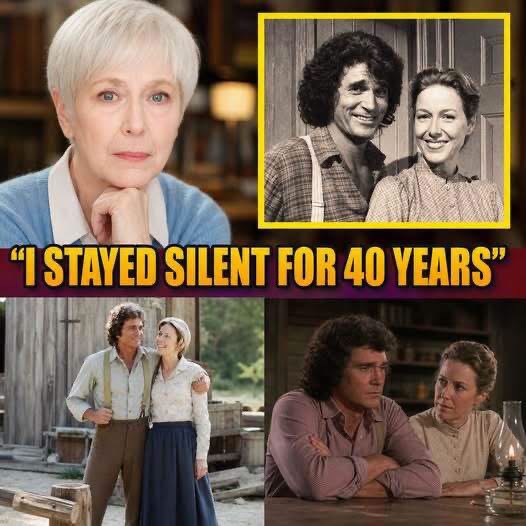
Karen Grassle kept quiet for decades.
The woman who became known around the world as Caroline Ingalls has finally opened the door on a part of her life that existed far away from the warm, wholesome image audiences saw on television. Behind Michael Landon’s reassuring smile, the sunsets, the prairie fields, and the carefully constructed family values of *Little House on the Prairie*, Grassle says there was another reality—one involving power struggles, unequal pay, uncomfortable behavior, and private humiliations that never made it onto the screen.
For generations, viewers believed in the gentle myth of Walnut Grove. It was a place where families faced hardship together, where moral lessons arrived before the closing credits, and where Charles and Caroline Ingalls represented a kind of old-fashioned goodness that seemed increasingly rare.
But the wholesome prairie was a set.
The pain was not.
For years, Grassle allowed the public to hold onto the comforting version of the story, even as she carried memories that didn’t fit the glow of those sunset-lit fields. She didn’t immediately turn every painful experience into a public accusation. Instead, she continued living with the complicated reality of having been part of one of television’s most beloved shows while also feeling that the environment behind the scenes could be deeply difficult.
Her memoir gave her the opportunity to tell that story in her own words.
Grassle describes walking onto a set where Landon’s authority was enormous. He wasn’t simply the star. He was deeply involved in the machinery of the series, writing, producing, directing, and exercising significant influence over the world being created around him. His position gave him power over creative decisions, working relationships, and, ultimately, the careers of people who depended on the production.
Grassle occupied an unusual position herself.
As Caroline Ingalls, she was the emotional center of the family and one of the show’s most important characters. She carried dramatic scenes, delivered moral conversations, and helped establish the warmth that made the Ingalls family so beloved.
Yet behind the scenes, she says, the recognition did not always match the responsibility.
One of the most painful issues was money.
Grassle discovered that she was being paid substantially less than male colleagues, despite carrying major responsibilities and appearing in significant portions of the series. The realization was more than disappointing. It forced her to confront a difficult question that many women in the entertainment industry faced at the time:
What was her work actually worth?
When she dared to ask for greater pay parity, according to her account, the atmosphere changed.
The warmth disappeared.
Scripts became smaller.
Distance grew.
The consequences were not necessarily delivered through one dramatic confrontation. Sometimes power operates more quietly. A scene disappears. A character gets less to do. A conversation becomes colder. A person who once seemed essential begins to feel replaceable.
And that can be just as devastating.
Grassle’s recollections also describe a behind-the-scenes culture that could feel very different from the moral universe presented to viewers. Off-color jokes, drinking, and a boys’ club atmosphere created a contrast that was difficult to reconcile with the wholesome messages being delivered to millions of families each week.
On television, the characters preached responsibility, compassion, faith, and family.
Behind the cameras, Grassle says, the adults creating those lessons were dealing with a much messier reality.
That contradiction is part of what makes her story so compelling.
She does not present Landon as a simple cartoon villain. Her account is more complicated than that. She describes a man with enormous talent and charisma whose need for control could repeatedly collide with the dignity and autonomy of the people around him.
That distinction matters.
People can create beloved art and still behave in ways that hurt others.
They can inspire millions of viewers while making colleagues feel powerless.
They can leave behind a cultural legacy that is genuinely meaningful while also leaving complicated memories in the people who worked beside them.
Those truths can exist at the same time.
For fans, that can be uncomfortable.
It is easier to separate a beloved television show from the people who made it. We grow up with characters who feel almost like relatives. We remember their voices, their struggles, their homes, their jokes, and the lessons they taught us. Over time, the actors can disappear behind the characters they played.
Karen Grassle spent years being identified with Caroline Ingalls.
But Caroline was a character.
Karen was a person.
And the person behind the character had her own story.
By finally telling it, Grassle wasn’t necessarily asking audiences to throw away everything they loved about *Little House on the Prairie*. She was asking them to understand that the beauty seen on screen did not erase what happened behind the scenes.
The show can still mean something.
The memories can still be warm.
The characters can still matter.
And Grassle’s pain can still be real.
Those ideas do not cancel one another out.
In fact, acknowledging both may make the history more honest.
For decades, women in entertainment were often expected to tolerate unequal treatment quietly, particularly when they were fortunate enough to be part of a successful production. Speaking up could mean being labeled difficult. Asking for equal pay could be interpreted as disloyalty. Challenging a powerful star or producer could put an entire career at risk.
Grassle’s experience reflects that complicated reality.
She had something audiences wanted to keep watching, but she also had something she eventually wanted for herself: respect.
And respect is not the same thing as fame.
A person can be celebrated by millions and still feel diminished in the room where the decisions are made.
That may be one of the most important parts of her story.
Her memoir doesn’t simply reopen an old Hollywood controversy. It reminds audiences that entertainment history is usually told from the perspective of what appeared on screen. The credits list names. The ratings measure success. Awards celebrate performances.
But none of those things tell you what it felt like to walk onto the set every morning.
They don’t tell you who felt heard.
Who felt ignored.
Who had the power to say no.
And who didn’t.
By speaking now, Grassle restores something that had been missing from the story: her own perspective.
She can acknowledge Landon’s talent without surrendering her experience. She can recognize the importance of the show without pretending everything behind the scenes was equally beautiful. And she can allow audiences to hold onto the memories of Walnut Grove while refusing to carry the burden of protecting an image that no longer reflects what she remembers.
That is not bitterness.
It is ownership.
For years, the world knew Caroline Ingalls as a woman who held a family together through hardship. Now, decades later, Karen Grassle has demonstrated a different kind of strength—one that comes from finally telling the truth as she experienced it.
The prairie was fictional.
The family was fictional.
The moral lessons were scripted.
But the woman who helped make that world believable was real.
And her memories belong to her.
Fans can still love *Little House on the Prairie*. They can still remember the warmth, the family bonds, and the moments that shaped generations.
But they no longer have to pretend that the people who created that warmth were living inside the same perfect world.
Grassle’s story asks us to do something harder than simply choosing a hero or a villain.
It asks us to accept complexity.
To understand that nostalgia can be beautiful without being complete.
And to recognize that sometimes, after decades of silence, telling your own story is the final way of taking back the dignity you were once asked to surrender.