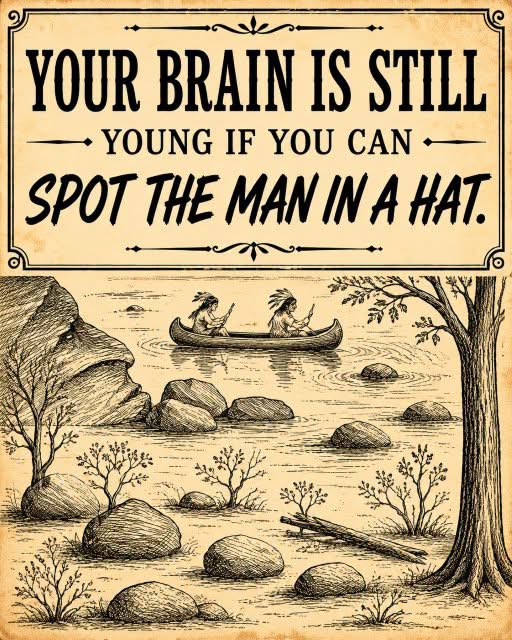
At first glance, there seems to be nothing unusual about this old-fashioned landscape illustration. A quiet stretch of water, scattered rocks, fallen trees, and patches of dry ground create the appearance of a peaceful countryside scene. In the distance, two people are paddling a small canoe across the water. Everything looks perfectly ordinary, almost like a painting from another time. But something unusual has been hiding in the picture all along, and many viewers overlook it during their first few attempts. The challenge is simple: can you discover what the artist secretly placed among the natural shapes?
Take a closer look before moving on. The trick isn’t to search for an actual person standing behind a tree or sitting among the rocks. Instead, try looking at the entire illustration rather than focusing on individual objects. Turn your attention to the outlines, shadows, and unusual curves scattered throughout the landscape. Some shapes may seem unrelated at first, but their arrangement creates a much larger image. Once you begin noticing how the different elements connect, you may find yourself looking at the picture in an entirely different way. And the hidden detail is much more surprising than it first appears.
The mystery is the face of a man wearing a hat, cleverly incorporated into the landscape. His forehead, eyes, nose, cheeks, and jaw are formed by the outlines of rocks, shadows, and surrounding natural features. Even the shape of his hat blends into the scenery, making the portrait difficult to recognize when viewed casually. The artist has used the landscape itself to construct the appearance of a human face without drawing a separate figure. This technique is known as a hidden-image optical illusion, where one picture contains another that only becomes recognizable after careful observation. The challenge is particularly interesting because the same shapes that initially look like ordinary scenery suddenly appear to form a recognizable portrait. Rather than adding obvious facial features, the artist relies on the viewer’s ability to connect visual patterns.
There is a reason these puzzles can be surprisingly difficult. The human brain naturally organizes visual information into familiar objects and patterns. When we see rocks, trees, and water, we tend to recognize them as separate elements instead of immediately searching for another image hidden within them. This makes optical illusions an entertaining way to explore perception, attention, and visual interpretation. Once someone points out the man’s face, however, it can become difficult to look at the illustration without noticing it again. So take another look and see whether you can find his features without help. Did you spot the man wearing the hat on your first attempt, or did you need a second look?