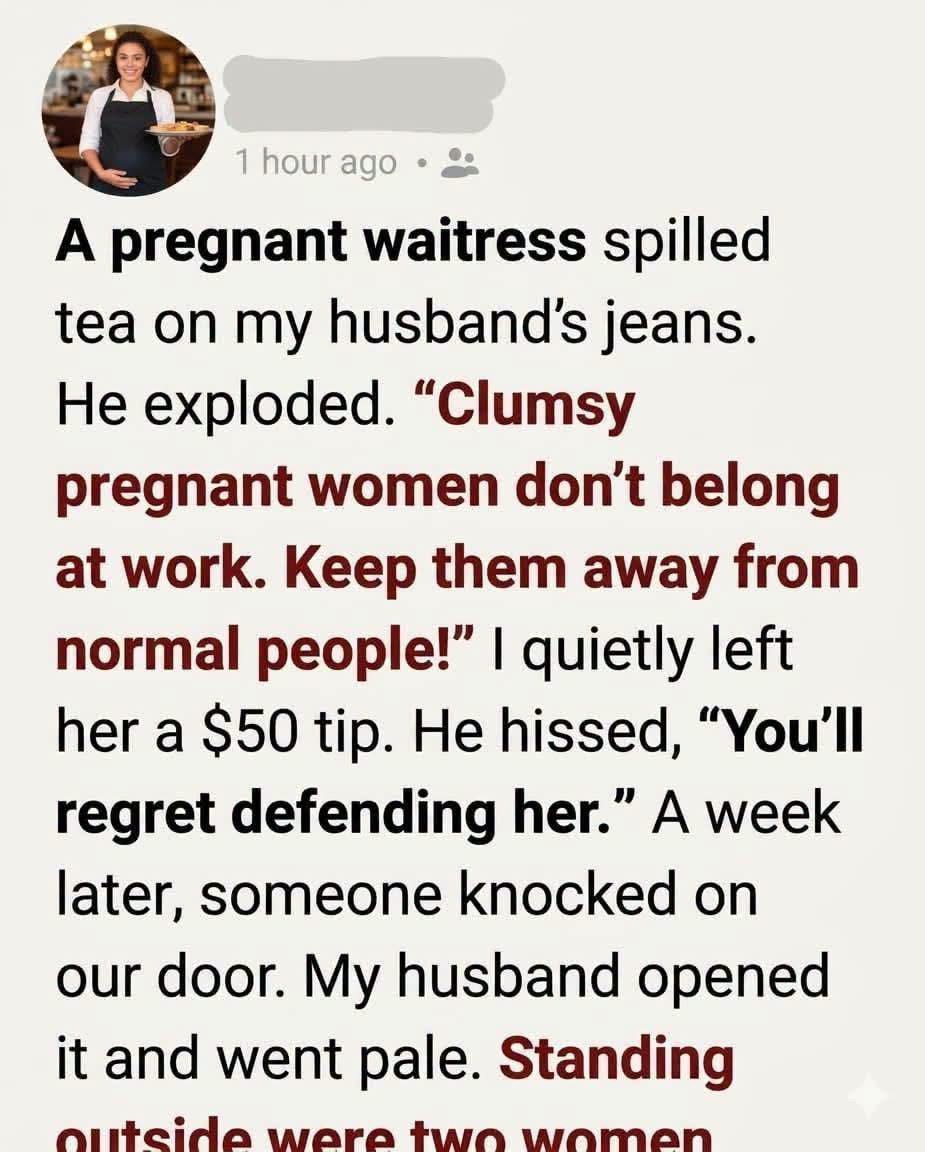
A spilled cup of tea should have been forgettable – an awkward accident, a brief apology, maybe an embarrassed laugh before dinner continued. But that night, in the middle of a crowded restaurant, it became something far heavier. The tea splashed across George’s designer jeans, leaving a dark stain that spread quickly through the expensive fabric. His reaction was instant, sharp, and far too loud for the situation. Chairs turned. Conversations paused. The clatter of glasses and silverware seemed to fade as his voice rose above everything else.
The waitress stood frozen beside the table, clutching a towel with trembling hands. She looked young, tired, and visibly pregnant, her exhaustion written plainly across her face. She apologized once, then again, each word more strained than the last, as if she hoped sincerity alone might calm him. But George did not want calm. He wanted an audience. He wanted the room to understand that he had been inconvenienced, that something precious of his had been ruined, and that someone else should bear the full weight of his outrage.
His words came fast and cold. He mocked her apology. He snapped at the way she moved. He dismissed her as careless, incompetent, and unfit for the job. The cruelty of it was worse than the volume. Anyone could have been angry in the first second after being burned or startled, but this was not startled anger. This was chosen humiliation, deliberate and public. The kind that does not just punish a mistake, but tries to reduce a person in front of strangers.
I sat there stunned, feeling the air in the restaurant change. People were no longer simply watching an unpleasant scene. They were witnessing something intimate and ugly: the moment when annoyance becomes contempt, and contempt becomes performance. Evelyn – I would learn her name only later – did not argue back. She did not defend herself or match his tone. She simply stood there, absorbing every word, her face tightening with effort as she tried to remain professional while being stripped of dignity.
Something in me shifted as I watched her. It was not only anger at George, though there was plenty of that. It was the sudden clarity of seeing him in a light I had managed, until then, not to fully face. There are moments when a person’s character reveals itself not through grand decisions, but through small situations where they believe there will be no consequences. A delayed order. A missed call. A stain on a pair of jeans. In those moments, the mask drops. What remains is not polished or strategic. It is instinct. And George’s instinct, when someone vulnerable made a mistake, was cruelty.
I tried to interrupt, to lower the temperature before it got worse. I told him it was enough. I said she had apologized, that it was an accident, that he was making too much of it. But he brushed me off with the same dismissive arrogance he aimed at her. My words barely registered. He was too committed to his own performance, too convinced that his anger justified whatever came next. Then, with one final cutting remark, he stormed away from the table and out of the restaurant, leaving behind a silence so complete it felt almost staged.
I stayed.
I could not undo what had happened, and I knew that. There is no perfect sentence that restores dignity after someone has tried to take it from you in public. But leaving without acknowledging it felt like joining him in the harm. So I stayed long enough to speak quietly to Evelyn. I told her I was sorry for what she had just endured. I told her she had done nothing to deserve that. I offered what little support I could – a kind word, a tip, the basic recognition that she was a human being and not a target for someone else’s ego. She thanked me with the weary politeness of someone too exhausted to do anything else, and I left thinking the moment, however awful, had ended there.
A week passed.
Like most painful scenes, it began to settle into memory – sharp in detail, but increasingly sealed off from the present. I thought about it more than I expected to. Not only because of what happened to Evelyn, but because I could not stop replaying George’s face as he spoke to her: the confidence, the entitlement, the certainty that he could behave that way and walk away untouched. Still, life has a way of moving forward even when certain moments remain unresolved. Days passed. The tension faded outwardly. Nothing more was said.
Then came the knock at the door.
George answered it with the casual confidence of someone who assumes every threshold belongs to him. But the moment he saw who was standing there, that confidence fractured. Evelyn was on the doorstep, standing straighter than she had in the restaurant, composed now in a way that made her seem almost transformed. But she was not alone. Beside her stood another woman, impeccably dressed, calm, and unmistakably familiar.
George knew her instantly.
Claire Whitman.
Her face was one he had seen on company leadership pages, in internal announcements, in the polished professional spaces where status is carefully managed and power is never accidental. She was his boss. Not a distant executive in name only, but someone whose judgment mattered directly to the course of his career. And in the second he recognized her, I watched the change move through him almost physically. His posture adjusted. His expression tightened. The easy arrogance that had filled the restaurant evaporated, replaced by something far less stable: fear disguised as formality.
The man who had barked at a pregnant waitress for staining his jeans now stepped back and invited them in with careful politeness. His voice lowered. His movements softened. Every instinct that had once pushed him toward dominance now pushed him toward self-preservation. It was startling, not because people adapt to power – everyone knows they do – but because the contrast was so clean. The cruelty from the restaurant had not come from strength at all. It had come from the assumption that the person in front of him had none.
Inside the house, the atmosphere shifted in a way that felt almost symbolic. The walls that had always protected his private self no longer seemed to offer shelter. What had happened in public, which he had likely dismissed as temporary and unimportant, had not disappeared when he walked away from it. It had followed him home. Not as gossip, not as vague reputation, but as consequence made flesh: the woman he humiliated, standing beside the woman whose opinion could alter his future.
No one had to raise a voice this time. That was part of what made the moment so powerful. The restaurant had been full of noise – clattering dishes, murmuring strangers, George’s anger filling every available space. But here, there was a quieter kind of authority. Claire did not need to humiliate him to make the point. Evelyn did not need revenge. Their presence alone rearranged the balance in the room. The power George had relied on so casually in the restaurant had dissolved, and in its place stood accountability.
What happened next mattered less than that transformation itself. Whether the conversation was brief or devastating, whether it led to formal consequences or a deeper reckoning, one truth had already become unavoidable: the people we demean in passing do not cease to exist when they leave our sight. Their dignity is not ours to measure, and the spaces in which we feel most untouchable are often the very places where character is being recorded most clearly.
That was what made the moment unforgettable. Not simply that George was confronted, but that he was forced to experience, however briefly, the same helplessness he had imposed on someone else. In the restaurant, he held all the social power and used it carelessly. At home, with Evelyn and Claire standing in his doorway, he discovered how quickly that arrangement could reverse.
A small accident had set everything in motion. A spilled cup of tea. A stained pair of jeans. The kind of incident most decent people would have brushed off within minutes. But because George chose cruelty over grace, the moment became something larger – a reckoning not created by fate, but by his own behavior. What followed was not random. It was consequence, arriving with perfect timing and a familiar face.
And in that quiet, charged space inside the house, one lesson became impossible to ignore: the way people treat those they believe are powerless tells the truth about them. Eventually, that truth finds its way home.