Skip to content

Daily News

  • Home
  • Sample Page
  • Toggle search form

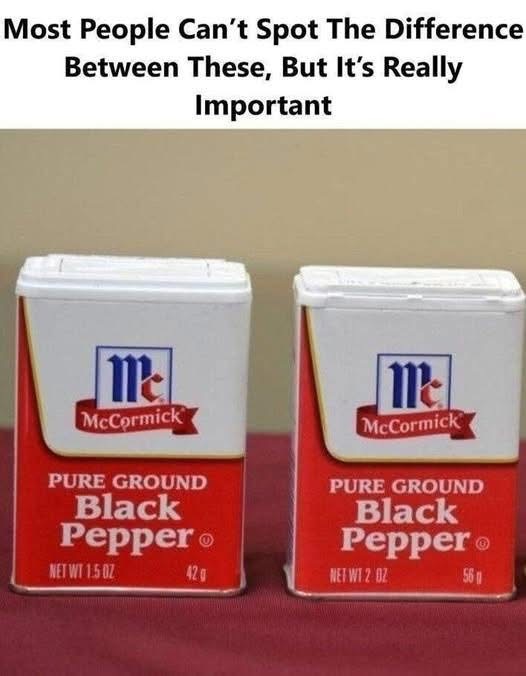
Many people cannot tell the difference between these things, but it is very important.👀⬇️

Posted on April 28, 2026 By admin No Comments on Many people cannot tell the difference between these things, but it is very important.👀⬇️

In a crowded retail environment, consumers are often asked to decide quickly, guided less by careful comparison than by what their eyes register first. Packaging, shape, and shelf presence quietly steer choices, especially when time and attention are limited. Small design decisions—barely noticed in isolation—can meaningfully affect how value is perceived. A recent legal dispute in the spice aisle illustrates how those subtleties can become consequential.

The case centers on McCormick & Company and a smaller competitor, Watkins Incorporated. Watkins alleges that McCormick reduced the amount of pepper in one of its popular containers—from roughly eight ounces to closer to six—while keeping the exterior packaging largely unchanged. The result, Watkins argues, is a visual continuity that may suggest to shoppers they are purchasing the same quantity as before.

A key point of contention is visibility. Watkins sells pepper in clear containers, allowing customers to see the contents directly. McCormick’s containers, by contrast, are opaque. Although both brands now offer similar quantities, McCormick’s packaging appears larger and more substantial on the shelf. Watkins contends that this difference in presentation creates a misleading impression, one that advantages shelf presence over transparency.

For consumers, the issue is not only financial but perceptual. Many shoppers intuitively associate larger containers with better value, especially in routine purchases where habits replace scrutiny. When products are placed side by side, visual cues can outweigh label details, quietly shaping decisions without deliberate intent.

McCormick maintains that its packaging complies with labeling requirements and that net weight is clearly disclosed. Critics counter that companies understand how consumers actually shop—often quickly, often visually—and that design choices are rarely neutral. Several class-action lawsuits have echoed this concern, arguing that the change crossed from efficiency into deception.

Beyond legal arguments, the dispute points to a broader issue of trust. Brands are sustained not only by compliance, but by the confidence customers place in them over time. Even lawful changes can erode credibility if shoppers feel misled rather than informed.

The McCormick–Watkins case is ultimately less about pepper than about perception. It raises a quiet but important question for modern commerce: whether transparency should be measured solely by what is printed, or also by what is implied. In markets built on long-term relationships, that distinction can matter as much as the product itself.

Uncategorized

Post navigation

Previous Post: See how they steal your voice: three words you should never say over the phone to avoid scams. 😱😱… See more details in 1st comment 👇
Next Post: Doctors reveal that eating avocado causes… see below 👇👇

Leave a Reply Cancel reply

Your email address will not be published. Required fields are marked *

Recent Posts

  • I found this tiny white stick in my son’s room and was too embarrassed to ask him does anyone know what it is?
  • Why Some Women Grow Distant from Their Husbands as They Get Older …The Reasons May Surprise You Check in comment 👇
  • A homeless man held up a sign that read, “Marry me. I have only one month left to live” — I agreed out of pity, but the letter I received after his funeral made the blood drain from my face. I passed Larry every morning on my way to the office. He was a quiet, respectful homeless man who usually sat outside my subway stop. Over the past two years, we’d developed a simple routine. I’d bring him a black coffee, and we’d talk about the weather for a few minutes before I hurried off to work. But on a freezing Tuesday morning last month, he wasn’t asking anyone for spare change. Instead, he was holding a piece of cardboard that read: “Marry me. I have only one month left to live.” I stopped and crouched beside him, handing him his usual coffee. “Larry, what is this?” I asked, confused. He looked awful—paler than normal, his hands shaking as he took the cup. “The clinic gave me a month,” he said hoarsely, staring down at the pavement. “Liver failure.” “I’m so sorry,” I whispered, completely caught off guard. “But… marriage?” “I just don’t want to die as a John Doe, Sarah,” he said quietly, his eyes filling with tears. “I want to belong to someone on paper. I want someone to claim my ashes instead of letting the city put me in an unmarked grave.” I’ve always been more empathetic than was probably good for me. I was single, practical, and my heart broke for him. Two days later, we went to the city courthouse and signed the papers. It wasn’t a real marriage in the traditional sense. It was simply a legal arrangement to give a dying man some dignity. Exactly three weeks later, Larry passed away in a state hospice facility. Yesterday, when I checked my mail, I found a thick envelope waiting for me, postmarked the day before he died. I sat down at my kitchen table and unfolded the handwritten pages, fully expecting a sweet and heartbreaking thank-you letter. But by the time I finished reading the first few sentences, all the color had drained from my face. I know you’re curious to see what happens next, so please be patient and continue reading in the comments below. Thank you for understanding the inconvenience. Please leave a “YES” below and give us a Like to get the full story
  • Check below
  • The White Cloth in Car Windows …A Little-Known Road Signal and What It Really Means FIND OUT MORE IN THE COMMENTS ⬇️

Recent Comments

No comments to show.

Copyright © 2026 Daily News.

Powered by PressBook WordPress theme