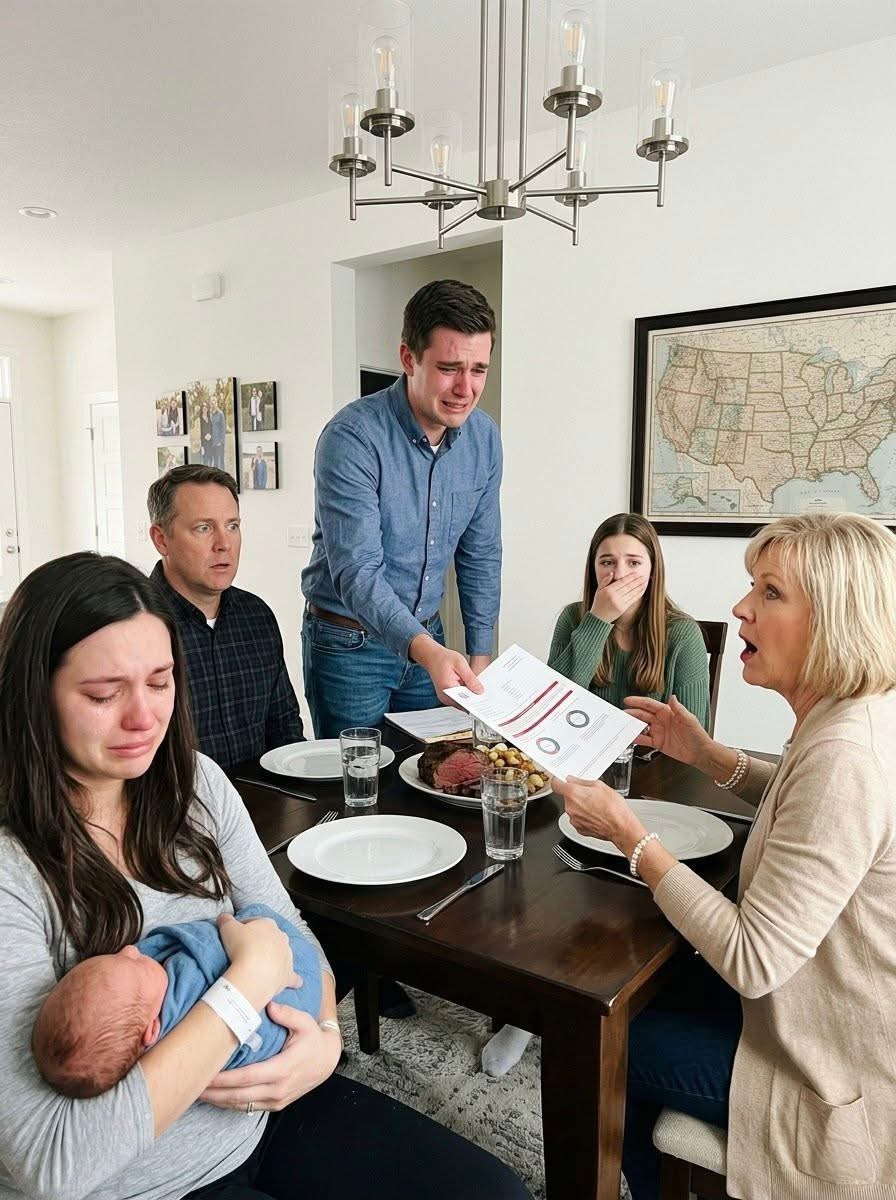
I was still wearing the hospital wristband when Marlene brought the envelope to Sunday dinner.
Three weeks had passed since the emergency C-section, and the plastic band kept catching the tender skin on the inside of my wrist whenever I shifted Noah against my chest. I had not taken it off. I am not sure why. Maybe because removing it felt like closing a door on something I was not ready to stop thinking about.
The dining room smelled like roast beef and rosemary and the particular warm-starch smell of good potatoes, but underneath all of it was something else, something metallic and sour that I had been carrying since the afternoon a nurse in the maternity ward lowered her voice and told me, carefully, that my mother-in-law had been seen near my newborn’s bassinet with a cheek-swab kit.
I had thought at first that I misheard her. I was still partially numb from the surgery. My body felt like it belonged to someone else, someone older and more tired and less certain about everything. Daniel had been with me all that morning, bringing ice chips, adjusting the pillow behind my back, watching the monitor with a focused attention that was his particular way of loving me under stress. He was a man who coped by watching, by making sure the small mechanical world of beeping machines and IV lines was behaving correctly, because watching those things was something he could actually do.
Then Marlene had disappeared, and we did not notice immediately because there was so much else to notice.
The nursery visitor log showed her signing in at two fourteen in the afternoon under the word grandmother, written in the neat, satisfied cursive she used for everything. Five minutes later, a nurse found her standing at Noah’s bassinet with a testing kit from a private diagnostics company tucked into her purse. Not hidden exactly, just not presented either, the way you carry something when you know you are doing something wrong but have decided the wrongness is someone else’s problem to deal with.
The nurse who told me later had a careful way of speaking, choosing words like concerned and inappropriate and protocol, but I could see in her face what she actually thought, which was the same thing I thought, which was that someone had looked at my two-day-old son and decided his cheek belonged to her suspicion.
When Daniel confronted his mother that same evening, she did not deny it. She sat in our hospital room with her pearl bracelet resting perfectly against her wrist and told us that a mother knows when something is wrong. That was the sentence. Not an apology, not an acknowledgment that she had done something no reasonable person would do to a newborn and his mother who had just come out of surgery. Just a small crown placed on top of cruelty, as if calling herself a mother transformed what she had done into something protective.
Daniel told her she had no right. She arranged her face into the wounded expression she had been using for the seven years I had known her, the one that meant she considered herself the real victim in any room where she was being held accountable.
I had met Marlene when Daniel and I had been together for about four months, at a family dinner she hosted with obvious effort and a particular kind of graciousness that had edges in it if you knew where to look. I had been prepared to like her. I had wanted to like her, because I loved Daniel and because I was the kind of person who believed, for a long time, that relationships with difficult people could be improved with patience and goodwill.
At our wedding, she smiled through every photograph and told three of her relatives, in the soft conspiratorial voice she used when she wanted to be heard without being accused of saying anything, that my dress was simple in a way that suited me. When I had a miscarriage in the second year of our marriage, she brought soup in a covered dish and asked Daniel privately, not me, whether stress might have been a contributing factor. When I became pregnant with Noah she started counting weeks out loud at family dinners, not obviously, just quietly, a habit of arithmetic that I noticed because I was paying attention to her by then in the way you pay attention to something you do not entirely trust.
Despite all of it, I kept offering her chances. I sent her the ultrasound photographs. I invited her to the baby shower. I let her put her hand on my stomach at Thanksgiving because Daniel wanted his mother included and I loved him and I believed that keeping things civil was the right kind of effort. I had been wrong about what my civility communicated to her. She had read it as confirmation that I could be managed, which is different from being respected, and the distance between those two things was where she had been operating all along.
The three weeks between the hospital and Sunday dinner were quiet in the specific way of something unsaid filling all available space. Daniel barely spoke to Marlene. He let her calls ring out and left her texts about family unity and the importance of not punishing grandparents unread. I watched him do this and understood that he was struggling with something larger than anger, which was the question of what you do with a version of your mother you have not been forced to see clearly before.
Then his father Robert called and asked, in a voice that sounded smaller than I expected from him, whether everyone might come for Sunday dinner. He said Marlene wanted to apologize. There was something in the way he said it, that diminishment in his voice, that made me agree when everything in me wanted to decline.
So I cooked the roast. I set the plates. I put Noah in the soft blue blanket Daniel had chosen before we knew whether we were having a boy or a girl, and I told myself that a woman who had violated my son in a hospital nursery might still be capable of shame. Shame is not nothing. I was willing to sit across a table from someone who felt it.
Marlene walked in holding a white envelope.
It was pinched between two fingers with the particular precision of someone presenting something they consider significant, and it was too clean, too deliberate for what it turned out to be. Daniel was at the head of the table with the carving knife in his hand. His sister Claire sat across from me. Robert had taken his seat beside Marlene and wrapped both hands around his water glass in the slightly braced way of someone who knows what is about to happen and has decided, or been persuaded, not to stop it.
Marlene placed the envelope on the table beside Daniel’s plate.
“I think everyone deserves the truth,” she said.
The room went very still.
The chandelier made its faint electrical hum. Steam rose from the potatoes. Noah slept against my chest with his mouth slightly open and his breath warm through the fabric of my sweater. Claire’s fork stopped partway to her mouth. Robert studied the condensation on his water glass as though it had become easier to look at than his wife.
“Marlene,” I said. “What did you do?”
She did not look at me. She had always been better at not looking at me than most people, a practiced avoidance that managed to communicate contempt without providing anything that could be called evidence of it. She looked only at Daniel.
“What any grandmother would do,” she said, “if she suspected her son was being lied to.”
The carving knife came down against the plate. Not violently, but sharply enough that everyone around the table flinched at the sound.
Robert said her name in a low warning voice. That should have been enough. It was not.
“You deserve certainty,” she told Daniel. She said it with the composed confidence of someone who has rehearsed a scene and believes it will proceed as written. “I paid for the test myself. ClearGene Diagnostics. Chain of custody. Sealed results.”
Then she said no more drama.
That was what she called stealing a swab from a newborn in a hospital nursery. That was what she called three weeks of my carrying her accusation in my body while I healed from surgery, while I nursed my son and wondered in the small hours of the morning whether she had managed to plant something irrevocable in my husband’s mind.
Daniel looked at the envelope. His face had gone to the cold place that came after anger in him, the place where fairness stops functioning because fairness has been mistaken for permission once too often. I had seen him angry before. What I was watching now was something more final than anger.
He picked up the envelope and opened it. The paper made a dry sound against the china. Marlene’s mouth moved at the corners in something that was not quite a smile, the expression of someone positioned to enjoy delivering pain they have decided was earned.
Daniel unfolded the first page and read it. Then he read it again. I watched his eyes move across the lines the second time with a stillness that was different from the first pass, the stillness of comprehension rather than reading.
I waited for him to look at me. I had been waiting for that look for three weeks, dreading the particular quality it might have, the flicker of something behind his eyes that I would be able to identify immediately and that would change everything. I waited for the crack I had been fearing since the nurse had pulled me aside in the maternity ward.
Daniel did not look at me.
He looked over my shoulder. Directly at his mother.
“Mom,” he said, and his voice was quiet in a way that carried further than loudness would have. “Why does this say I’m not related to Dad?”
The silence that followed was different from the one before. The earlier silence had been anticipatory, drawn forward by what Marlene was about to reveal. This silence was the kind that forms when something that cannot be taken back has entered a room.
Marlene’s face changed in stages. First her mouth, losing the curve of that almost-smile. Then her eyes, widening past the controlled expression she maintained as a matter of personal policy. Then the line of her chin, which had always carried a kind of habitual elevation, something she had worn so long it had become structural, dropping in a way that made her look suddenly unfamiliar.
Claire whispered something that I only half heard.
Robert pushed his chair back from the table by several inches, not standing, just creating distance, as though proximity had become a physical discomfort.
Daniel continued reading. His thumb moved along a line on the second page. Then he read it out loud, the way you read something when you need to hear the words in order to believe them.
“Alleged father Robert H. is excluded as the biological father of the tested adult male.”
He set the paper on the table.
Nobody moved.
The football game that had been playing in the background, which nobody had been watching, kept broadcasting through the silence. The potatoes sat in their dish with steam still rising from them. The roast I had made was untouched. The table I had set looked, for a moment, like a set piece for a scene that no one present had written or agreed to be in.
Marlene reached toward the page. Daniel moved it before her fingers reached it.
“No,” he said. “You told us everyone deserved the truth.”
Robert picked up the report with hands that were not steady. He read the first paragraph and then stopped. He set it back on the table. Then he looked at his wife with an expression I had never seen on him, not in seven years of Sunday dinners and holidays and family occasions. It was the look of a man encountering a stranger wearing a familiar face, the specific disorientation of finding out that a version of your life you believed was real has been replaced, at some point you cannot pinpoint, by a different one.
“What does this mean?” he said.
Marlene shook her head. “It’s an error. The samples were mixed up.”
Daniel turned the second page so that the table could see the ClearGene letterhead, the sample identification numbers, the chain of custody form stapled behind it, and the client signature on the intake sheet.
Marlene’s signature.
“You signed every page,” Daniel said. “Chain of custody was the point. You said so yourself.”
Marlene’s lips parted. Nothing came out.
Claire had picked up the intake form with shaking hands. Claire had always been the one in that family who held things together, who remembered birthdays and pulled people into the kitchen when arguments sharpened and called family occasions salvageable when they were not. But there is a category of document that resists the kind of smoothing Claire was good at, and she was holding one.
She looked at the sample list. Then she looked up slowly.
“Mom,” she said, barely above a whisper. “Who is Michael?”
That was when Marlene started crying.
Not in the large dramatic way she sometimes cried, which had a quality of performance to it, the tears deployed strategically to redirect a conversation or reclaim sympathy. These tears were different. Smaller and more involuntary. Her eyes filled and her face folded in a way I had not seen in seven years, the face of someone who has been outrun by something they spent a long time keeping ahead of.
Robert’s water glass tipped over. The water moved across the white table runner and spread to the corner of the envelope, soaking the edge. No one reached to stop it.
Robert said the name. Michael. He said it the way people say a name when the name is not new to them, when it arrives from the past rather than from the present, when the recognition is late and heavy rather than immediate.
“Before,” Marlene said. She had her hand over her mouth. “It was before.”
“Before what?” Robert’s voice cracked on the second word.
She shut her eyes. “Before the wedding. Mostly.”
That single word, mostly, did more damage than a full confession would have. A full confession can be addressed. A qualification that small and that honest, delivered without apparent awareness of its weight, cannot be managed back into anything that holds.
Claire stood so quickly that her chair bumped the wall behind her. “Mostly,” she repeated, and the way she said it made it clear she was not asking for clarification.
Marlene looked at Daniel. Not at Robert. That told me something important about what she was afraid of losing. She had lied to her husband for more than thirty years, and in that moment she was looking at her son. She was not afraid of losing the marriage she had built on the lie. She was afraid of losing the child she had used as the proof of her own goodness, the evidence she offered herself and others that whatever else she had done, she had been a good mother.
“I was young,” she said. “I made a mistake.”
Daniel laughed, once, without humor. “A mistake is a wrong turn,” he said. “A mistake is a burned dinner. You let Dad raise me while you kept this, and then you came into my house and accused my wife of doing what you did.”
Marlene flinched. I am not proud that I noticed the flinch with something like relief. But for three weeks I had carried her accusation in my body. I had lain awake at two in the morning with my incision aching and my baby asleep in the bassinet across the room, turning over the image the nurse had described, Marlene standing over Noah’s crib with a swab and a certainty she had no right to. The flinch was not justice, but it was accurate, and accuracy was the only thing in the room that felt real.
Daniel set the papers down on the table with the particular care of a man doing something deliberately rather than reactively. Then he looked at his father.
“Did you know?”
Robert’s eyes did not move from Marlene. “No,” he said. The word was flat and final and contained, in one syllable, the sound of thirty years collapsing into a single present-tense fact.
Marlene reached toward his hand. He moved it.
She broke then in a different way, more completely, the composure that had been eroding since Daniel read the report gone entirely.
“I didn’t want to lose everything,” she said.
Daniel looked at her for a long moment. “So you decided I could lose everything instead.”
She shook her head. She said she had thought, and he said no. Just no. Not no you’re wrong, not no let me explain the situation differently. Just no, with the quiet authority of someone closing a door.
“You suspected my wife because suspicion is easier when the mirror is pointed at somebody else,” he said.
The room was so quiet that I could hear Noah swallowing in his sleep against my chest. I looked down at him. His eyelashes rested against his cheeks. Those cheeks. The same ones Marlene had believed she had the right to claim.
Daniel came around the table and stood beside me. He placed one hand on my shoulder and the other gently over Noah’s blanket, the soft blue one, and the touch was not for comfort or display. It was placement. He was telling everyone in the room where he stood.
Then he looked at his mother.
“You will not touch my son again,” he said.
Her head came up. “Daniel.”
“You will not be alone with him. You will not ask to hold him. You will not call yourself protective while you violate my family.”
Her tears were falling faster now. “You can’t keep your mother away. You can’t keep your son from his grandmother.”
Daniel’s voice dropped, not in volume but in temperature. “I can keep a stranger away from my child.”
That sentence took something out of her. Not because it was cruel. Because it was precise. Marlene had spent years using the word family the way some people use keys, to open things she wanted access to and lock things she wanted to control. Daniel had just removed the key.
Robert stood up from the table. His hands were shaking visibly. He said he needed air and walked toward the hallway without looking at anyone.
Claire followed him and then stopped in the doorway. She turned back and looked at her mother. Thirty years, she said. And you thought she was the problem. Then she followed her father out.
Marlene sat at the table with her head bowed and no answer available to her, because there was no answer that would fit inside what the room had become.
Daniel gathered the papers. Not with anger, with precision. He stacked them in the order they had come out of the envelope and then added to them the copy of the hospital visitor log he had been keeping in a folder at home, the one with Marlene’s signature at two fourteen and the nurse’s written incident note attached. He put everything back into the envelope, all of it together, the test results and the intake form with Michael’s name and the record of what she had done in the nursery, and he slid it across the table to me.
“I’m sorry,” he said.
I shook my head because the apology was not his to give. But he held my eyes and said, “I should have protected that room better,” and I understood that he was not apologizing for what his mother had done but for the ways his own management of her, the years of hoping her behavior would stay manageable, had contributed to the conditions in which she had felt able to do it.
“We both thought she was a grandmother,” I said.
Marlene made a sound. It might have been a sob. It might have been an attempt to speak. No one turned toward her to find out. That was the first consequence, not a confrontation or a slammed door, just a table full of people who had stopped orienting toward her feelings as the primary object of consideration.
The next morning Daniel called the hospital privacy office. He did not raise his voice. He asked for the nursery log, the nurse’s incident report, and the visitor policy documentation in writing. By midweek he had the copy of the two fourteen sign-in page, the nurse’s written statement, and an internal review number. He also contacted ClearGene Diagnostics and told them that a sample had been obtained from a newborn without parental consent. They used careful institutional language, client misconduct and unauthorized collection and we will document this complaint, but I did not need legal precision to understand what they were recording: that a line had been crossed while I was too recently cut open to stand guard, and that the crossing now had a paper trail.
Marlene called every day for a week. Daniel did not answer. She sent long texts about forgiveness and family and the importance of not allowing one terrible mistake to define a relationship. She sent one that said I was turning him against her. He read that one aloud to me with the flat expression of a man who has arrived somewhere past the point where a thing can hurt him, and then he blocked her number.
Then he sat on the edge of our bed in the dark with Noah asleep in the bassinet and pressed both hands over his face. I sat beside him. I did not say anything for a while, because some things need to be felt before they can be addressed, and Daniel was feeling something that I could not shorten for him.
When he finally spoke, his voice sounded younger than it normally did, the voice of someone who has had a version of himself removed and is sitting with the absence.
“I don’t know who I am right now,” he said.
I put my shoulder against his. “You are Noah’s father,” I said. “And you are my husband. And when that envelope opened, you did not look at me with doubt.”
That was what I needed him to know I had seen. Not the confrontation or the precision of the things he had said to his mother. The direction of his eyes when the truth turned out to be different from the accusation. He had looked at the person who had done the harm, not at the person she had accused. That moment had not been nothing.
Robert came to the house a week later, alone. He stood on our porch holding a grocery bag containing diapers, a package of wipes, and a rotisserie chicken, because grief makes people practical in ways that would not make sense in other circumstances. He looked older than he had at Sunday dinner. Before he said anything else, before he explained why he had come or what he hoped would happen, he looked at me and said he was sorry.
I told him he did not owe me an apology for his wife’s choices.
He was quiet for a moment, looking through the front window at Daniel inside with Noah. Then he said he owed me one for every time he had let Marlene say what she said and called his own silence keeping peace.
That stayed with me for a long time afterward. Silence can feel harmless from inside it, especially when it is deployed in service of avoiding conflict. From the outside, from the position of the person the silence enables others to target, it feels like a door being locked from the wrong side.
Daniel asked Robert to come in. They sat at the kitchen table while I made coffee. At some point Robert asked, haltingly, whether Daniel still wanted him in Noah’s life. He asked it with the careful uncertainty of someone who is not sure he has the right to want what he wants, who has been standing in the vicinity of a fraud for thirty years without knowing it and is now trying to figure out whether that proximity makes him responsible.
Daniel looked at him for a long time. Then he said: you are my dad. That part is not up to a lab.
Robert put his face in his hands. Daniel held Noah with one arm and put the other around his father’s shoulders and it was ungainly and imperfect and entirely genuine. Some of the most important moments look like that.
As for Michael, the name on the intake form, Daniel did not pursue it. Not immediately. He said he might want answers eventually, might want to understand the shape of his own history, but not while Noah still needed night feedings and not while I still caught my breath sometimes when I stood up too quickly. Some truths, he said, can wait in a folder. A baby cannot.
Marlene did not return to our house. This was not solely the result of Daniel’s words at the dinner table, though those had been clear enough. Daniel had changed the locks. He had removed her from the emergency contact forms that would eventually be required for school and medical appointments. He had done it with the same careful thoroughness he brought to the hospital paperwork, methodically and without drama. And he had told every family member who asked a simple version of the truth: his mother had taken a DNA sample from his newborn son without parental consent, and the test had exposed her own secret rather than the one she had been looking for.
He did not elaborate. He did not ask anyone to take sides. He simply told the truth in the same tone you use to describe any other fact, and the fact was sufficient.
Marlene spent months trying to make the story smaller. She called it a misunderstanding, a private family matter, a grandmother’s understandable fear. But a misunderstanding does not come sealed with a chain of custody form. A private family matter does not get presented at a table with an audience. And fear does not explain the curve at the corner of her mouth before Daniel opened the envelope.
The last message she sent, through an account Daniel had not yet blocked, was addressed to me. It said she hoped I would understand one day that she had been trying to protect her family.
I looked at Noah in his crib, under the oak tree print Daniel had hung before he was born, and I sat with the message for a while. I thought about what protection looks like and what it does not look like, and about all the things she had done in seven years that she had described, in the moment or afterward, as forms of care.
Then I deleted the message.
Because the honest answer was that I did understand. Marlene had been trying to protect her family. Her version of it, the version in which the lie she had been living was safe, in which no one looked too closely, in which her position as mother and grandmother was secure and unexamined. She had looked at me and decided I was the most convenient place to locate the threat to that version. And she had walked into a hospital nursery with a testing kit while I was too recently cut open to stop her, and the test had come back and told the truth she had not intended it to tell.
She came to Sunday dinner expecting to expose me.
The last thing Daniel said to her at that table was quiet enough that it arrived without announcement, which was why everyone heard it.
“You stole from my son to punish my wife,” he said. “And all you proved was that the liar in this family was never her.”
Marlene cried then, in front of all of them.
No one moved toward her.
Not because anyone in that room was cruel.
Because no one was willing, anymore, to confuse her tears with innocence.