My son removed me from the family group chat on a Tuesday afternoon.
That was the kind of sentence I never imagined I would have to say at seventy-six years old. It sounded small. Almost foolish. Like something a teenager would cry about behind a locked door. A group chat. A little square icon on a screen I still had to hold too close to my face because the letters had grown smaller with the years.
But some wounds arrive dressed as small things.
A door closing quietly.
A chair pulled away from a table.
A name disappearing from a conversation where it had once belonged.
The chat had been called Family Weekend. Carlos had created it years ago, after José died, when the children started using my farm the way some people use a public park. Freely. Loudly. Without much thought for who swept the porch after they left. At first I liked the messages. Mom, we’re coming Friday. Grandma, can we swim in the creek? Leave the key where you always do.
That last kind of message had started to bother me, but I swallowed it. Mothers are trained to swallow small hurts until they become part of the body.
So when the chat disappeared that Tuesday, I thought I had pressed the wrong thing. I checked the archived conversations. I turned the phone off and on again the way my grandchildren always told me to when technology behaved like a spoiled animal.
Nothing.
The group was gone.
I called Carlos.
He answered on the fourth ring, which meant he had looked at the screen long enough to decide whether I was worth interrupting whatever he was doing.
“Is everything okay?” he said, already tired.
I looked out the kitchen window at the lemon trees José and I had planted thirty-two years earlier. The fruit had come in heavy that season.
“Carlos,” I said, “did something happen to the family chat?”
A pause. Not confusion. Not concern. The pause of someone deciding how much truth to spend.
“Oh,” he said. “Yeah. I removed you from that one.”
My fingers tightened around the phone.
“You removed me?”
“It was just for working adults, Mom. Planning things. You don’t really understand what we talk about in there.”
Working adults.
I looked down at my hands.
Old hands, yes. Veined and spotted, with knuckles widened from arthritis and decades of scrubbing, planting, sewing, cooking, folding, carrying, mending. Not pretty hands. They had not been pretty since I was twenty-nine and sold my wedding ring to buy the water pump for the farm.
But they were working hands.
They had always been working hands.
“I see,” I said.
Carlos sighed, the way he always did when he thought I was making something emotional.
“Don’t take it personally. It’s just logistics.”
Just logistics.
That was what children called it when they stopped seeing the person beneath the service.
“Of course,” I said.
He was already moving on. I could hear voices behind him. The important voices of a world where my son had become someone who spoke quickly, decided quickly, and apparently removed his mother from conversations quickly.
“We’ll talk later,” he said. “I’m in the middle of something.”
“Yes,” I said. “Go back to your working adults.”
He either did not hear the sharpness in my voice or chose not to.
The call ended.
I sat at the kitchen table holding the silent phone, and the quiet of the house had a different quality than usual. Not empty. Removed.
The next thing came by accident, the way truth often does.
That evening, my granddaughter Sofia sent a message.
Grandma, do you still have the big silver pot? Mom says we might need it Saturday.
Saturday. For what, my love?
The three dots appeared. Disappeared. Appeared again.
Then nothing.
Five minutes later, the message vanished.
I called Juan.
Juan had been living in the small caretaker’s cottage near the lower field for six years. He was not family by blood, though blood had done less for me than he had on most days. He fixed the fences, checked the pipes, drove me to appointments when my children were too busy, and never once entered my kitchen without knocking.
He answered immediately.
“Doña Benita?”
“Has anyone called you about this weekend?”
Silence. That silence told me everything.
“Carlos called yesterday. He said the family was coming Saturday morning. He asked me to make sure the lower field was clear for parking.”
“Did he ask if I knew?”
Another silence.
“No, señora.”
“What else?”
Juan hesitated.
“Tell me.”
“He said they would bring coolers, coal, meat, mattresses. He said not to worry because the key would be under the planter like always.”
Like always.
I looked toward the front porch, though from the kitchen I could not see the old clay planter beside the door. José had bought it the year Laura was born. It had held geraniums, basil, two dead rosemary bushes, and for the last twenty-five years a spare key under its cracked saucer.
That key had once meant welcome.
Somewhere along the way, it had become permission they no longer asked for.
“Thank you, Juan,” I said.
“Do you want me to prepare the house?”
I looked around my kitchen. At the clean counters, the curtains I had washed the day before, the row of jars José had labeled by hand, and the old brown leather notebook sitting on the shelf near the radio.
The notebook no one wanted.
“No,” I said. “I want you to buy a new chain.”
Juan did not ask why.
“A heavy one?” he asked.
“The heaviest one they sell.”
After the call, I walked to the shelf.
The notebook was brown leather, cracked at the corners, thick with years, tied with a faded strip of cloth because the clasp had broken long ago. José had started it the first year we bought the farm, before there was a house on the land, before running water, before anyone thought of that place as somewhere to rest.
Back then it was just dirt and weeds and a leaning shed and a dream too large for our pockets.
I opened it.
The first pages still smelled of dust and old ink. José’s handwriting leaned to the right, firm and patient. Every number in its place. Every expense, every payment, every borrowed tool, every day of labor. He wrote down everything because, as he used to say, a dream without records becomes a story people can steal from you.
I had laughed at the time.
Now I understood.
I turned the pages slowly.
Cost of wire fencing: paid in three parts.
Well repair: delayed two weeks.
Water pump: bought after Benita sold small wedding ring.
I touched that line with my fingertips.
I remembered the pawn shop. Removing the ring and feeling naked though I was fully dressed. José standing beside me, ashamed, his face turned toward the window. I remembered telling him, “A ring on my hand will not water lemon trees.” He cried in the truck afterward. I pretended not to notice.
I turned another page.
Benita sewed until midnight for six weeks. Money saved for lemon saplings.
Another.
Carlos sick with mumps. Roof repair postponed. Medicine first.
Another.
Laura wanted white shoes for school festival. Bought them. Dining room floor can wait.
Another.
Diego broke the window playing ball. Did not scold him. Happiness is worth more than glass. Replace next month.
I sat down before my knees could betray me.
For years, that notebook had been nothing more than an old family object. Something the children teased gently. Something Diego once called Dad’s little book of ancient suffering. Old accounts, Elena had said one Christmas, setting it down after three seconds with the polite disinterest people reserve for cemetery plaques.
Old accounts. As if sacrifice becomes old when the person who benefited no longer wants to remember.
I turned farther, past José’s last entries. His handwriting grew weaker near the end. The letters trembled. He had known he was dying before the doctors said it plainly. I had known because he stopped making plans out loud. But in the notebook, he kept planning.
If I go first, remind the children this house is their mother’s shelter, not their storage room.
I pressed my hand over my mouth.
I had forgotten that line. Or maybe I had chosen not to remember it, because remembering would have required me to act.
The last pages were blank.
Waiting.
That night, for the first time, I wrote in José’s notebook.
My hand shook at first. The first sentence looked weak, like someone asking permission to exist.
Then I stopped. I breathed. I thought of Carlos saying it was for working adults. I thought of Elena telling me to leave the sheets out, please. I thought of Diego opening my refrigerator before kissing my cheek. I thought of Laura arriving with dirty laundry because the machine at the apartment was acting weird. I thought of the grandchildren running through the house with shoes full of mud, not because they were cruel, but because no adult had taught them that a grandmother’s work was still work if she did it smiling.
Then I wrote again.
This time, my hand steadied.
By midnight I had filled six pages.
By one in the morning I had called Mr. Ferrer.
He was an old lawyer with a voice like folded paper and a mind sharp enough to cut fruit from across the room. He had handled José’s estate. When he answered, he did not ask why a seventy-six-year-old woman was calling after midnight. He only said, “Benita, what has happened?”
I told him.
He was quiet until I finished.
“Do you still have the deed copies?”
“Yes.”
“Bring them tomorrow morning.”
“I want to make changes.”
“I assumed so.”
“Can they fight me?”
“People can fight anything. That does not mean they can win.”
By dawn I had slept maybe forty minutes.
It was enough.
Juan arrived at seven with the chain, a new lock, and a roll of wire. He had also bought black paint and a clean piece of wood without being asked.
“I thought you might need a sign,” he said.
I looked at him for a long moment.
“Yes,” I said. “I do.”
While the kettle boiled, I wrote the words on a piece of paper. Juan painted them carefully, each letter black and even.
This house no longer receives visitors who forget to ask permission. The key is no longer under the planter. If you do not understand why, read the notebook.
He read it once when he finished. His jaw tightened.
“Too much?” I asked.
“No,” he said. “Too late, maybe.”
I almost smiled.
At ten, Mr. Ferrer and I signed the papers. The deed had always been in my name after José’s death. Only mine. No co-owners. No loans.
I added two decisions.
While I lived, no one could use, enter, organize gatherings at, or claim access to the property without my express written authorization.
Upon my death, the farm would not be divided among my children. It would become a small retirement home and community garden for widows of the municipality, managed by a local association and by Juan as resident manager. The main room would become a small library bearing José’s name.
Mr. Ferrer read the final page aloud.
When he finished, he looked at me over his glasses. “Are you certain?”
“No,” I said honestly.
His eyebrows lifted.
“I am heartbroken. I am tired. I am old enough to know certainty is a luxury. But I am clear.”
He nodded once. “That is better than certainty.”
I signed.
When I returned to the farm, Juan had replaced the chain. The old one lay in the grass like a dead snake. I picked it up and felt how light it was. How easily it had opened all those years.
By Friday evening, the guest beds were stripped. The pantry stocked for me, not for twelve. The big silver pot stayed in the cabinet. The key was removed from under the planter and placed in the pocket of my apron.
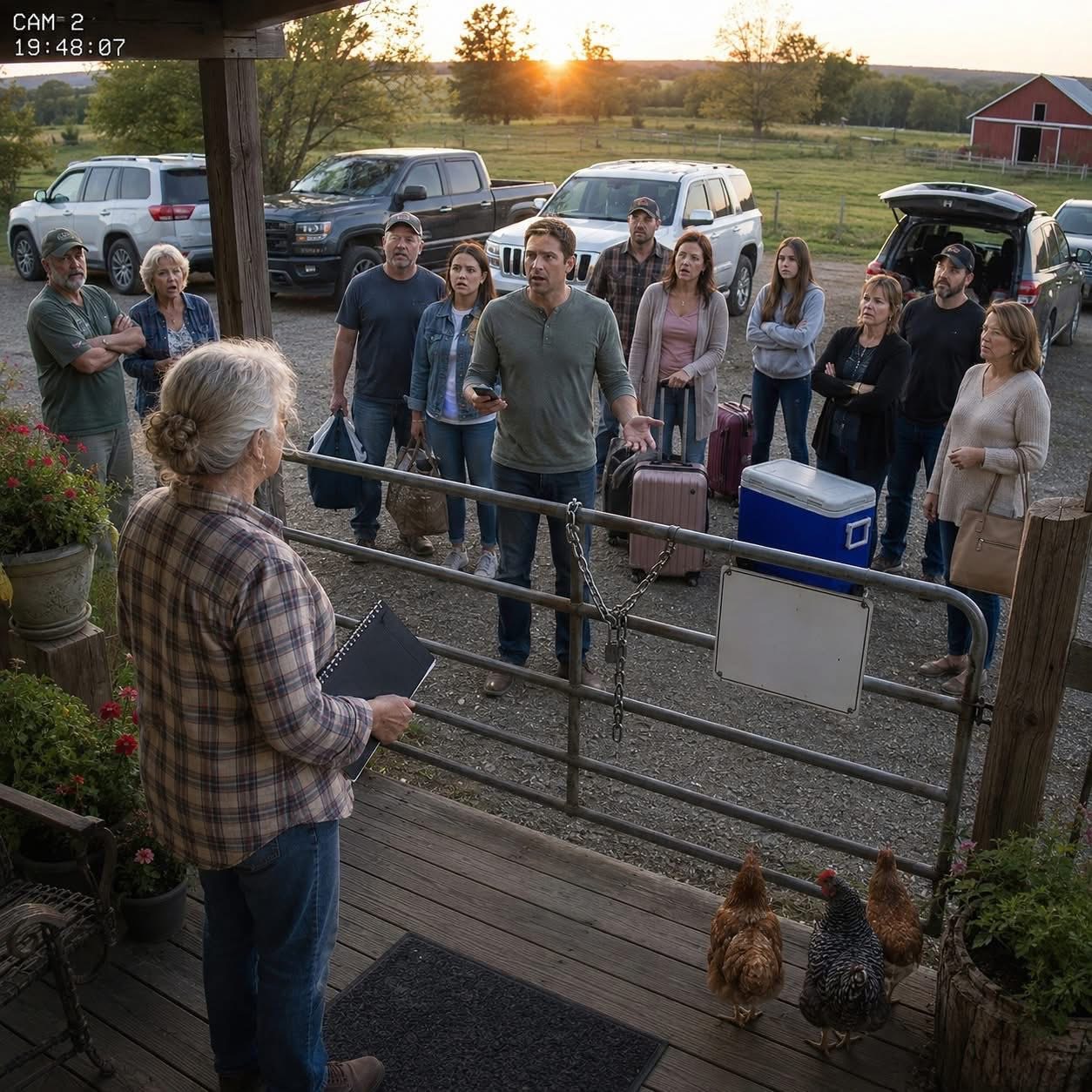
At dawn Saturday, Juan nailed the sign to the gate.
Below it, on a folding table outside the fence, we placed the brown leather notebook. Clean. Brushed. Dry. Tied with a red ribbon.
Then I dressed carefully. My navy dress, the one José always said made me look like I knew secrets. Hair pinned back. Low black shoes. I made coffee. I sat on the veranda with Juan on my right and Mr. Ferrer on my left.
I did not hide.
I wanted them to see me.
I wanted them to understand the locked gate was not a misunderstanding.
It was a sentence.
They arrived at 9:17.
Three vehicles. Two trucks and Laura’s white SUV. They came with suitcases, coolers, bags of coal, folding chairs, pool towels, loud children, and the noisy joy people bring when they believe pleasure is waiting for them by right.
Carlos got out first, wearing sunglasses and the expression of a man prepared to be mildly inconvenienced.
He walked toward the gate.
He read the sign.
His face changed.
Not with shame.
With offense.
He reached for the gate and shook it. The new chain held beautifully.
“What is this, Mom?” he called. “Open it. The kids are hungry.”
That was the moment the old habit rose in me. The mother habit. Hungry children. Tired faces. Coolers sweating in the sun.
For one dangerous second, my body remembered forty years of automatic service. Stand up. Open the door. Make coffee. Heat tortillas. Find towels. Smile. Swallow. Serve.
Then I placed my hand over the pocket where the key now rested.
And I stayed seated.
“I was hungry many times too, Carlos,” I said. “You never cared enough to get out of the car and knock before entering.”
Silence fell strangely.
Not because what I said was cruel.
Because they had never heard me say anything like it.
Laura stepped forward with the wounded expression of someone who wants forgiveness before admitting fault.
“Oh, Mom, it’s not that big of a deal. It was just a WhatsApp group.”
“No. It was the habit of speaking about me as if I were not there. It was organizing in my house without asking me. It was coming with twelve people believing the old woman would have clean sheets, a full fridge, and a closed mouth.”
Elena crossed her arms.
“Benita, no one wanted to offend you. You always said the farm was for the family.”
The way she said my name.
Benita. Not Mom. Not even warmth. Just Benita, as if I were a stubborn housekeeper refusing to unlock a rental.
“I said the farm was for family,” I answered. “Not for abuse.”
Diego picked up the notebook from the folding table with two fingers, like it might stain him.
“And what’s this? Another one of Dad’s notebooks with old accounts?”
Mr. Ferrer leaned forward slightly.
“I suggest you read it in its entirety before continuing to speak.”
Carlos looked at him sharply.
“And what are you doing here?”
Mr. Ferrer’s expression did not move.
“What you never did. I came because the lady called me.”
That lowered the air around them.
Carlos opened the notebook with the impatience of a man who believes nothing written by his parents can teach him anything.
The first page stopped him.
I knew what it said.
If one day our children forget that this farm was made with hands and not with magic, let them read slowly. Land is not inherited only through surnames. It must also be deserved.
Carlos did not read it aloud.
But his face read it for him.
He turned the page.
The accounts, year by year. The well. The fencing. The roof. The trees. The medicine. The repairs.
Then the intimate notes.
We sold the small wedding ring to buy the water pump.
Benita sewed until the early hours to pay for the lemon trees.
Carlos had mumps; the roof money went to medicine.
Laura wanted white shoes for the festival. They were bought. The dining room floor will wait.
Diego broke the window playing. He was not scolded because he was happy. Glass can be repaired next month.
Laura’s eyes changed first.
She remembered the shoes.
White shoes with little buckles. She had wanted them so badly she had stopped speaking at dinner. I had taken extra sewing that week. José had eaten beans without meat and told the children he was craving them. When she wore the shoes at the school festival, she danced as if the world had been made only for her feet.
And the dining room floor had waited three more years.
Carlos kept turning pages.
Today we brought the first mattress to the farm. The children threw themselves on top of it as if it were a cloud.
Benita kept a key under the planter because she said an open house makes children feel always expected.
Carlos swallowed.
So did I.
That sentence had been written for me. For the version of me who thought being always available meant being always loved.
Then Carlos reached the final section.
Mine.
My handwriting was shakier at first, then firmer.
This notebook does not hold old things. It holds the price of your childhood.
No one moved.
Here is written how many times we said yes when we wanted to rest. How many times we opened the door without warning. How many times we washed other people’s sheets while you called what was work for me a family weekend.
Carlos’s thumb rested on the page as if he feared it might close.
It did not hurt me only to be taken out of a chat. It hurt me to understand that you had been removing me from decisions, respect, and even language for years. I was no longer a mother. I was the one who leaves the key.
Laura put one hand over her mouth.
Diego stared at the dirt.
Then Carlos reached the folded cream-colored paper tucked near the end.
The notary seal showed before he opened it.
He looked at Mr. Ferrer.
Then at me.
“What is this?”
“Read it.”
He read quickly at first. Then slowly. Each line took color from his face.
The farm was mine. Legally. Entirely. Unquestionably. No entry without written permission. Upon my death, a home for widows. A library in José’s name.
Laura made a small sound.
“You can’t do that.”
“I already did.”
“Mom,” Diego snapped, “that’s insane. The farm belongs to the family.”
I stood.
My back felt straighter than it had in years.
“No. The farm was built by a family. It has been used by people who forgot how to behave like one.”
Then something happened none of the adults expected.
Sofia, fifteen, usually half-hidden behind her phone, stood and approached the notebook.
“Grandma,” she said slowly, “can I read?”
Carlos opened his mouth. Mr. Ferrer lifted one hand. Carlos closed it.
Sofia took the notebook.
She read slowly. As if the pages were rooms she had entered without permission and was seeing for the first time.
She read about the well. About the ring. About the white shoes.
Then she froze at a page near the end.
“Mom,” she said to Laura, “here it says Grandma was left alone for a whole week cleaning after my ninth birthday. That you left early because you had adult things.”
Laura closed her eyes.
Sofia turned another page.
“And here it says Grandpa wanted no one ever to come to this house without first kissing the mistress of the house.”
No one laughed.
Because everyone could imagine José saying it.
Sofia looked up at me.
Her face had changed. Not dramatically. Deeply.
“Grandma,” she said, “I’m sorry.”
Just two words.
Not the kind of apology that reaches for a key. Not the kind said to end discomfort.
Just sorrow.
My chest loosened in one small place.
Martina let go of Elena’s shirt and moved closer to the gate.
“I did want to say hello,” she said in a thin voice. “But everyone was walking fast.”
That was when Laura started to cry.
Not gracefully. The way she had cried as a child when she fell and ran to hide between my knees. Her face bent. Her shoulders shook.
“Mom,” she said. “I didn’t realize.”
I looked at her without cruelty.
But I did not give her relief.
“That hurts too, daughter,” I said. “That you did not notice.”
Carlos was still stiff. Still holding himself together with anger because anger was easier than shame. Then Tomás, his son, dropped the bag of coal hard into the dirt.
“Dad,” he said, “did you really take Grandma out of the chat?”
Carlos did not answer.
“And did you really say it was for working adults?”
No one moved.
Tomás’s eyes were wet but his voice did not shake.
“That’s embarrassing.”
A child’s sentence.
Sometimes a child can return your harvest to you in one handful.
Carlos looked down. At his shoes. At the dirt. At the notebook. Then finally at me.
For a moment, he looked older than I did.
“Mom,” he said. The word came out as if he had forgotten its proper weight.
“I don’t know what I thought,” he said.
“No. You never thought. You got used to it.”
Then he removed his sunglasses.
Slowly. Like a man deciding to stop hiding even his eyes.
“I’m sorry.”
No excuses. No blaming Elena. No if you felt offended.
Just sorry.
And maybe that was why I believed him a little.
Not enough to open the gate.
Not yet.
But a little.
I breathed in.
“You are not coming in today,” I said.
Elena protested. Carlos lifted one hand and stopped her.
“You are not coming in today,” I repeated. “And you may not come in for a long time. Forgiveness is not a key under a flowerpot. It is not left in the same place for anyone to use whenever they feel like it.”
My hands trembled.
My voice did not.
“If you want to return to this house, you will not return with coolers. You will return with respect. You will knock. You will ask how I am. You will sit down and listen to what you never wanted to hear.”
Then I did the only thing left to do.
I took the notebook from the table and pressed it to my chest. I walked down the three steps of the veranda. Not all the way to the gate. Just far enough for them to see me clearly.
“This farm was not closed out of hate,” I said. “It was closed to find out if you still know how to knock.”
Then I turned to Juan.
“Open the small gate.”
Confusion passed through the group.
Juan opened only the narrow side gate, meant for a single person.
“The children may come in to eat with me,” I said. “The adults may not. Not today.”
Sofia was already walking toward the small gate with Martina by the hand. Tomás followed without looking at his father.
I let them in.
Because I did not want to teach them that wounds are healed by blind punishment.
I wanted to teach them that doors are not opened by habit.
They are opened by conduct.
When the children crossed and hugged me one by one, I felt something I had not felt in years.
Not usefulness. Not obligation. Not resignation.
Authority.
The calm authority of a woman who had finally stopped begging for the place that had always belonged to her.
Inside, I heated soup. Juan sliced bread. The children sat at the kitchen table quietly, as if they had entered a church disguised as a farmhouse.
Martina watched me ladle soup into bowls.
“Grandma, are you mad at us?”
“No, my love.”
“Are you mad at Daddy?”
I looked toward the window. Carlos stood outside with one hand on his hip, staring at the ground.
“I am tired of being forgotten. That is not the same as being mad.”
Sofia looked at her bowl.
“I didn’t know you cleaned after my birthday.”
“You were nine. You were supposed to eat cake and be happy.”
“My mom should have helped.”
“Yes,” I said.
The word landed gently, but it landed.
After lunch, the children helped wash their bowls. Not because I asked. Because Sofia stood up and said we should.
Through the window, I saw Carlos open the notebook again and begin from the first page. This time standing still. Without hurry. As if reading something that had arrived too late but still demanded to be received.
The adults left at 2:43.
No barbecue. No music. No creek. No coolers opened.
Carlos was the last to leave. He stood at the gate for a long time, then placed his palm against one of the iron bars. Not shaking it. Just touching it. He lowered his head once, got into his truck, and drove away.
That night the farm was quiet.
But not like before.
This quiet had shape.
It belonged to me.
Juan came by after sunset.
“You did well,” he said.
“I don’t know.”
“You did.”
He leaned against the porch rail.
“People are always shocked when a chair learns to stand up.”
I laughed. A real laugh. Small and rusty, but mine.
The next morning, Carlos sent a message.
Mom, may I come by today? Alone. No coolers. No agenda. I would like to talk if you are willing.
I finished my coffee. Then I replied.
You may come at noon. Knock.
He arrived at 11:58. For the first time in years, my son parked outside the gate and walked up empty-handed. He stood at the small gate and knocked on the metal frame.
The sound was awkward.
Beautifully awkward.
He walked up the path slowly, looking around like a visitor who had finally realized he was standing on someone else’s land.
When he reached the porch, he stopped.
“May I come in?”
Those five words were worth more than every Mother’s Day bouquet he had ever ordered through a website.
We sat in the kitchen with coffee. He looked smaller without entitlement around him. More human.
He asked if his father had written all of it.
“Most of it.”
“And the last pages were yours.”
“Yes.”
He looked into the cup.
“I told Tomás I was trying to keep the chat practical,” he said. “He asked me if practical meant pretending you weren’t family.”
The kitchen clock ticked.
“I didn’t know what to say.”
“That is because he asked the right question.”
Carlos closed his eyes briefly.
“I have been selfish.”
“Yes.”
The word was not cruel. It was clean.
“I thought because you always said yes, it meant you didn’t mind.”
“I minded many things.”
“Why didn’t you say so?”
I leaned back.
“Because every time I said a small no, someone made it expensive. If I said I was tired, someone said they had driven far. If I said the house was not ready, someone said family doesn’t need formal invitations. If I asked for help with dishes, someone disappeared outside. If I looked hurt, someone told me I was sensitive. So I learned to say yes because yes was faster.”
Carlos stared at the table.
“I did that.”
“Yes.”
He placed something on the table. An envelope.
“I wrote down what I remember. Not to defend myself. To remember correctly. Dad carrying lumber. You sewing near the lamp. Laura’s shoes. Diego’s window. The first mattress.”
He pushed it slightly closer.
“I want to add it to the notebook. Only if you allow it.”
“The notebook is not a confession booth, Carlos.”
“I know.”
“It will not buy you access.”
“I know.”
“Do you?”
He looked directly at me.
“I am trying to.”
That was an honest answer. Better than a perfect one.
I took the envelope.
Not forgiveness.
Not yet.
But a beginning.
The weeks that followed were not clean. Families do not heal like movie scenes. There were arguments. Long messages. Short replies. Silences. Elena sent a text saying she felt things had been very unfairly framed. I waited six hours before writing: That is because you are used to holding the frame.
Laura came and cried in my arms and spent three hours cleaning the pantry with me. Not as punishment. Not as theater. We took down jars and washed shelves and found an old birthday candle shaped like a duck. Laura held it and cried again because grief hides in strange places.
Diego sent jokes first. Should I submit a formal application? I replied: Yes. He didn’t answer for two days, then called and said it made him feel like a stranger. I said: you were behaving like one. Silence. Then: fair.
He came the next weekend and fixed the broken hinge on the barn door he had walked past for five years. He brought tools, knocked, asked if there was anything I needed, and worked until his shirt was soaked through. When he finished, he said Dad would have fixed that sooner. I said yes. He nodded. I should have too.
Elena did not come for a month. When she finally appeared at the gate, arms crossed and then uncrossed, I let her wait five minutes. Not to punish her. To let her feel the gate.
We sat on the porch.
She said she had thought I judged her.
I told her I often had.
She looked startled.
I told her exactly why. Moving things without asking. Telling grandchildren Grandma would get the plates. Saying my name in the tone you would not use with your boss.
She flushed. She said her mother-in-law had treated her badly. She said she came into this family ready to defend herself from a woman I never was.
That was the first real thing she had ever given me.
“And when I did not fight you,” I said, “you mistook kindness for weakness.”
Her eyes filled. “Yes.”
She looked away toward the lemon trees. Sofia had barely spoken to her since the gate. One of the notebook pages was now taped to Sofia’s mirror. The one about no one entering without kissing the mistress of the house.
Then Elena said the words I had not known I needed.
“I treated your home like something Carlos inherited early. I treated you like part of the arrangement. I am sorry.”
No excuses. No decorative sadness.
I accepted it with a nod.
Sometimes forgiveness begins not with an embrace, but with the absence of further argument.
Six weeks after the gate, a new family chat appeared.
Carlos added me first.
The chat name was: Ask Grandma First.
Tomás sent the first message.
Rule one: nobody plans anything at Grandma’s farm unless Grandma says yes.
Sofia replied: Rule two: everyone washes dishes.
Martina added eleven flower emojis.
Diego wrote: Rule three: Diego is forgiven for the window of 1989.
I wrote: Rule three denied.
For the first time in a long time, a family chat made me laugh.
But I did not confuse laughter with repair. That mattered.
Three months after the locked gate, we held the first proper family dinner.
Planned two weeks in advance. With my permission. Everyone arrived at four because I said dinner was at six and anyone who wanted to eat could arrive early enough to help.
Carlos brought bread. Laura brought flowers and put them in water herself. Elena brought a salad and before stepping into the kitchen asked where would you like this.
I almost looked behind me to see if another woman had entered.
The grandchildren set the table. Juan joined us, not as help, but as family. I made that clear before anyone could decide otherwise. Mr. Ferrer arrived with wine and the satisfied look of a man who enjoys seeing legal documents produce moral education.
Before dinner, I brought out the notebook.
The room quieted.
Not with fear. With recognition.
I placed it on the sideboard, beneath the framed photograph of José standing in the half-built porch, one hand on his hip, smiling like a poor man who owned the moon.
“This notebook will stay here,” I said. “Not hidden. Not worshiped. Read when needed. Add to it only with truth.”
Sofia stood near the sideboard and read from a folded paper.
“I used to think Grandma’s farm was magic because every time we came, beds were ready, food appeared, towels were folded, and the house smelled like lemons. I know now magic is usually someone’s work with the hard parts hidden. I don’t want to be the kind of person who enjoys comfort and ignores the hands that made it. I want to remember the key was under the planter because Grandma loved us, not because we owned her.”
By the time she finished, no one in the room was untouched.
Sofia placed the paper inside the notebook. Not at the back. Near José’s line about the key.
Dinner was not perfect. Diego burned one side of the bread. Martina spilled lemonade. Carlos and Laura argued about whether their father preferred black coffee or coffee with sugar.
I corrected them both.
“He preferred it with sugar when no one was looking.”
Everyone laughed.
And for the first time in years, I did not rise while others kept eating. I did not clear plates early. I did not hover in the doorway waiting for needs.
When dinner ended, Carlos stood.
“Everyone,” he said, “take your plate.”
They did.
Every single one.
I stayed seated.
That was the miracle. Not the apology. Not the dinner. Not even the changed deed.
The miracle was that I remained sitting while others carried the weight.
Near sunset, Carlos found me on the porch.
He sat beside me leaving space between us.
“Are you going to change the deed back?”
“No.”
He nodded, though pain crossed his face.
“If respect is a price paid for inheritance, it is not respect. It is negotiation.”
Carlos breathed out slowly.
“Dad would have liked the library.”
“Yes.”
“He would have hated that we made you do this.”
That one hurt him.
But it was supposed to.
Then he said, “Can I help build it?”
I looked toward the old front room.
“You can start by sanding the shelves.”
He smiled faintly.
“I can do that.”
“Carlos.”
“Yes?”
“You will knock when you arrive.”
His smile broke into something sadder and softer.
“Every time.”
People will probably tell this story wrong.
Families often do.
They will say I locked my children out because of a group chat. That I was dramatic. That an old woman became sensitive over a misunderstanding.
People love small explanations for large consequences. Small explanations let them sleep.
But that is not what happened.
I did not lock the gate because of a chat.
I locked it because the chat showed me the shape of my absence.
I locked it because the key under the planter had stopped meaning welcome and started meaning access.
I locked it because my children had begun treating my silence as consent, my labor as tradition, my age as ignorance, and my love as something that could be used without being replenished.
Now the key is no longer under the planter.
It hangs on a hook inside my kitchen, beside the door, where I can see it.
Carlos knocks now. So does Laura. So does Diego. Even Elena.
Juan says the sound of knocking has become the farm’s new bell.
Because every time someone knocks, they are saying something before the door opens.
They are saying: I know this is yours. I know I am not entitled to enter. I know love does not erase permission.
And every time I choose to open the door, I am saying something too.
Not the old thing. Not use me. Not take what you need and leave me the mess.
Now when I open the door, I am saying: come in correctly.
That is the only way this house receives visitors now.
The farm still smells like lemons in the morning.
The porch still catches the best light at dusk.
The old planter still sits by the door, cracked and faithful, holding geraniums.
But beneath it, there is nothing.
No key.
No permission.
No old version of me waiting to be useful.
Only soil.
And roots.
And a woman inside the house who finally remembered that an open door means nothing if you are not allowed to close it.