The rain started just before they lowered Thomas’s casket, which felt like something he would have found mildly inconvenient and faintly funny.
He was that kind of man. If the roof leaked, he put a bucket under it and called it a temporary indoor water feature. If the car wouldn’t start, he named it Gerald and negotiated with the engine. If five children showed up in his life from five different directions without any of them carrying his blood, he called them his and went looking for a library book about braiding hair.
I stood at the graveside with my hands locked together and watched the casket disappear inch by inch into the wet ground. My shoes were sinking into the cemetery grass. The rain had come in fast and none of us had brought umbrellas because Thomas would have said umbrellas were for people who hadn’t made peace with weather.
Beside me, Michael kept clearing his throat in the particular way he does when he is trying to keep something inside that wants very much to come out. Mara had both arms wrapped around herself, staring at the hole in the ground with an expression I recognized from every hard moment we had all shared since we were old enough to understand that Thomas had chosen us deliberately, each of us, and that deliberate was the most important word.
Noah stood to my left looking straight ahead with the compressed stillness of a man who has two young children at home and has spent the last several years learning to hold himself together in front of witnesses. I could see what it was costing him.
I closed my eyes.
Thank you, Dad. Thank you for the school lunches with the notes folded into the napkins that I was always slightly embarrassed about until I wasn’t, until the day in sixth grade when a girl asked me why my dad wrote me notes and I said because he does and I felt something in my chest that I would not have been able to name at eleven but know now to call pride. Thank you for learning to braid hair from a library book because I refused to go to school with a ponytail that lopsided. Thank you for the pink teddy bear with one button eye. Thank you for looking at my grandparents with their practical voices and their folded hands and their quiet certainty and saying she’s my daughter like the sentence was already finished before he started it.
Thank you for taking five children who did not come from your blood and never once making us feel borrowed.
I opened my eyes.
My mother married Thomas when I was five. He was thirty-one, newly settled in a house three streets over from the school, working as a civil engineer who spent his evenings reading novels and his weekends fixing things that didn’t need fixing because, as he explained, he was practicing optimism.
The first time I met him, he crouched down to my level and held out a pink teddy bear missing one of its button eyes. He had the careful expression of someone who has been told that a specific child is particular about things and is trying very hard to get this right.
“Your mom says you are very particular,” he told me. “This bear also seems high-maintenance. I thought you two might get along.”
I looked at the bear for a long moment. Then I took it.
He smiled. “Hi, Pumpkin.”
I carried that bear for three years and loved it in the way children love objects that were given to them at the exact moment they needed something to hold onto.
When I was seven, my mother died. Wet road, a Tuesday evening in November, the kind of loss that does not announce itself and does not make sense and does not recede with time so much as it becomes part of the architecture of who you are. My grandparents came with practical voices and folded hands and the quiet certainty of people who have decided what is going to happen and are arriving to make it official.
Thomas listened to every word they said. He sat at the kitchen table with his hands around a coffee mug that had gone cold and he listened with the complete attention of a man who respects the people in front of him even when he disagrees with everything they are proposing.
Then he looked at me on the couch in mismatched socks with my teddy bear jammed under one arm.
“She’s my daughter,” he said. That was the whole discussion.
He was not my father by blood. He was my father in every way that ever fed me, and if you had asked him whether there was a difference, he would have looked at you the way he looked at expired milk, with the expression of a person who could not understand why you were asking.
When I was nine, he adopted the twins, Michael and Mara, from a shelter. He brought them home on a Thursday and made pancakes for dinner because he said breakfast foods at unconventional hours were a form of celebration, and they needed celebrating. Two years later, he fostered siblings named Noah and Susan and eventually adopted them too. None of us came from the same beginning. Thomas made us feel as though we shared the same home, which we did, which he had built for exactly this purpose even before he understood what the purpose was.
He told me once, when I was seventeen, that he had always wanted a large family and simply been unclear on the mechanism.
I stood at the graveside and tried to hold all of this at once and found that grief is simply too large for the body to process standing up. You manage it. You stand straight and breathe and let it move through you in pieces because the alternative is to sit down in wet cemetery grass and not get up.
Michael leaned close to my ear. “Susan came.”
I turned.
She was standing at the back of the gathered group under a red umbrella, pale and still in her black coat. She was twenty years old and looked older than twenty should allow. Not physically. More like something had been worn down in her by two years of being away from us, two years of whatever it had cost her to stay gone when she must have known, must have always known, that Thomas left the porch light on.
I had left her a message about his passing. Just in case. I had not expected her to come and had been trying to decide how to feel about that when I turned and found her there, under the red umbrella, looking at the casket with an expression that told me she had never stopped loving him.
Thomas had waited for her until the end. Three nights before his heart gave out he told me to leave the porch light on. Just in case.
“Go talk to her, Christina,” Noah said. “Before she slips out again.”
I walked toward her through the wet grass.
She looked up when I reached her. Two years older. Two years of whatever had built up between leaving and here.
“You came,” I said.
“He’s still my father,” she answered. “The one who raised us all.”
I heard Michael and Mara behind me, the specific quality of their silence that had always meant disapproval held in check by manners. Noah, who had witnessed Thomas’s grief up close through two years of holidays and birthdays and one particularly bad night when Thomas sat on the back porch in the dark and could not explain why, had very little give in him on this subject.
Mara joined us. Her voice was controlled and direct. “That’s all you have to say? He waited for you for years.”
Michael: “He sent cards. He called. He left the porch light on every single night.”
Something moved across Susan’s face, fast and painful, the expression of someone who has been carrying a knowledge that others don’t have and does not know yet whether she will share it.
“I did what I had to do,” she said.
Mara turned away.
I had seen Thomas cry only a handful of times. Once at my college graduation. Once watching the end of a movie he claimed was just an action film. Once, on a Sunday afternoon two years earlier, when I came home and found him sitting on the porch steps alone with a piece of paper in his hands and an expression I had not seen before on his face.
He had handed me the note when I asked. Susan’s handwriting. I’m leaving. I’m staying with a friend. I need to build my life on my own terms.
He had looked at the yard for a long time after I read it.
“Not mine to tell, Christie,” he said, when I asked why.
Later, when Susan finally answered one of my calls, I had been less patient than I should have been. I had told her what she’d done to him. She had been quiet for a moment and then said, “You don’t know Thomas the way I do.”
Then she hung up.
I had spent two years not knowing what she meant by that.
The attorney, a man named Elwood in a charcoal coat, appeared from the side path as the graveside service was concluding. He had the contained manner of someone who has delivered difficult things before and understands that delivery is its own form of kindness.
He told us Thomas had left something for each of us. A box. He asked us to come to his office.
Susan’s hand tightened on her umbrella handle.
Elwood’s office smelled like old paper and coffee and the specific quality of rooms where important things happen quietly. On his desk sat a small wooden box, the kind with a brass clasp and a key, the kind Thomas would have found in an antique shop and bought because he said objects with history deserved continued use.
Elwood handed me the key. Thomas had specifically asked that I be the one to open it.
The click of the lock was too loud for such a small sound.
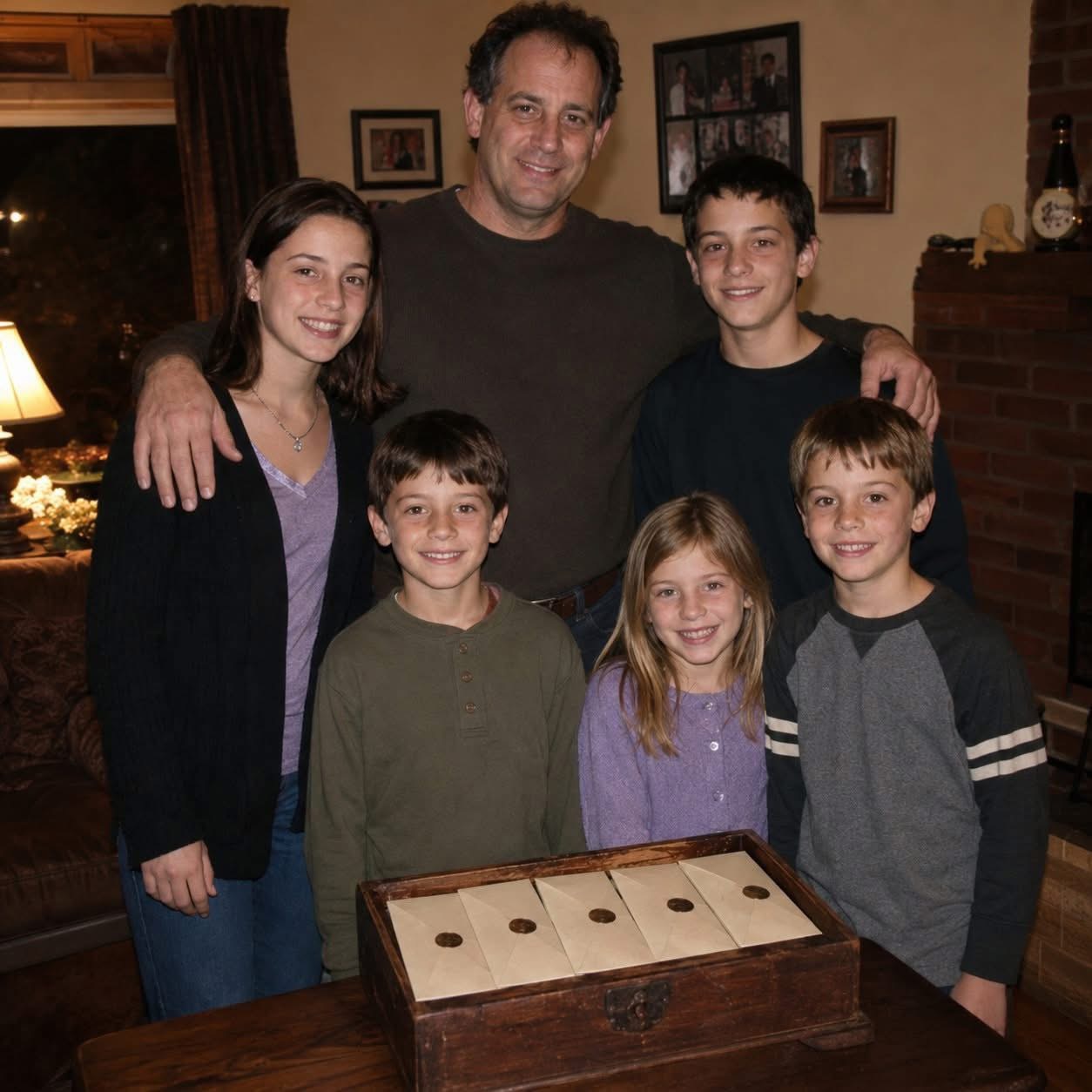
Inside were five envelopes, one for each of us, addressed in Thomas’s handwriting from his final years when his hands had begun to shake, each letter formed with the careful effort of a man who understood that what he was writing mattered.
We found corners of the room. Michael took a chair by the window. Mara sat on the small sofa. Noah stood with his back to the wall. Susan took the chair nearest the door, which I noticed and said nothing about.
I opened mine.
My sweet girl, the first line said. Susan left because she discovered something about me the rest of you never knew.
I stopped.
Then I started again, more slowly.
Thomas wrote that two years earlier, Susan had been looking for a pen in his desk and found instead an old locket, heart-shaped, the kind that opens. She opened it. Inside was a photograph of Thomas standing beside a young woman.
Susan recognized the woman instantly. Her mother.
I read that sentence three times. Then I kept reading, because Thomas had not stopped there. He had written the rest of it, the truth he had been trying to find the right moment to tell for two years, that had grown heavier in his chest with each month Susan stayed away until he ran out of time.
The woman in the photograph was his sister.
Her name was Elise. She had run away at seventeen and disappeared from his life for years, moving from city to city in the particular way of young people who are trying to outrun something they haven’t named yet. When she finally wrote to him, she was already sick. By the time he reached her apartment, she had passed away. Her two children, Noah and Susan, had gone into foster care.
Thomas had brought them home that same month.
He had never told them because he did not know how, because the truth was complicated and he was afraid of complicating what they had, because he kept waiting for the right moment and the right moment kept not arriving. When Susan found the locket and confronted him, he tried to explain. She was too hurt and too certain to stay long enough to hear the full thing.
Every year after that, he said, the explanation grew heavier in his mouth. Until he ran out of time to say it.
I lowered the letter.
Across the room, Noah had both hands over his face. Mara had both palms pressed against her mouth. Michael was blinking at the page with the slow, deliberate blinks of someone whose understanding of something large is being reassembled in real time.
Susan had gone completely white.
She finished her letter, folded it in half, shoved it into her coat pocket, and walked out without a word.
I called her name. She kept going.
I followed her out of the office and across the street and caught up to her at the oak tree on the corner where she had stopped because her body had run out of the ability to keep moving. She bent over with both hands on her knees and cried the way people cry when something they have been certain of for years collapses all at once. Not the quiet kind. The kind that looks like it hurts.
I put my arms around her before she could argue.
“I made a terrible mistake, Christie,” she said into my shoulder.
The others had followed us out. They formed a rough circle without being asked, which was something Thomas had taught us, the instinct to surround rather than confront.
Susan pulled the letter from her coat. Her hand was shaking.
“You read it,” she said. “I can’t do it again.”
So I read it aloud. The whole thing. Thomas’s shaky handwriting describing his sister Elise, the locket, the photograph, the night he reached her apartment and found it too late, the children who went into foster care and came home to him one month later.
When I finished, the street was very quiet.
Susan whispered, “He didn’t leave her. He wasn’t the man who had abandoned my mother the way I thought. Thomas was my uncle. He came back for us.”
Noah sat down on the wet curb. Not because he was weak. Because his legs had simply made a decision.
Mara whispered, “Oh, Thomas.”
Michael looked up at the gray sky with one hand over his mouth.
And I stood there holding the letter and thought about my stepfather spending two years leaving the porch light on every single night for a child who believed he had betrayed the person she loved most, carrying the truth alone because he had lost his courage at exactly the wrong moment and then could not find his way back to it.
“Come with us,” I said to Susan.
She shook her head. The reflex of two years of being away, the body not yet caught up to the understanding.
Then Noah stood up from the curb and said the thing.
“Thomas would be furious if we split up in a parking lot after all this.”
Susan made a sound that was not quite a laugh and not quite a sob, the specific sound of a person who has just remembered who they are talking about, who understood exactly who Thomas was and what he would say standing here in his charcoal coat with a cough drop in his pocket and absolutely no patience for unnecessary grief when soup was available.
She nodded.
“Take me home,” she whispered.
We went back to Thomas’s house that evening, all five of us.
The porch light was still on.
Susan stopped at the bottom of the steps and looked at it for a long time, that single bulb glowing above the door in the gathering dark, burning the way it had burned every night for two years, patient and steady and entirely like him.
Nobody said anything. Nobody moved. Thomas had raised us well enough to understand that some silences need room to breathe.
Inside, the house smelled of coffee and cedar and the cinnamon mints he kept in every jacket pocket because he claimed they helped him think, though we suspected he simply liked cinnamon mints and needed a reason.
Michael went to the kitchen automatically because grief makes people need jobs and the kitchen had always been Michael’s job, the practical application of care in the form of something warm to hold.
Mara found the photo albums in the cabinet beneath the television, where they had always lived, organized by year in Thomas’s precise way, labeled on the spine in his handwriting.
Noah stood in the middle of the living room and cried quietly in the way of a man who has children at home watching him and has gotten too good at holding things in, and now was alone with his siblings and could let some of it go.
Susan sat on the couch with the locket in both hands. She had asked if she could hold it. I had given it to her without hesitation.
“I hated him for so long,” she said.
“You were eighteen and hurt,” I told her. “You found something that looked like proof of the thing you were most afraid of.”
“I still left.”
“Yes.”
“Do you think he forgave me?”
“Yes,” I said. “I think he already had.”
Michael came in from the kitchen carrying mugs of tea, which was Thomas’s response to every situation requiring comfort. Thomas believed strongly in the curative properties of hot beverages and a person sitting close enough to hand one to you.
“Please,” Michael said, sitting down. “Thomas would have forgiven a bank robbery if you looked sorry enough.”
Susan’s mouth did something complicated. Then she laughed. A small, broken laugh, but a real one.
Mara opened an album across her lap and tilted it so we could all see. There we were in matching Christmas pajamas that Thomas bought on clearance every year and told us were designer. Noah missing his front teeth. Susan with the bangs she had cut herself using craft scissors and genuine optimism. Me with my arm around Thomas’s neck and cake frosting on both our faces from a birthday that I could not remember clearly but felt in my body as warmth.
Thomas in every photograph with the expression of a man who cannot believe his luck.
“Look at his hair,” Mara said through tears.
“He parted it with a ruler,” Michael said. “He thought precision was stylish.”
“He thought gel was a personality,” Noah said.
“He used the word groomed unironically,” I added.
Susan was smiling now, a real smile, the kind that comes from memory rather than effort.
Three days later, all five of us went back to the cemetery.
The ground had dried. The sky was clear and pale blue, the particular blue of early spring mornings when the light is honest. Someone had left fresh flowers at the headstone before we arrived, and Michael accused Mara in the softest possible voice, and she did not deny it.
Susan knelt first.
She put one hand flat on the headstone and cried openly, not trying to save face or manage the expression or give grief a shape that was easier for other people. Just crying, the way Thomas had always allowed us to cry, without rushing us toward the part where we felt better.
“I’m sorry,” she said. “I’m so sorry, Thomas.”
I set the small lantern I had brought on the ground in front of the stone and clicked it on. The flame inside it glowed warm and steady in the morning air.
Susan looked at it for a moment. Then she broke open all over again, but differently this time. Not the sharp, shattering kind of crying. The releasing kind.
Just like the porch light. Just like him.
We stood there for a long time in the quiet of a clear morning, the five of us in a loose circle around the stone, not saying much because everything that needed to be said had been written in letters in a locked wooden box and delivered to us by a man who ran out of time before he ran out of love.
Thomas spent his whole life telling children who were not his by blood that home is not a place you earn. It is a place that stays lit for you. It is a porch light burning through two years of absence and every holiday and every unanswered call, patient and reliable, saying whenever you are ready, the door is the same door.
Eventually Susan stood up. She was still crying a little, but she wiped her face with the back of her hand in the practical way Thomas had always wiped his, quickly and without drama, because feelings deserved to be felt and also there was usually something that needed doing.
She reached over and took my hand.
I felt Michael step close on my other side. Mara linked her arm through Noah’s. We stood together at the gravestone for another quiet minute, five people who had arrived at family from five different directions and had been held in the same orbit by a man who understood that the holding was the whole point.
Then Susan looked at all of us and said, “He would have hated all this crying.”
“He absolutely would have,” Michael said.
“He would have made soup,” Mara added.
“He would have put on something embarrassing on the television,” Noah said, “and pretended it was an accident.”
“He would have given us all terrible jokes,” I said. “And been hurt when they didn’t land.”
Susan laughed. A full laugh, the kind that sounds like relief.
We walked back toward the road together, all five of us, moving the way people move when they have been through something and have come out the other side of it still belonging to each other.
The lantern stayed burning on the ground behind us, small and warm and steady, the way he had always been.
The way he always will be.
Because love is not blood. Love is who stays lit for you.
And Thomas, even now, had left the light on.