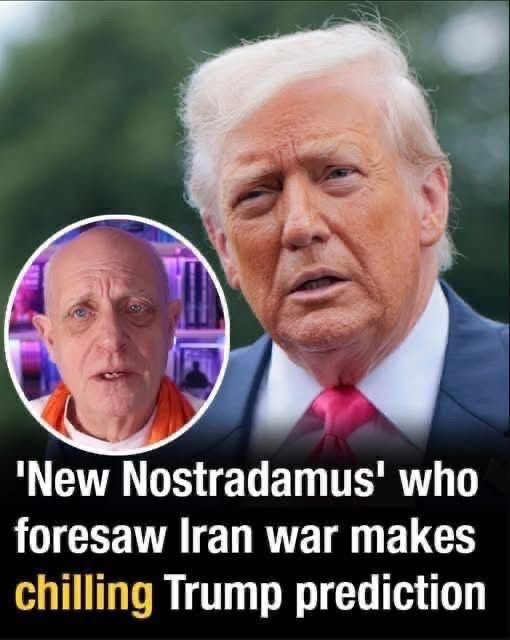
The latest viral claim surrounding a so-called “New Nostradamus” has captured widespread attention, largely because it blends two powerful forces: uncertainty about the future and fascination with bold, dramatic predictions. At the center of this narrative is Craig Hamilton-Parker, a British psychic who has built an audience by forecasting global events, often tying his predictions to themes of war, political upheaval, and societal transformation. His newest claim—that Donald Trump could somehow secure a third presidential term despite constitutional limits—has sparked both curiosity and concern. However, understanding this story requires stepping back from the headline and examining what it actually represents: not a credible political forecast, but a speculative interpretation rooted in belief systems rather than verifiable evidence.
Hamilton-Parker’s prediction is framed around the idea that global instability could create conditions severe enough to disrupt established political norms. In his view, escalating conflicts or crises might lead to extraordinary circumstances where existing rules no longer apply in the same way. This concept, while dramatic, is not grounded in how political systems actually function, particularly in the United States. The U.S. Constitution, through the 22nd Amendment, explicitly limits any individual to two elected presidential terms. Changing this would require a formal amendment process involving both Congress and the states—a complex and highly visible procedure that cannot occur quietly or suddenly. Even in times of crisis, constitutional frameworks are designed to remain in place, precisely to prevent the kind of unchecked power that such predictions imply.
The appeal of Hamilton-Parker’s claims lies partly in how they intersect with real-world anxieties. In periods of geopolitical tension, economic uncertainty, or rapid social change, people often become more receptive to narratives that suggest hidden or extraordinary outcomes. The idea that a major crisis could upend democratic norms taps into a deeper fear that systems people rely on may not be as stable as they appear. However, while history does show that crises can reshape political landscapes, those changes are driven by tangible forces—legal decisions, institutional actions, public response—not by prophetic insight or psychic interpretation. The distinction between these two sources of change is critical.
Another important factor is the nature of the methods used to generate such predictions. Hamilton-Parker relies on spiritual frameworks, including practices like Nadi astrology, to interpret future events. These systems are based on belief rather than empirical evidence and are not recognized as reliable tools within political science, law, or international relations. While they may hold personal or cultural significance for some, they do not provide a factual basis for predicting specific political outcomes. When presented alongside real-world developments, however, these interpretations can appear more credible than they actually are, especially when framed in a way that aligns with current events.
The perception that Hamilton-Parker has successfully predicted major events in the past also contributes to his credibility among followers. He is often credited with anticipating developments such as Brexit or Donald Trump’s earlier political rise. However, a closer look reveals a more complicated picture. Many of these predictions were broad, open to interpretation, or made during periods when the outcomes were already being widely discussed. Additionally, there have been notable inaccuracies, including incorrect forecasts about election results. This pattern—highlighting successful predictions while minimizing or ignoring incorrect ones—is common among public figures who make frequent forecasts. Over time, this selective attention can create the impression of greater accuracy than actually exists.
The role of media and social platforms in amplifying these claims cannot be overlooked. Headlines often focus on the most dramatic elements of a story, emphasizing phrases like “chilling prediction” or “unprecedented outcome” to capture attention. In doing so, they may omit important context, such as the speculative nature of the claim or the lack of supporting evidence. As a result, what begins as a personal interpretation can quickly take on the appearance of a credible warning. This transformation is not necessarily intentional, but it reflects how information is shaped by the need to engage audiences in a fast-moving digital environment.
It is also worth considering how Hamilton-Parker himself frames his predictions. He has stated that the future is not fixed and can change depending on circumstances, suggesting that his forecasts are not meant to be taken as certainties. This nuance is often lost when his statements are shared more broadly. Instead of being presented as possibilities within a range of outcomes, they are frequently portrayed as imminent or inevitable events. This shift in framing can significantly alter how the information is perceived, turning speculation into something that feels far more concrete and urgent.
From a legal and institutional perspective, the idea of a third presidential term remains highly implausible. The constitutional process required to alter term limits is intentionally rigorous, involving multiple layers of approval designed to ensure broad consensus. Even in extraordinary situations, such as national emergencies, the mechanisms of government continue to operate within defined boundaries. While debates about executive power and constitutional interpretation do occur, they are conducted within established legal frameworks. The notion that these frameworks could be bypassed entirely without widespread recognition and opposition does not align with how democratic systems function.
To understand why such claims gain traction, it is helpful to look at the psychology behind belief in predictions. Humans are naturally drawn to narratives that reduce uncertainty. The future, by its nature, is unpredictable and often unsettling. When someone presents a confident, detailed vision of what is to come, it can feel reassuring—even if the prediction itself is alarming. This paradox, where fear and comfort coexist, is a key reason why prophetic narratives remain popular across cultures and generations. They offer structure in moments when reality feels chaotic.
Cognitive biases also play a significant role. Confirmation bias, for example, leads people to favor information that aligns with their existing beliefs or concerns. If someone already fears political instability, a prediction suggesting dramatic upheaval may feel more believable. Similarly, hindsight bias can make past predictions seem more accurate than they were. Once an event has occurred, people tend to reinterpret earlier statements as having clearly predicted it, even if the original claim was vague or ambiguous. These psychological tendencies can reinforce the perceived credibility of individuals who make bold forecasts.
Another factor is the blending of entertainment and information in modern media. Predictions like Hamilton-Parker’s are often presented in a way that blurs the line between analysis and storytelling. They are not just statements about the future; they are narratives designed to captivate. This storytelling aspect makes them more engaging and shareable, particularly on social media platforms where attention is a limited resource. As a result, the most dramatic interpretations are often the ones that spread the fastest, regardless of their factual accuracy.
The concept of a “New Nostradamus” itself is part of this narrative appeal. Nostradamus, a historical figure known for his cryptic quatrains, has long been associated with mysterious predictions that are interpreted after events occur. By drawing a parallel to this legacy, Hamilton-Parker’s claims are positioned within a familiar framework that already carries a sense of intrigue and authority. However, the comparison is largely symbolic. Like many figures labeled in this way, his predictions are not based on a method that can be independently verified or tested.
It is also important to consider the broader context in which these claims emerge. The current global landscape is marked by rapid change, from technological advancements to shifting geopolitical alliances. In such an environment, uncertainty is heightened, and people may feel that traditional sources of information are insufficient to explain what is happening. This can create space for alternative narratives to gain traction, particularly those that promise insight into hidden or future developments. While this does not mean that all unconventional ideas are without value, it does highlight the importance of evaluating claims based on evidence and reasoning.
The resilience of democratic institutions is another key aspect often overlooked in these discussions. While no system is immune to pressure, the structures of governance in established democracies are designed to withstand challenges. Checks and balances, legal oversight, and public accountability all serve as mechanisms to prevent abrupt or unilateral changes to fundamental rules. The process of amending a constitution, for example, is intentionally difficult to ensure that any significant change reflects a broad and sustained consensus rather than a momentary shift in circumstances.
Public reaction also plays a crucial role in shaping political outcomes. Even if a theoretical scenario were proposed in which term limits could be extended, it would likely face significant scrutiny and debate. Citizens, advocacy groups, legal experts, and political leaders would all engage in the process, making it highly visible and contested. This level of engagement further reduces the plausibility of sudden, unchallenged changes to established norms.
Ultimately, the story reflects a broader pattern in how people engage with uncertainty. When faced with complex and unpredictable global developments, there is a natural tendency to seek out explanations that offer clarity, even if that clarity comes from unconventional sources. Psychic predictions, with their dramatic tone and sense of inevitability, can provide a kind of narrative certainty that real-world analysis often cannot. However, this certainty is not the same as accuracy. Distinguishing between the two is essential for making informed judgments about what is likely to happen versus what is simply being imagined.
In the end, the claim that Donald Trump could secure a third presidential term based on a psychic prediction is not something supported by evidence, law, or credible political analysis. It is a reflection of speculation shaped by current anxieties and amplified through media channels that prioritize attention-grabbing narratives. The more meaningful takeaway is not the prediction itself, but the way it spreads and resonates. It highlights how easily belief, fear, and uncertainty can combine to create stories that feel compelling, even when they lack a factual foundation. Understanding this dynamic is key to navigating an information landscape where not everything that captures attention is grounded in reality.