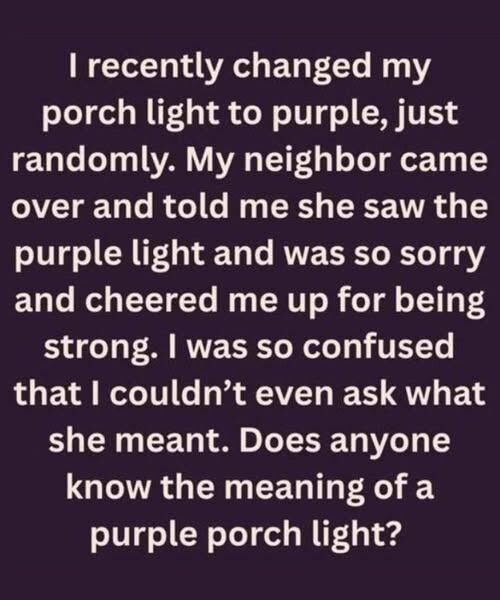
The True Meaning Behind Purple Porch Lights
If you’ve ever driven through a neighborhood at night and noticed a porch glowing softly in purple, you may have paused for a moment. Purple isn’t a common choice for outdoor lighting. It stands out — not in a harsh way, but in a way that feels intentional.
Over the past several years, purple porch lights have quietly become more than just decorative accents. For many households, they carry a deeper message — one rooted in awareness, solidarity, and compassion.
But what exactly does a purple porch light mean?
The answer depends on context. In some cases, it’s seasonal décor. In others, it’s a powerful symbol of support for survivors of domestic violence. In certain communities, it represents remembrance, advocacy, or participation in awareness campaigns.
Like many symbols, the purple porch light has evolved — and understanding its meaning requires looking at both its cultural and emotional roots.
The Origin of the Purple Porch Light Movement
The most widely recognized meaning behind purple porch lights is domestic violence awareness.
October is Domestic Violence Awareness Month in the United States and several other countries. During this time, advocacy organizations encourage individuals to replace their standard porch bulbs with purple ones as a visible sign of support for survivors and a commitment to ending abuse.
Why Visibility Matters
Domestic violence is often hidden behind closed doors. It crosses every demographic boundary — age, income, ethnicity, geography.
Because it is so frequently concealed, public acknowledgment becomes powerful.
A purple porch light does several subtle but meaningful things:
It sparks curiosity and conversation.
It signals awareness.
It tells survivors they are not alone.
It shows that someone cares enough to make a visible statement.
For a person experiencing abuse, seeing a home lit in purple can feel like a quiet sign of safety — a reminder that compassion exists in their community.
Even if no direct conversation happens, the symbol communicates solidarity.
Beyond October: A Year-Round Message
While October is the most common time to see purple porch lights, some households keep them illuminated year-round.
For these families, the issue is not seasonal.Family games
Domestic violence affects millions of people annually. Survivors carry their experiences long after a calendar month ends. Keeping a purple light on continuously reflects ongoing commitment — not temporary awareness.
It can also represent personal experience. Some households install purple lights in honor of a loved one who survived abuse — or in memory of someone who did not.
In those cases, the light becomes deeply personal.
Other Meanings of Purple Porch Lights
Although domestic violence awareness is the most recognized association, purple porch lights have taken on additional meanings in different contexts.
1. Epilepsy Awareness
Purple is also the color associated with epilepsy awareness. November is Epilepsy Awareness Month, and some households use purple lighting to show support.
2. Alzheimer’s and Dementia Awareness
Purple is connected to Alzheimer’s awareness campaigns. While porch lighting is less common for this cause, some families choose purple as a tribute.
3. Military Support
In some communities, purple lighting is used to honor wounded veterans, as purple represents the Purple Heart medal awarded to service members injured or killed in action.
4. Seasonal and Decorative Use
Not all purple porch lights carry advocacy meaning. Some homeowners simply enjoy the aesthetic — especially around Halloween, when purple is a popular decorative color.
This is why context matters.
But when purple lighting appears outside of October or Halloween season, it often carries intentional symbolism.
The Psychology of Color and Why Purple Resonates
Color psychology plays a powerful role in why purple works so well as a symbolic light.
Purple is often associated with:
Royalty
Spirituality
Reflection
Transformation
Mystery
Strength
It commands attention without being aggressive. Unlike bright red or flashing colors, purple has a softness that invites curiosity rather than alarm.
For survivors of trauma, subtlety matters. A purple porch light is noticeable but not confrontational.
It’s a signal — not a spectacle.
The Impact of Small Public Gestures
It may seem like a small act — changing a light bulb.
But symbolic gestures have long played an important role in social movements.
Think about:
Wearing ribbons
Displaying yard signs
Lighting candles
Changing social media profile frames
These small acts accumulate. They create visibility. They normalize conversations that once felt taboo.
Domestic violence, in particular, thrives in silence. Breaking that silence requires cultural shifts — and culture changes through repeated, visible reminders.
A purple porch light is one of those reminders.
How the Movement Spread
The purple porch light movement gained traction through advocacy groups encouraging community participation.
Neighborhood campaigns often include:
Flyers explaining the meaning
Bulk distribution of purple bulbs
Social media hashtags
Community challenges
As more households participate, entire streets glow purple during awareness month. The visual impact is striking.
When one home changes its light, it may spark curiosity. When twenty homes do it, it becomes a statement.
The True Meaning Behind Purple Porch Lights
The True Meaning Behind Purple Porch Lights
If you’ve ever driven through a neighborhood at night and noticed a porch glowing softly in purple, you may have paused for a moment. Purple isn’t a common choice for outdoor lighting. It stands out — not in a harsh way, but in a way that feels intentional.
Over the past several years, purple porch lights have quietly become more than just decorative accents. For many households, they carry a deeper message — one rooted in awareness, solidarity, and compassion.
But what exactly does a purple porch light mean?
The answer depends on context. In some cases, it’s seasonal décor. In others, it’s a powerful symbol of support for survivors of domestic violence. In certain communities, it represents remembrance, advocacy, or participation in awareness campaigns.
Like many symbols, the purple porch light has evolved — and understanding its meaning requires looking at both its cultural and emotional roots.
The Origin of the Purple Porch Light Movement
The most widely recognized meaning behind purple porch lights is domestic violence awareness.
October is Domestic Violence Awareness Month in the United States and several other countries. During this time, advocacy organizations encourage individuals to replace their standard porch bulbs with purple ones as a visible sign of support for survivors and a commitment to ending abuse.
candles
LED bulbs
LED bulb
Purple has long been associated with domestic violence awareness. It symbolizes:
Courage
Survival
Honor
Dedication to change
The color choice is not random. Purple blends the calm stability of blue with the fierce energy of red. Together, it represents both strength and resilience — two qualities deeply tied to survivors’ journeys.
When someone installs a purple porch light during October, they’re often sending a message that their home stands in solidarity with those affected by domestic abuse.