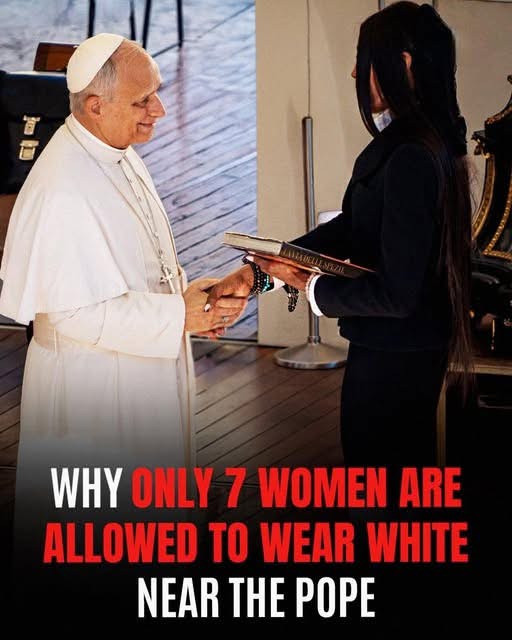
Within the labyrinthine corridors of the Vatican, where ancient stone meets divine authority, there exists a protocol so exclusive that it quietly separates ordinary audiences from rare historical privilege. In a world governed by strict formality and visual symbolism, the Holy See is traditionally marked by restraint—especially in women’s dress codes, which typically call for black gowns, long sleeves, and a veiled mantilla as a sign of humility before the Pope.
Yet, against this dark and solemn palette, a very small number of women are permitted to wear white when meeting the Pontiff. This rare distinction is not a matter of personal style or modern preference. It is known as le privilège du blanc—“the privilege of the white”—an ancient papal honor reserved for a select group of Catholic queens and princesses whose monarchies have historically held a special relationship with the Vatican.
The origins of this privilege trace back to a time when European politics and Catholic authority were deeply intertwined. Certain royal houses were formally recognized by the Holy See as especially devoted to Catholicism, often bearing titles such as Rex Catholicissimus (“Most Catholic Majesty”). In recognition of that historic allegiance, the Vatican preserved a symbolic right allowing specific royal women to appear before the Pope in white rather than black—a visual marker of honor, continuity, and spiritual closeness to the Church.
In the modern era, this privilege has narrowed to an extremely small group of royal figures. Among those traditionally associated with it are Queen Sofia of Spain and Queen Letizia, Queen Paola and Queen Mathilde of Belgium, Grand Duchess Maria Teresa of Luxembourg, Princess Marina of Naples, and Princess Charlene of Monaco. These women represent the remaining link between contemporary Europe and a ceremonial tradition that once defined the relationship between throne and altar.
When exercised, the privilege transforms a papal audience into a striking visual contrast. While most attendees appear in black as a sign of deference, these select royals may appear in white—often paired with a veil—signaling their unique status within the Catholic monarchical tradition. However, the privilege is not a requirement. It is optional, and many eligible royals choose black depending on the tone of the occasion, the pontificate in question, or personal preference.
For example, Princess Charlene of Monaco has appeared in both white and black during different Vatican-related events, reflecting the flexibility of the tradition. Queen Letizia of Spain has also modernized the interpretation, sometimes opting for simpler white ensembles rather than traditional lace mantillas, signaling how even ancient protocols adapt subtly to contemporary aesthetics.
What makes the privilege particularly strict is its exclusivity. It is not granted based on personal faith alone, nor on political influence or global prominence. Catholic queens outside the designated monarchies do not receive it, and even deeply influential public figures must adhere to the standard black dress code when meeting the Pope. The rule is tied not to status in the modern sense, but to historical recognition of specific royal houses.
Occasional misunderstandings have highlighted how carefully guarded this tradition remains. There have been instances where well-known Catholic figures wore white to papal audiences without holding the privilege, prompting confusion and quiet correction from traditional observers. These moments reinforce that within Vatican protocol, symbolism carries as much weight as diplomacy.
Even outside Catholic monarchy, dress at the Vatican remains a language of its own. Figures such as Queen Elizabeth II, for example, adhered to the traditional expectations of modest, subdued attire during visits, while subtly incorporating modern diplomatic touches. Every choice of color and fabric communicates respect, hierarchy, and historical awareness.
Ultimately, le privilège du blanc endures as one of the Vatican’s most visible yet least understood traditions. It is a living relic of a Europe shaped by crowns and cathedrals, where clothing was not merely aesthetic but declarative—an expression of allegiance, history, and identity.
In today’s world, its rarity only heightens its significance. When white appears among the sea of black in a papal audience, it is not fashion—it is a signal from another era still quietly present within the modern world.