Skip to content

Daily News

  • Home
  • Sample Page
  • Toggle search form

Whoa.. I never knew this!

Posted on September 1, 2026 By admin No Comments on Whoa.. I never knew this!

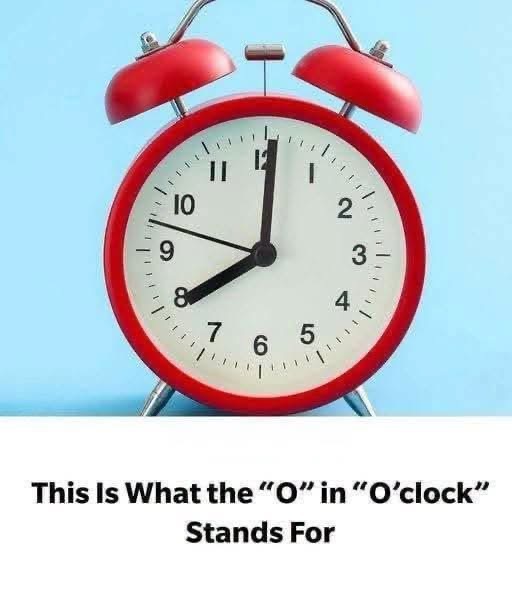
We say “o’clock” countless times without thinking about what the word actually means. Yet the small “O” has a history that goes back hundreds of years. The word is a shortened form of the older phrase **“of the clock.”** So, when people once said “It’s three of the clock,” they simply meant that it was three according to the time shown by a clock.

Before mechanical clocks became common, people used sundials, water clocks, hourglasses, candles, and the position of the sun to estimate the time. As mechanical clocks became more widespread during the Middle Ages, saying “of the clock” helped make it clear that the time came from a clock rather than another method.

Over time, everyday speech naturally became shorter. Instead of saying “five of the clock,” people gradually began saying **“five o’clock.”** The longer version eventually disappeared, but the shortened expression remained part of English. The apostrophe in “o’clock” is a small reminder of those missing words.

English contains many other expressions that preserve similar pieces of its past. **“Jack-o’-lantern,” “will-o’-the-wisp,”** and **“ne’er-do-well”** all contain older shortened forms. These words show how frequently used expressions can change while still keeping traces of their original structure.

The next time you say “It’s six o’clock,” you’re using a phrase with centuries of history behind it. What sounds like a simple letter is actually a shortened form of **“of the clock.”** It’s a fascinating reminder that everyday language is constantly changing, and even the smallest words can carry stories from the past.

Uncategorized

Post navigation

Previous Post: A man smells a strong smell in his house, when he finds out that he opens the wall he finds… See more
Next Post: Details Below 😢👇

Leave a Reply Cancel reply

Your email address will not be published. Required fields are marked *

Recent Posts

  • Pay attention to these signs! 😳
  • A farmer bought a giant slave for seven cents… No one imagined what he would do with her. Everyone mocked him when he paid only seven cents for a woman nearly two meters tall, considered useless by the other buyers. They said no job suited her poorly controlled strength and that she would only be a source of losses. But the farmer looked at her differently, as if he could see beyond the words. That night, he took her to the stable, not to make her work, but to train her in secret. The auction took place on a sweltering morning in February 1857, in the central square of Vassouras, in the countryside of Rio de Janeiro. The Paraíba Valley smelled of ripe coffee and human sweat. Dozens of farmers crowded around the wooden platform, where men, women, and children were displayed like cattle. The auctioneer, a heavyset man with a twisted mustache and a shrill voice, announced each lot with the enthusiasm of a seller of purebred horses. When it was her turn, the silence was immediate—not out of admiration, but discomfort. The woman stood 1.95 meters tall, perhaps more. Her shoulders were as broad as a man’s, her hands enormous, her bare feet leaving deep marks on the wooden platform. Her torn coarse cotton dress barely covered her angular body, its lines and muscles marked by hunger and forced labor. Her black hair had been shaved off. Her deep, dark eyes did not look at anyone; they drifted into the void, as if she were somewhere else.“Her name is Benedita,” announced the auctioneer, his voice losing enthusiasm. “Twenty-three years old, from the Recôncavo Baiano region, strong as an ox.” But… and here he paused awkwardly… “no overseer has managed to tame her. She has already been to four farms. She obeys no orders. She is not suited for the fields, not suited for the big house—she only brings headaches.”“Does anyone offer five réis?” Silence fell over the square. No one raised a hand. Three réis. The auctioneer lowered the price, almost pleading. Nothing. Two réis. Silence. One réis. The farmers began to disperse, losing interest. Then a deep voice from the back of the square broke the silence: “Seven cents!” Everyone turned. It was Joaquim Lacerda, owner of the Santo António farm, a medium-sized plantation of 320 hectares of coffee trees employing about 80 forced laborers.A man in his fifties, with gray hair, a trimmed beard, and simple but clean clothes. He was neither rich nor powerful—just a farmer barely surviving, always in debt to the bank, always calculating every cent. The other buyers laughed. Seven cents for that u I know you’re curious what happens next. Type KEYS and I’ll continue. (I know you’re curious about the next part, so please be patient and read on in the comments below. Thank you for your understanding of the inconvenience. please leave a ‘KEYS’ comment below and give us a “Like ” to get full story )👇
  • Woman caught having …See more
  • Details Below 😢👇
  • Whoa.. I never knew this!

Recent Comments

No comments to show.

Copyright © 2026 Daily News.

Powered by PressBook WordPress theme